 Translate

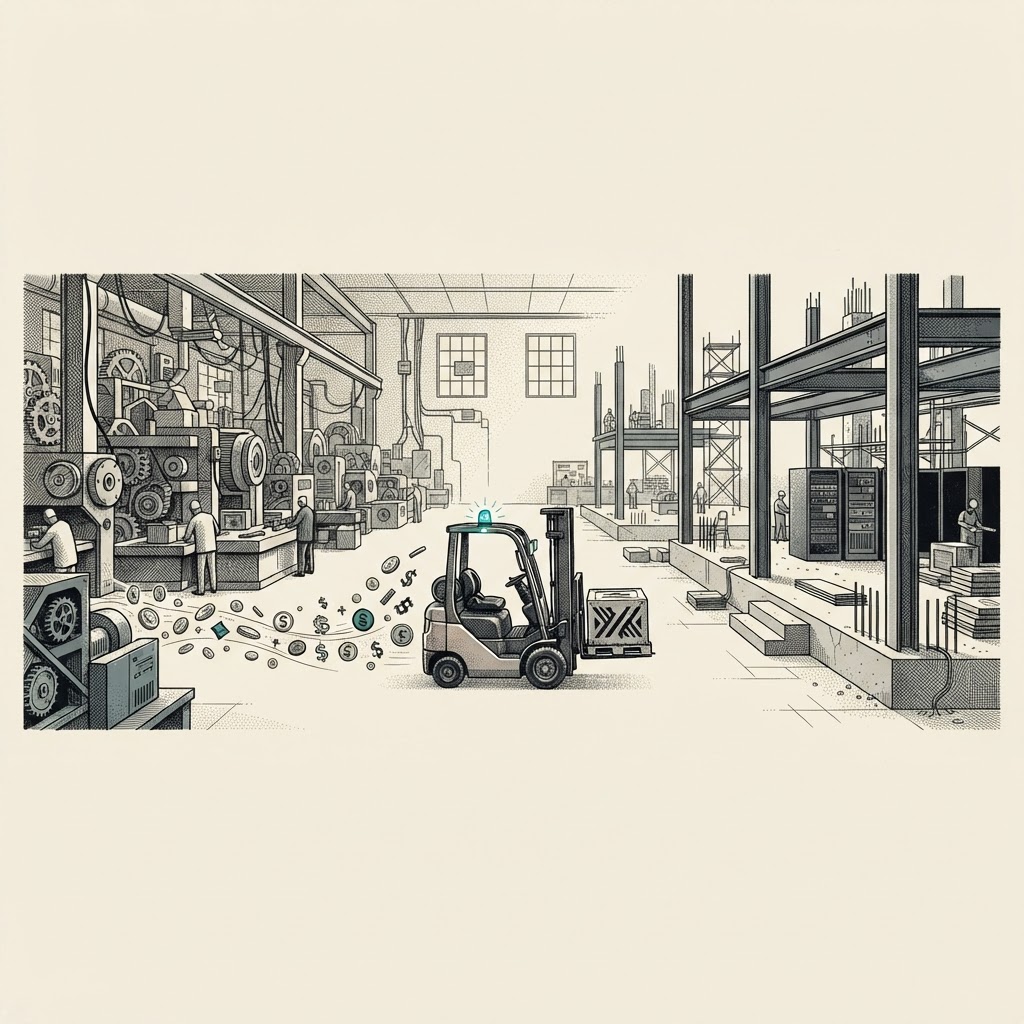
Aformic has raised $6.95 million to expand a factory-robot business that it now hopes to extend into AI data centers, a market where construction schedules and equipment demands are growing quickly but the company has yet to establish a record.
DIG Analysis — 2026-11-09: The financing stands out less for its size than for the operating figures behind it. Aformic reports more than $34 million in purchase orders and $10 million in revenue in the previous year, metrics that suggest customers are already buying its automation. The question is whether factory-floor experience can translate into equipment suited to data-center sites.
The South Carolina startup, spun out of Polish automation group AIUT, said the seed round was led by Veteran Ventures Capital. It plans to add engineering and sales staff and develop hardware for new applications, including data-center construction and maintenance. The Next Web reported the funding and the company’s stated operating figures.
Building on factory work
Aformic makes autonomous mobile robots and forklifts for moving materials through industrial facilities. The product category is established, but deployments can still require site-specific integration: robots must work around people, changing layouts, existing machinery and operational safety rules. Scaling sales therefore depends not only on building units, but also on installation, support and the ability to show customers that automation performs reliably in their own facilities.
The company’s reported purchase orders give it a stronger starting point than a startup still testing its first commercial product. They also require careful reading. A purchase order is not necessarily recognized revenue, and the source account does not specify how much of the $34 million has shipped, when it will be delivered or how concentrated the orders are among customers. Aformic did not disclose the identities of customers tied to those figures or provide details on margins.
That leaves investors and prospective buyers with evidence of traction, but not a full picture of its quality. The $10 million in prior-year revenue provides a measure of completed business; purchase orders may indicate future demand, subject to delivery and customer acceptance. How quickly the company can convert those orders into revenue will matter as it adds staff and develops new products.
“The funding gives Aformic room to extend its industrial robotics work into new applications, including AI data-center construction and maintenance.”
Company plans as reported by The Next Web
A different operating environment
Data centers present a plausible adjacent market for mobile robots and material-handling equipment. Building one involves moving components and supplies across large sites; once operating, facilities require recurring maintenance. Yet the setting differs from a factory, where workflows and routes can be defined around a comparatively stable production process. Construction sites change as work progresses, while data centers impose demanding uptime and access requirements.
Aformic has not said which specific tasks its new hardware will perform, whether it has secured data-center customers or when it expects commercial deployment. Those omissions make it difficult to estimate the opportunity. Developing hardware for a new use case can also consume capital before sales arrive, while established robot makers and equipment suppliers may already be positioned to serve large construction and facility operators.
The company’s industrial background may help it adapt designs and operating systems for material movement. Its connection to AIUT also gives it a base in automation, though the funding announcement does not describe how engineering, manufacturing or customer support are divided between the two organizations. The planned additions to Aformic’s own engineering and sales teams suggest that the company expects to build more of that capacity directly.
Funding against execution
The round is intended to support both expansion of the existing business and development for emerging applications. That creates competing demands: additional sales capacity can help turn orders into shipments, while new hardware work may be necessary to establish a position in data-center projects. A seed round can finance that effort, but the company will need to demonstrate that its core deployments produce repeat business and that new products solve defined site problems.
Veteran Ventures Capital led the financing. Aformic’s reported work with large industrial names, including Toyota, 3M, Oshkosh Defense, Hitachi and Hyundai Mobis, points to the range of sectors in which industrial automation is relevant; the available account does not specify the terms or scope of those relationships. For now, the measurable test is execution on the orders already in hand, alongside the engineering work for data centers.
Aformic plans to expand its engineering and sales teams as it develops hardware for the new applications.
