
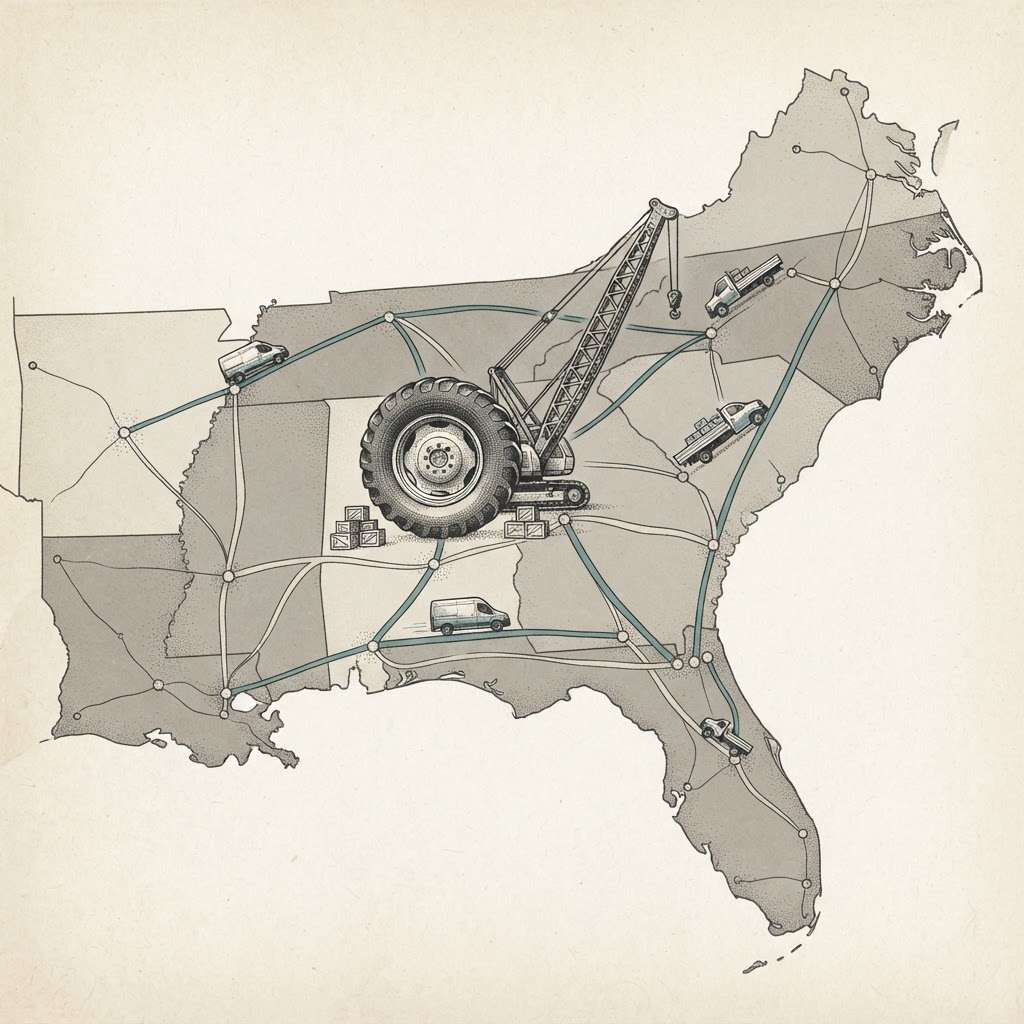
Atlantic & Southern Equipment now operates 10 locations across Georgia, Alabama, North Carolina, South Carolina and Tennessee, extending its reach as a dealer for AGCO and Link-Belt Crane. The footprint puts the company across two equipment markets with different buying cycles and service needs: agriculture and construction.
DIG Analysis — 2026-10-21: The expansion gives Atlantic & Southern a broader regional platform, but location count alone does not establish how much additional sales or service capacity it has gained. The strategic test will be whether the company can staff and supply the network consistently across five states.
A wider regional reach
Farm Equipment reported the expansion in its coverage of mergers and acquisitions. The company’s 10-location footprint spans a region where agricultural customers and construction contractors depend on local access to parts, technicians and equipment support. Adding sites can reduce the distance between a customer and a service operation, a material consideration when downtime carries a cost in the field or on a job site.
The dealer’s two principal product relationships also give the network a mixed demand base. AGCO serves the agricultural market, where equipment purchases often reflect farm income, crop conditions and replacement timing. Link-Belt Crane serves construction applications, whose demand is more closely tied to project activity and contractor investment. That mix may moderate reliance on a single customer segment, though the available account does not quantify revenue by brand, state or business line.
Nor does the reported footprint specify whether all 10 locations are newly added, acquired, or part of an existing network that has been consolidated under the company’s current name. Without details on transaction structure, staffing, facilities or investment, the expansion cannot be read as a direct measure of new capital deployed or market share gained.
Coverage brings operating demands
A larger territory can improve customer access, but it also raises the burden of maintaining service standards across dispersed branches. Parts inventory must be positioned where machines operate; technicians need training across product lines; and management must coordinate field support, transport and branch-level working capital. Those demands are especially relevant when one dealer serves both farm customers and construction fleets, whose seasonal patterns and urgency can differ.
For AGCO and Link-Belt Crane, a dealer with more locations can create additional points of contact with buyers and expand the potential reach of product support. But network growth does not automatically translate into stronger execution. OEMs generally depend on dealers to represent products, maintain customer relationships and provide after-sales service. The quality of those functions depends on local capability, not simply the number of addresses.