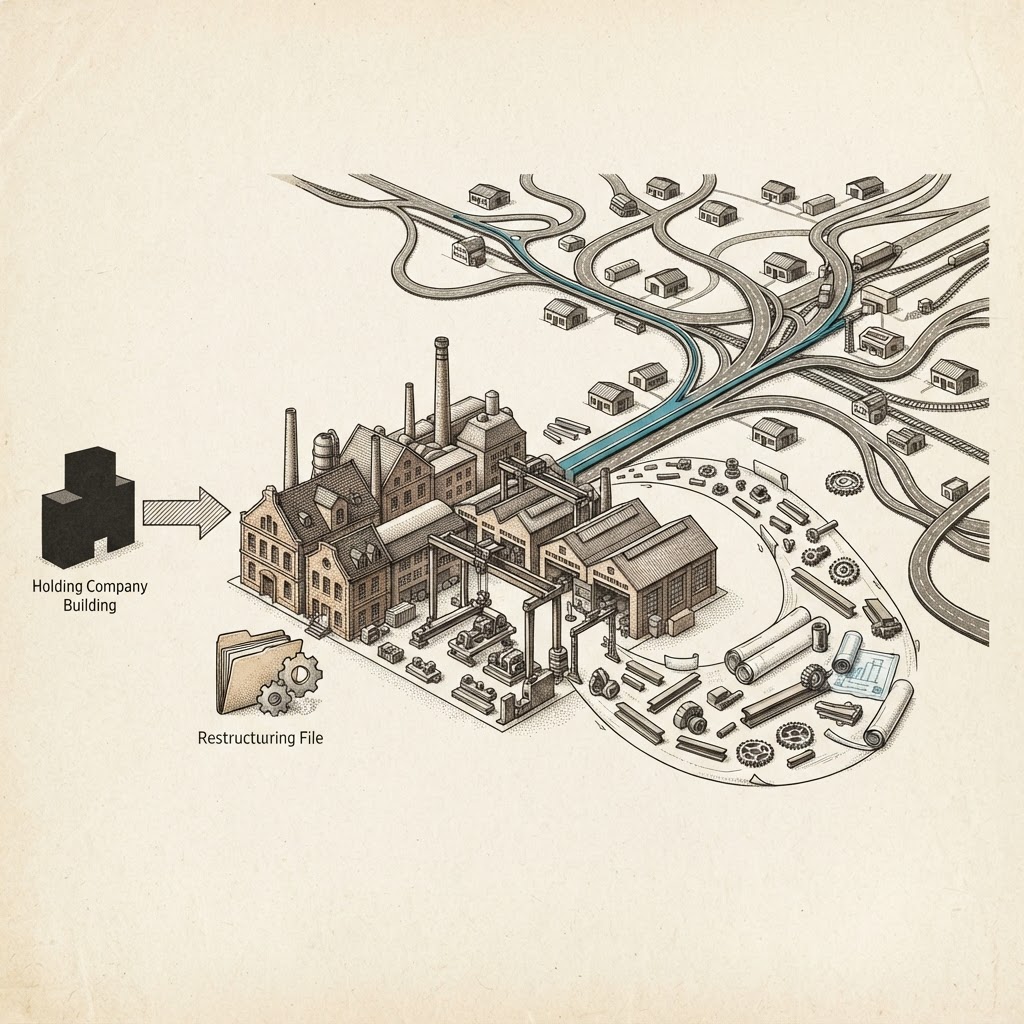
Buhler Versatile has agreed to acquire operating assets of German equipment maker ATLAS Group after its insolvency restructuring. The transaction adds a century-old manufacturer to the Canadian-backed company’s European expansion, while leaving questions about the deal’s terms and the future of ATLAS operations.
Buhler Versatile Inc. has agreed to acquire the operating assets of German construction machinery maker ATLAS Group, a move that would give the ASKO Group subsidiary a larger manufacturing and commercial foothold in Europe as ATLAS emerges from an insolvency restructuring.
DIG Analysis — 2026-10-19: The agreement brings together ATLAS’s established engineering and product base with Buhler Versatile’s manufacturing capacity and international dealer network. Its strategic logic is clear; the operating details are not. The announcement does not specify the purchase price, the assets included beyond named entities, or how many jobs and facilities are expected to continue.
The assets at stake
The agreement covers operating assets of ATLAS Group, including Atlas GmbH and Atlas Cranes UK Ltd. ATLAS entered self-administered insolvency restructuring in February 2026, according to the company announcement carried by Newswire. The transaction is therefore less a conventional expansion purchase than an attempt to preserve and reposition a machinery business undergoing financial reorganization.
ATLAS has more than a century of engineering history in construction machinery. That heritage may matter commercially, but it does not by itself establish the value of the assets being acquired. Product lines, intellectual property, customer agreements, inventory and production sites can each carry different costs and obligations. The public announcement does not break out which of those items will transfer, or whether liabilities will remain with the restructuring entities.
Those distinctions will shape the integration. A buyer can acquire operating assets without assuming every obligation of the former business. It can also inherit practical dependencies, including supplier relationships, service requirements and the need to support machines already in customers’ fleets. Until the transaction documents and closing conditions are disclosed, the boundary between the assets acquired and the business customers recognize remains uncertain.
“The acquisition aims to integrate ATLAS’s century-long engineering heritage with Buhler Versatile’s international dealer network and manufacturing capabilities.”
Company description, as reported by Newswire
A European foothold
For Buhler Versatile, the agreement offers a route to broaden its presence in a region where a local manufacturing and service base can matter as much as product availability. The company’s stated plan is to combine ATLAS engineering with its own manufacturing capabilities and dealer reach. That could extend the routes through which ATLAS equipment is sold and supported, while giving Buhler Versatile a platform for a wider European product strategy.
The mechanics will determine whether that promise turns into a durable operation. Manufacturing capacity requires investment, suppliers and a stable order book. A dealer network can extend market access, but it must also carry parts, train technicians and provide warranty support. The announcement does not identify a production plan, a timetable for integration, or any commitments to retain particular ATLAS facilities. Nor does it say whether the companies intend to continue all existing product lines.
That silence matters because restructuring can leave customers and suppliers facing decisions before a new owner’s operating model is settled. ATLAS machines already in service need parts and technical support regardless of who owns the operating assets. A transition that preserves those functions would help protect the value of the installed base; a disruption could weaken customer confidence just as Buhler Versatile seeks to expand the brand’s reach.
Terms still matter
The announcement frames the acquisition around engineering, manufacturing and distribution, but provides no financial terms. It also does not state when the transaction is expected to close, what regulatory or insolvency-process approvals remain, or how the acquisition will be financed. Those omissions prevent a clear assessment of the purchase price relative to the assets, or of the capital needed after closing.
For ASKO Group, the move adds an established European name to a portfolio that includes Buhler Versatile. For ATLAS, a new owner could provide continuity and access to a broader commercial network, but that outcome depends on which operations are retained and how quickly they are funded. The restructuring context also leaves open the possibility that parts of the former business, its workforce or its supplier base will not follow the assets.
Newswire reported the agreement based on the companies’ announcement. Until the parties provide further detail, the central measure of the deal will be operational: which ATLAS assets transfer, where production continues, and whether customers receive uninterrupted parts and service support.