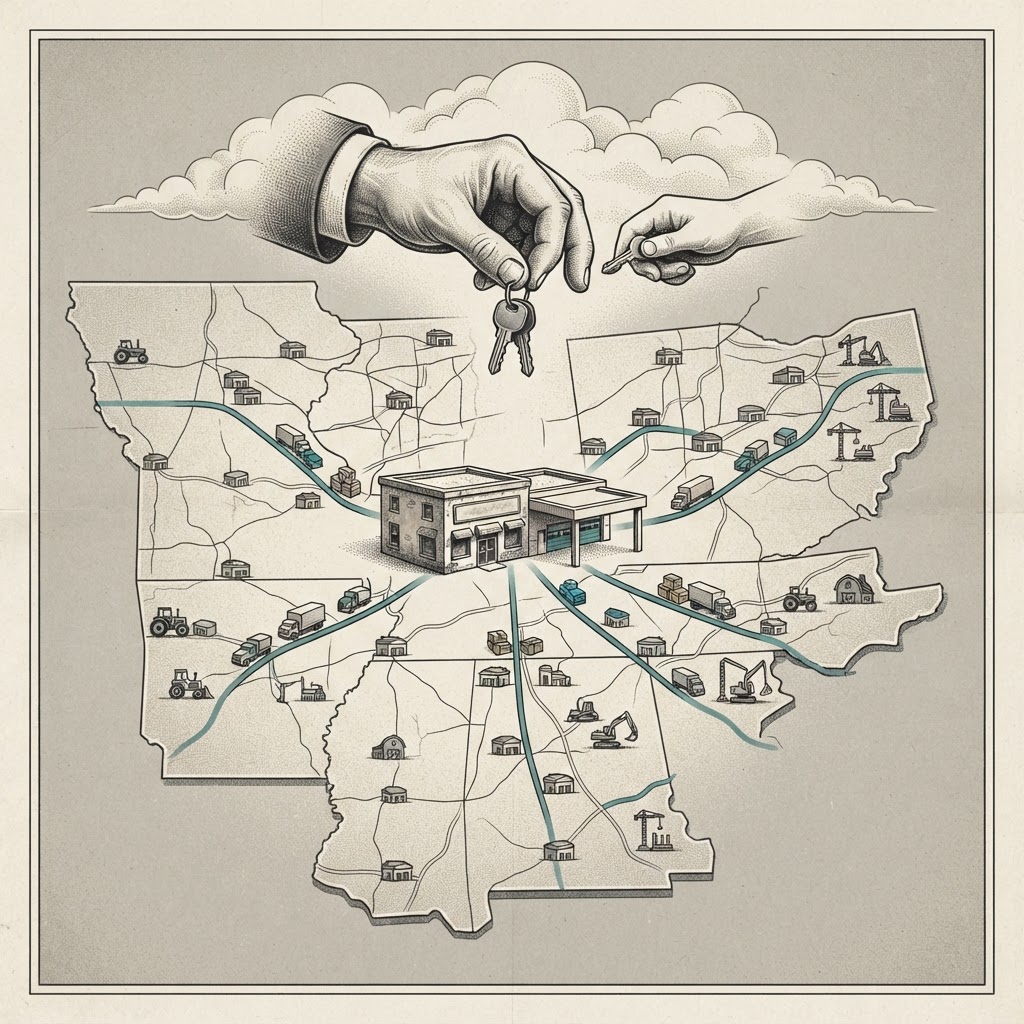
Caterpillar has completed its acquisition of John Fabick Tractor Company, ending a period of family ownership disputes and placing a large regional dealer organization under direct OEM control. The move raises questions about continuity for customers and the future boundaries of Caterpillar’s dealer model.
Caterpillar has completed its acquisition of John Fabick Tractor Company, bringing a 37-location dealership across Missouri, Illinois, Wisconsin and Michigan’s Upper Peninsula under the manufacturer’s direct ownership. The century-old business is now led by Caterpillar Senior Vice President Steve Ferguson, who has been named CEO and Dealer Principal.
DIG Analysis — 2026-11-02: The acquisition resolves an ownership problem at a significant dealer, while giving Caterpillar more direct responsibility for the people, facilities and customer relationships that carry its products into the field. Its longer-term significance will depend on how the manufacturer manages the network and whether this remains a specific response to a family ownership dispute or signals a broader willingness to own dealerships.
A dealership changes hands
John Fabick Tractor Company has served customers for about a century, according to the transaction announcement distributed by PR Newswire. Its footprint spans four states, with locations in Missouri, Illinois, Wisconsin and Michigan’s Upper Peninsula. That reach gives the company a substantial role in sales, parts and service for Caterpillar equipment across a varied mix of markets.
The acquisition follows internal ownership disputes at the family-owned dealership. The announcement described the transaction as a way to ensure continuity of service, but did not detail the disputes, identify the parties involved or disclose financial terms. Nor did it specify whether Caterpillar plans changes to the dealership’s locations, workforce, operating structure or customer agreements.
Those omissions leave practical questions open. Customers will want clarity on who handles accounts, warranty matters and service scheduling during the transition. Employees and suppliers will be watching for decisions about reporting lines and purchasing. Caterpillar’s appointment of Ferguson gives the organization a senior executive with direct authority, but the announcement does not set out his operating priorities.
“The move follows a period of internal ownership disputes at the family-owned dealership and aims to ensure a seamless transition of service for customers.”
Transaction summary, PR Newswire
Control and channel boundaries
In the conventional dealer model, independent businesses provide the local capital, facilities and management that connect an equipment manufacturer to customers. A manufacturer’s acquisition of a dealer changes that allocation of responsibility. Caterpillar will have more direct control over decisions at Fabick, while also assuming the operating exposure that comes with owning a multi-location retail and service organization.
The move does not, by itself, establish a new acquisition strategy. A family ownership dispute can make a sale to the manufacturer a practical route to preserve operations, particularly when a dealer has a long history and a broad territory. Caterpillar has not said whether it is considering other dealership purchases, or whether the Fabick transaction is an exception tied to this company’s circumstances.
For other dealers, the distinction matters. A manufacturer that becomes an owner in one territory may still rely on independent principals elsewhere, whose local investment and customer ties remain central to the channel. But the transaction may prompt dealer boards and family shareholders to review succession plans, governance arrangements and the options available if ownership fractures.
Continuity still has to be delivered
Caterpillar’s stated objective is continuity of service, a promise that will be judged in the ordinary work of the business: parts availability, technician coverage, equipment uptime and response times. A change in ownership can preserve a dealership’s locations without automatically preserving the relationships and routines that customers depend on.
The scale of the organization makes execution consequential. Thirty-seven locations require coordination across several states, and service needs can vary between agricultural customers, construction fleets and other equipment users. Caterpillar’s direct ownership may ease alignment between manufacturer and dealer operations, but the company has not described any planned changes to staffing, investment or service standards.
For now, the clearest operational fact is the leadership appointment: Ferguson, a Caterpillar senior vice president, is both CEO and Dealer Principal. Whether that arrangement remains in place as the company settles into Caterpillar ownership, and how much autonomy local management retains, were not specified in the announcement.
 Translate