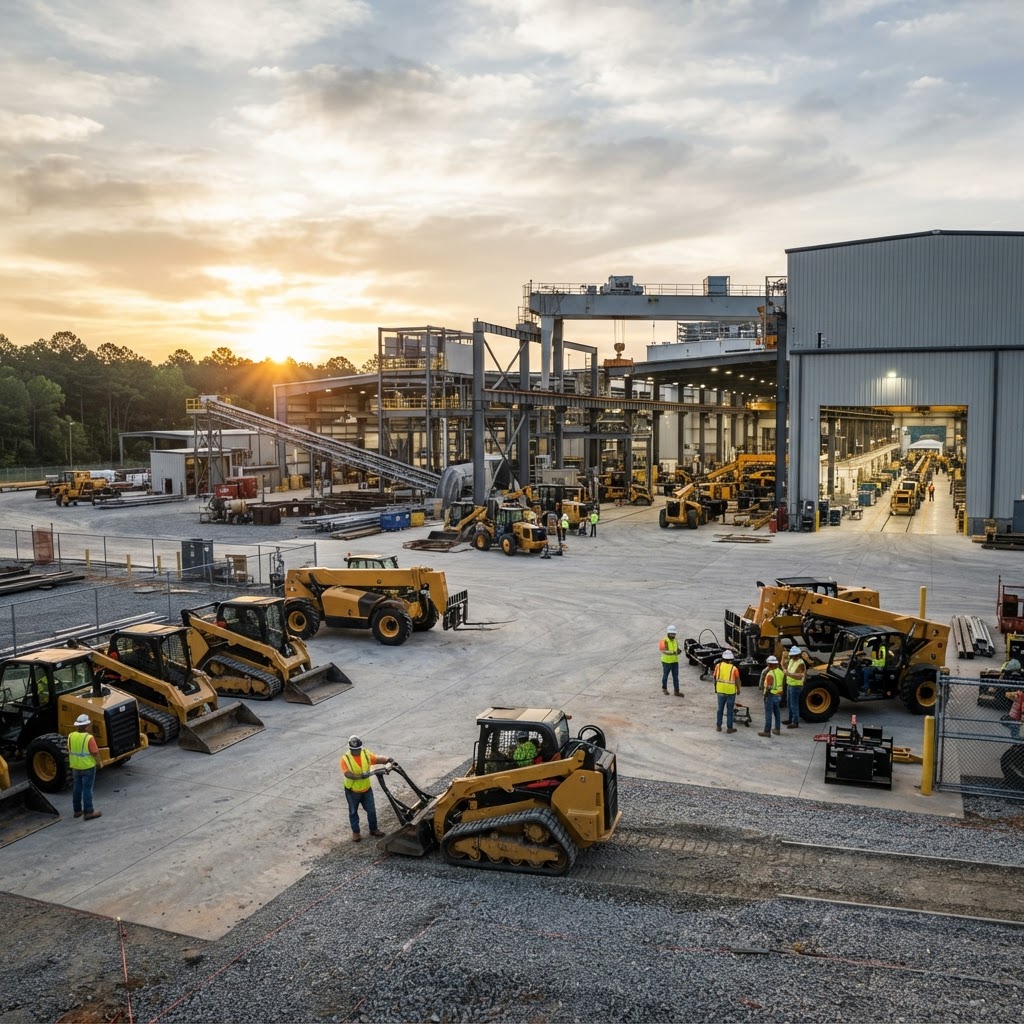
Caterpillar is committing $1 billion to expand North Carolina manufacturing for compact track loaders and telehandlers. The investment signals confidence in sustained global demand while raising questions about capacity timing, supplier readiness and channel execution.
Caterpillar plans to invest $1 billion to expand its manufacturing footprint in North Carolina, with the capital directed primarily toward higher production capacity for compact track loaders and telehandlers. The move is a clear bet that demand for smaller, more versatile construction machines will remain strong across global markets, even as equipment buyers continue to manage elevated ownership costs and uneven regional conditions.
DIG Analysis — 2026-09-30: Caterpillar is not simply adding floor space. It is positioning compact equipment as a larger pillar of its production strategy, with implications for lead times, sourcing, dealer inventory and the competitive balance in a segment attracting both established manufacturers and newer entrants.
Capacity is following a durable equipment shift
Compact track loaders and telehandlers occupy a strategically important part of the construction equipment market. They can operate on constrained sites, support multiple attachments and serve contractors that need one machine to perform several jobs. That flexibility has broadened their use in residential construction, utility work, landscaping, agriculture and rental fleets.
The North Carolina expansion indicates Caterpillar sees demand as more than a short-cycle replacement opportunity. A larger installed base of compact equipment creates follow-on revenue through attachments, parts, service and financing. It also gives the company more manufacturing capacity to respond when regional demand moves quickly between applications.
“The investment places production capacity behind one of the most commercially flexible categories in Caterpillar’s portfolio.”
Digital Iron Group analysis
Execution will matter as much as the capital
A $1 billion commitment does not immediately translate into available machines. Facility expansion, equipment installation, workforce recruitment, training and supplier qualification all have to move in sequence. Any mismatch between new assembly capacity and the availability of engines, hydraulic components, undercarriages, electronic controls or attachments could limit the practical benefit of the investment.
North Carolina also provides Caterpillar with a concentrated manufacturing base and an established industrial labor market, but competition for skilled technicians, welders, maintenance personnel and production supervisors remains intense. The company will need to manage expansion without sacrificing quality, safety or delivery reliability across existing operations.
According to the report from Traders Union, the investment is specifically tied to increasing production of compact track loaders and telehandlers. That focus gives the announcement a sharper meaning than a general factory modernization program. It suggests Caterpillar is prioritizing products where utilization rates, rental demand and attachment compatibility can support repeat purchases and broader customer penetration.
What the move changes in the market
Additional Caterpillar capacity could improve machine availability over time, particularly if production is allocated to markets facing long waits or constrained dealer inventories. It may also intensify price and specification competition. Rivals will face pressure to defend share through product updates, financing programs, rental relationships and faster delivery rather than relying solely on list-price positioning.
The expansion could also influence how customers plan fleets. Contractors and rental companies may gain more confidence in standardizing around compact machines if supply becomes more predictable. At the same time, greater availability can expose differences in residual values, service coverage, telematics performance and attachment support. Buyers will judge the investment through operating cost and uptime, not factory size.
For Caterpillar, the central test is whether North Carolina can add capacity at the pace demand requires while preserving channel discipline. If the buildout is well executed, the company will have more room to serve a growing compact-equipment market and capture related parts and service revenue. If demand softens before the new capacity is fully absorbed, the company will carry a larger fixed-cost base in a category where rental cycles and construction activity can change quickly.