
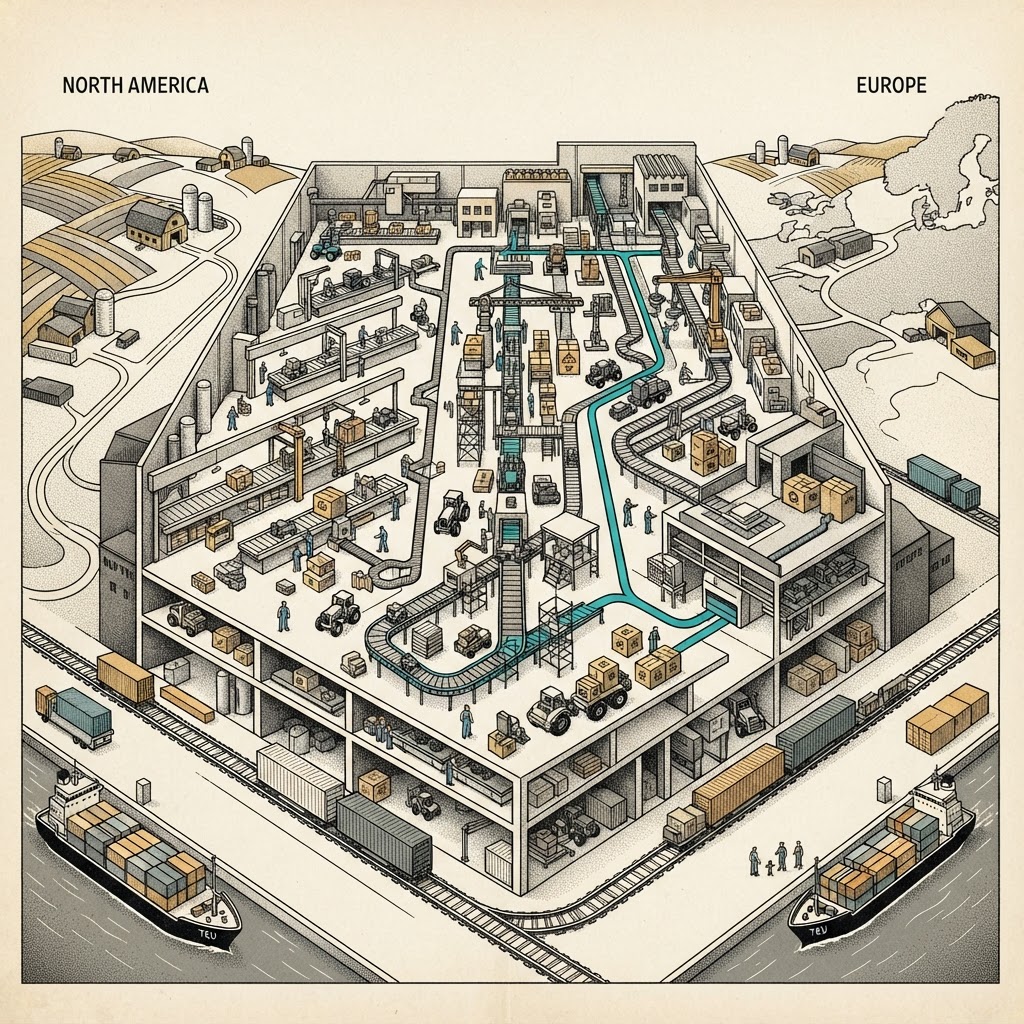
CNH Industrial is adjusting its agricultural manufacturing footprint to match a softer market, putting production capacity and supply-chain costs under review across North American and European facilities. The company says the changes are intended to improve margins and strengthen its competitive position ahead of the 2027 season, but has not identified which plants, products or jobs will be affected.
DIG Analysis — 2026-11-01: The announcement signals that CNH is treating the demand slowdown as more than a short-lived sales setback. Realigning capacity can reduce the cost of running factories below efficient output, but it also risks leaving the company less able to respond if farm-equipment demand rebounds faster than expected.
Capacity meets demand
In a statement published by the CNH Industrial Newsroom, the company described a strategic realignment of its global agricultural manufacturing footprint. The plan includes optimizing production capacity at facilities in North America and Europe, with the stated aims of improving margins and streamlining supply-chain logistics. CNH connected the timing to cooling demand in the agricultural sector and framed the work around the 2027 season.
The company did not disclose a facility-by-facility plan, a timetable for implementation, expected savings or a projected effect on employment. Nor did it specify whether optimization means lower output, a shift in product assignments, changes to sourcing, or some combination. Those omissions make it difficult to distinguish a targeted capacity correction from a broader restructuring.
That distinction matters because factory decisions tend to persist beyond the market conditions that prompted them. Moving work between plants can alter freight costs and supplier relationships; reducing shifts can lower near-term expense but make it harder to add volume quickly. CNH’s description points to both production and logistics, suggesting the company is weighing where equipment is built as well as how much is built.
“The plan includes optimizing production capacity across its North American and European facilities to improve margins and streamline supply chain logistics.”
CNH Industrial Newsroom, company announcement
Margins and execution
For manufacturers, weaker demand can expose the cost of maintaining capacity built for higher volumes. If production schedules fall while fixed factory costs remain, unit economics deteriorate. A realignment may help close that gap, especially if CNH can consolidate output around facilities with better utilization or shorter routes to customers and suppliers.
But the savings are not automatic. Transferring production can require investment, qualification work and coordination with vendors. Suppliers that have organized labor and inventory around a particular plant may face abrupt changes in order patterns. If production is concentrated in fewer locations, disruption at one site could also carry a larger operational consequence. CNH has not provided enough detail to quantify these trade-offs.
The market signal is equally important. A capacity move made in response to cooling demand can improve profitability if lower volumes endure. If conditions recover, however, constrained lines or relocated supply could limit the company’s ability to capture orders. The company’s reference to the 2027 season establishes a planning horizon, not a forecast of when demand will return or how quickly capacity could be restored.
What remains unclear
CNH’s announcement gives investors a direction of travel, but not the metrics needed to judge its scale. The company has not said how many facilities are in scope, whether production will shift among regions, or what financial charges or savings it expects. It also has not described any changes to its agricultural product portfolio.
Further disclosure will determine whether the realignment is chiefly a scheduling adjustment or a more durable reshaping of the manufacturing network. Until then, the clearest fact is that CNH plans to optimize agricultural production capacity across North America and Europe as it prepares for the 2027 season.