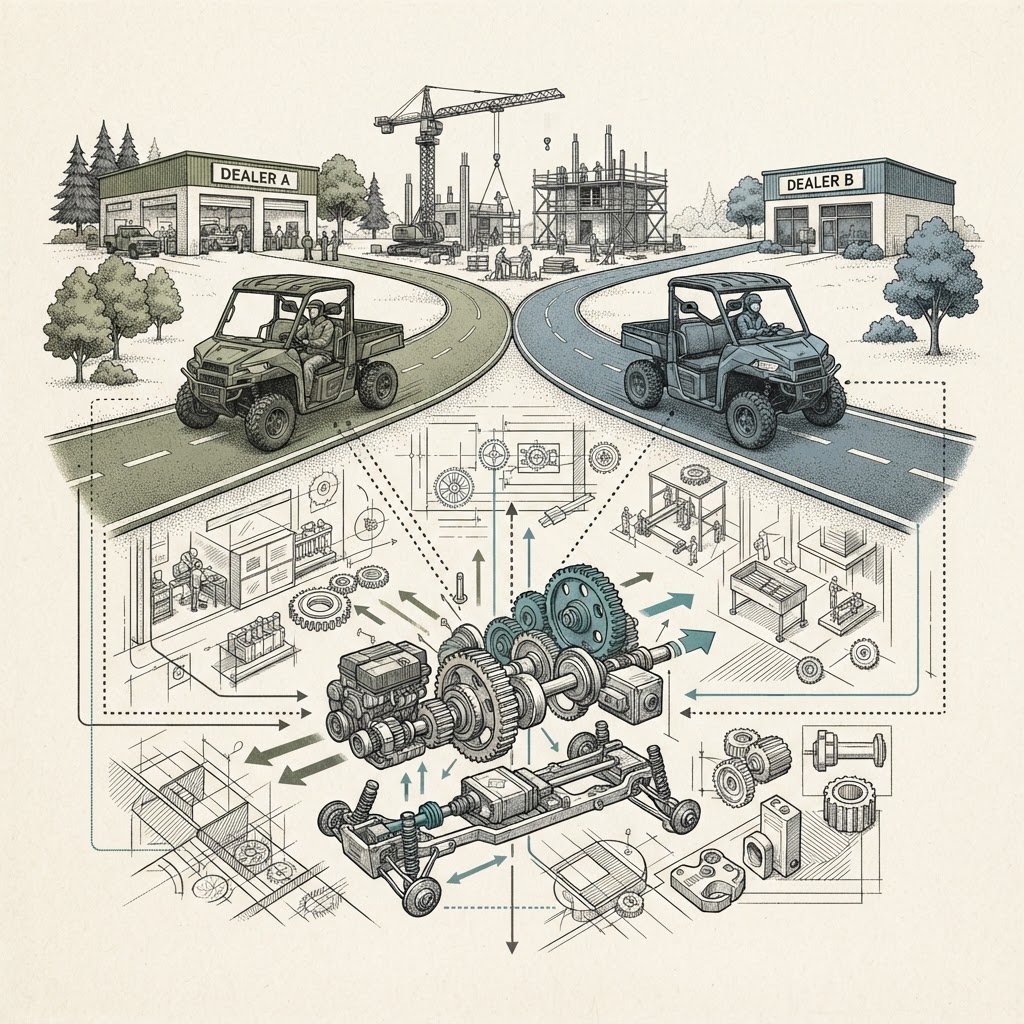
The companies will develop future utility vehicles and side-by-sides while retaining separate brands and dealer networks. The agreement points to shared product development in a segment where channel reach and product differentiation both matter.
John Deere and Yamaha have agreed to develop future utility vehicles and side-by-sides together, a partnership that combines product-development capabilities while leaving each company’s brand and dealer network intact. The arrangement puts two established manufacturers in closer alignment in a compact utility market where buyers increasingly expect vehicles suited to work as well as recreation.
DIG Analysis — 2026-10-23: The partnership is a response to the cost and complexity of serving a growing utility segment, but the available details leave key commercial questions open. The companies have not disclosed a timetable, product specifications, production plans or the financial terms of the agreement.
A shared development effort
Equipment World reported the partnership, describing it as a strategic collaboration to develop future utility vehicles and side-by-sides. The companies intend to preserve their distinct identities and existing dealer networks. That structure suggests cooperation behind the product, rather than a merger of sales channels or a single shared brand.
For Deere, the arrangement offers a way to pursue future vehicles alongside a manufacturer with experience in recreational and utility side-by-sides. Yamaha, in turn, gains a partner with a broad presence among agricultural, construction and rural customers. The fit is commercially legible, although neither company has publicly detailed which engineering, manufacturing or component responsibilities will be shared.
Those omissions matter. Joint development can spread engineering costs and shorten the path from concept to market, but it can also require careful decisions about platforms, sourcing and intellectual property. The companies have not said whether future models will share a common chassis or powertrain, or whether the collaboration will extend to production. Until those points are clearer, it is difficult to judge how much the partnership changes either company’s cost base or product cadence.
“The collaboration aims to target the growing utility segment while allowing both companies to maintain their distinct brand identities and existing dealer networks.”
Partnership summary, as reported by Equipment World
Brand and channel boundaries
Keeping separate brands and dealer networks may help both manufacturers avoid a disruptive channel redesign. Deere can continue to sell under its own name through its established network, while Yamaha retains its own customer relationships. That is a meaningful distinction in equipment markets, where dealers do more than deliver a vehicle: they provide service, parts and a local point of contact for customers who rely on machines for daily work.
At the same time, parallel channels place pressure on the product strategy. If vehicles share underlying engineering, each company will need to give buyers a clear reason to choose its version. Differences in equipment, pricing, warranty support or intended use could preserve distinct value propositions. The companies have not announced how they will divide those choices, nor whether dealers will receive access to products from both manufacturers.
Channel separation also leaves open the question of how the partnership will affect dealer economics. A shared platform could reduce development expense for the manufacturers without changing which dealer receives a sale. But if the resulting models compete closely with each other, dealers may have to explain overlapping products to customers, and each brand will need to protect its own service and parts business.
What remains unknown
The announcement signals a strategic shift in how the two companies may approach compact utility product development, but it is not yet a launch plan. No model names, release dates, expected volumes or target markets were specified in the information reported. Nor have the companies described whether the first products will be aimed primarily at agricultural users, property owners, recreational buyers or a mix of customers.
That leaves room for competing interpretations. The partnership could produce a broader range of vehicles at a lower development burden for each company. It could also remain limited in scope, with the companies sharing selected work while competing for customers and dealer attention. For now, the clearest commitment is to develop future products together while keeping the commercial identities and networks that buyers already recognize.
The next concrete signal will be whether the companies disclose a product timetable, platform details or a production arrangement. Until then, the partnership defines a direction, not a specification.
 Translate