
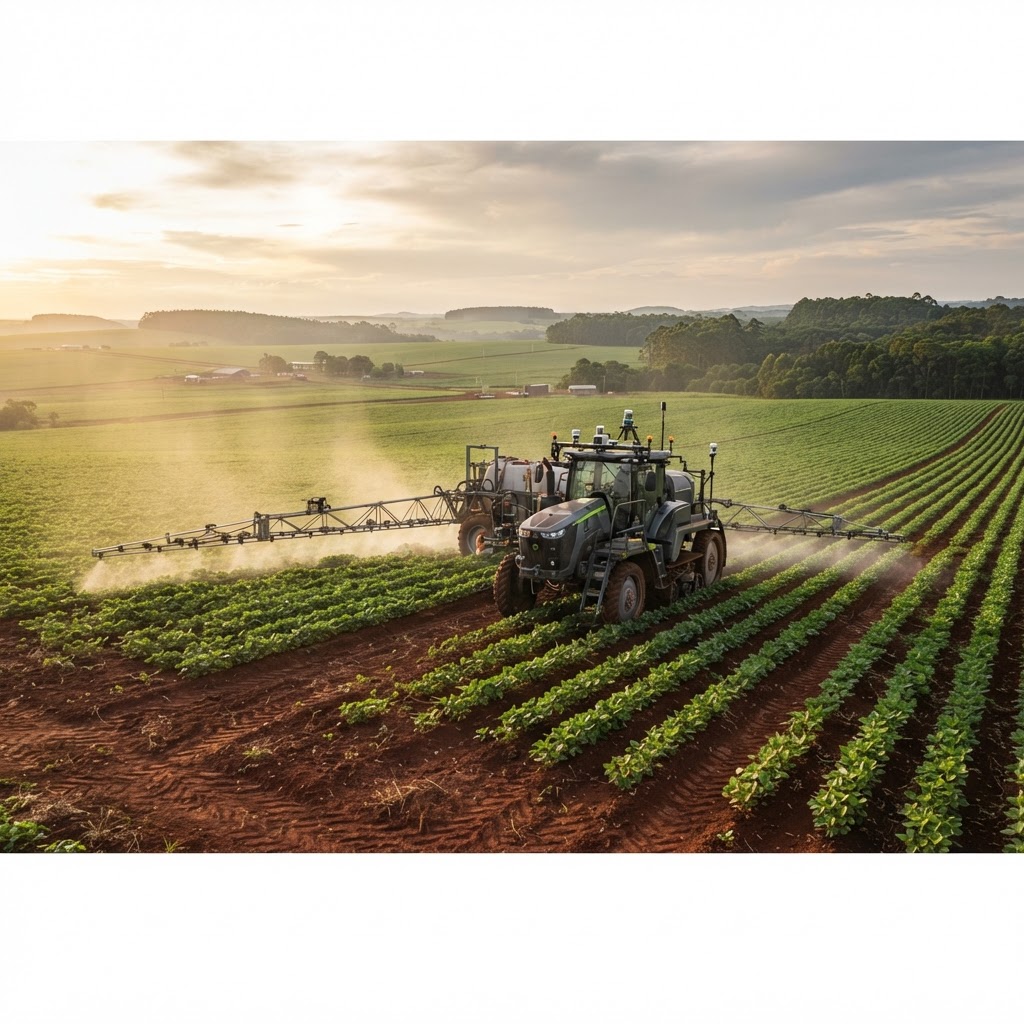
John Deere plans to invest $450 million to expand its manufacturing facilities in Indaiatuba, Brazil, increasing production capacity for autonomous tractors and smart spraying systems by 30%. The move positions Brazil as a more important production base for the company’s precision-agriculture business as demand grows across South America.
DIG Analysis — 2026-10-01: The strategic weight of this investment lies in the combination of regional capacity and a product mix built around automation. Deere is adding manufacturing headroom for equipment that depends on software, sensing and machine integration, not simply increasing output of conventional tractors. The expansion could help the company serve regional demand with shorter supply lines while reinforcing its ability to bring advanced features into its broader equipment lineup.
Manufacturing closer to the growth market
As reported by Agri-Business Global, the Indaiatuba expansion is intended to lift output of autonomous tractors and smart spraying systems by 30%. That target gives the investment a concrete operating purpose: meet anticipated regional demand with more locally produced precision equipment. The announcement does not specify a completion timetable, employment impact or the exact allocation of capital between facilities and production systems.
For Deere, additional Brazilian capacity can address a practical challenge in selling advanced machinery across a geographically large agricultural market. Equipment availability, delivery timing and access to service are central to purchase decisions, particularly when machinery is expected to work within narrow planting and spraying windows. Local manufacturing does not by itself guarantee lower prices or faster deliveries, but it can give the company more flexibility to align production with regional requirements.
The focus also reflects a shift in what manufacturers must scale. Autonomous functions and smart spraying require consistent integration among machines, sensors, control systems and software. Expanding production means building the processes and quality controls needed to deliver that package reliably, rather than treating digital features as isolated options added after the machine is built.
More than a capacity announcement
Deere says the investment fits a wider strategy to integrate AI-driven diagnostics and automated field-management tools into its global equipment lineup. That ambition links the Brazilian manufacturing plan to a broader product transition: equipment is increasingly designed to collect operating information, identify problems and support decisions about field work. Manufacturing capacity is one part of the equation; product validation, software support and dependable service remain essential to adoption.
The expansion may also make Brazil a more consequential node in Deere’s production network. A stronger regional base can help the company respond to local demand while creating experience in manufacturing precision systems at scale. Whether that experience translates into broader exports or additional regional investment is not detailed in the announcement, but the added capacity gives Deere more options as adoption develops.
“The expansion aims to increase the output of autonomous tractors and smart spraying systems by 30% to serve the growing South American market.”
Agri-Business Global, reporting on Deere’s investment plan
Execution will determine the return
The investment’s commercial payoff will depend on whether customer demand keeps pace with the planned increase in output. Precision equipment carries a higher operational proposition than basic machinery: buyers need confidence in uptime, parts availability, operator training and the value of automation under local field conditions. A larger production footprint can support that proposition, but it cannot replace the service and technical infrastructure required to keep machines productive.
For the wider equipment market, Deere’s move is a signal that major manufacturers are committing capital to precision-agriculture capacity in Brazil, not merely testing demand through imported machines. Competitors will be watching whether the 30% production increase converts into sales and sustained utilization. The more consequential measure will be how quickly Deere can connect manufacturing scale with reliable field performance and support across South America.