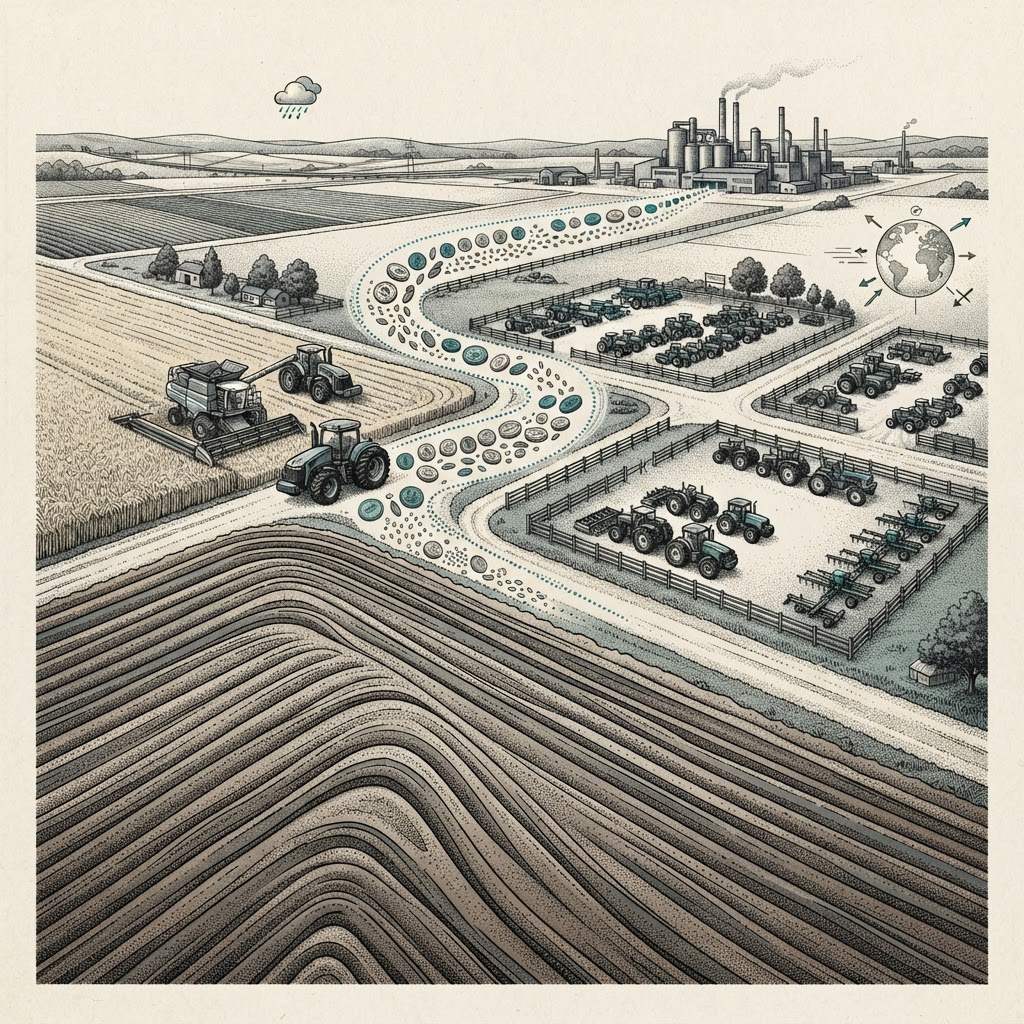
New Holland expects global agricultural equipment demand to recover only gradually, with weak farm earnings, weather extremes and geopolitical instability keeping investment on hold. The outlook places pressure on manufacturers to manage capacity and dealer inventory through an uncertain cycle.
New Holland expects the global farm machinery market to recover slowly over the next two to three years, extending a difficult demand cycle for manufacturers whose customers are holding back on capital spending. The brand, part of CNH Industrial, pointed to weak farm profitability, extreme weather and geopolitical instability as factors discouraging farmers from replacing or expanding equipment fleets.
DIG Analysis — 2026-10-21: The forecast is less a timetable for a rebound than a warning about its limits. A two-to-three-year horizon leaves producers and dealers exposed to continued volatility in order books, while the causes cited by New Holland are largely outside manufacturers’ control. Farm earnings, weather and political risk can shift sharply by crop, region and season.
A cautious demand outlook
The company’s view contrasts with the shorter recovery periods that manufacturers may prefer when planning production, channel inventory and investment. New Holland did not specify how quickly sales might improve within that horizon, or identify particular regions and product categories expected to lead. The forecast therefore signals caution without establishing a precise path for demand.
Farm machinery purchases are closely tied to expected returns from crop production. When commodity prices or farm margins weaken, operators can defer replacements, repair existing machines for longer or reduce purchases of higher-capacity equipment. Extreme weather adds another layer of uncertainty: it can damage output and cash flow, while also making the timing and type of machinery needed less predictable.
Geopolitical instability can affect farmers through input costs, trade flows and uncertainty around access to markets. Those pressures compound the investment decision. Even where equipment is needed, a producer facing uncertain revenue may choose to preserve liquidity rather than take on financing or commit to a large purchase.
“The company sees a slow recovery for the global agricultural machinery market over the next two to three years.”
New Holland, as reported by Valor International
Valor International reported the outlook and the factors behind it. The report does not provide a detailed breakdown of New Holland’s assumptions, including the market indicators or regional sales trends informing the forecast. That omission matters because agricultural equipment demand is not uniform: crop mix, farm size, credit conditions and local harvest outcomes can produce different cycles within the same global market.
Revenue under pressure
CNH Industrial reported $3.2 billion in agricultural equipment revenue for the second quarter. That figure establishes the scale of the business, but, on its own, does not show whether revenue fell because of lower unit volumes, pricing, product mix or currency effects. Nor does the available information state how much of the quarter’s result came from New Holland specifically.
For an equipment maker, a prolonged recovery can complicate decisions on factory utilization and inventory. If production is set too high against subdued retail demand, finished machines can accumulate in distribution channels and require discounts or financing support. If output is cut too aggressively, a turn in demand may leave dealers short of the models customers want. The forecast offers no indication of planned production changes or channel targets.
The uncertainty also extends to the pace at which farm profitability can improve. Better crop economics could release deferred demand, but a favorable season in one region would not necessarily offset weak returns elsewhere. Weather disruptions may also create local replacement needs without restoring broad-based investment appetite. That makes aggregate market recovery a poor proxy for conditions facing individual dealers and manufacturers.
What remains unclear
New Holland’s two-to-three-year estimate gives the market a broad planning window, not a firm turning point. The company has not said when orders are expected to bottom, what level of farm income would prompt customers to buy, or whether financing costs are materially limiting purchases. Those details would help distinguish delayed demand from demand that has been lost or shifted to lower-priced equipment.
For CNH, the near-term test is whether its agricultural business can protect revenue and margins while customers wait for stronger returns. The reported $3.2 billion in second-quarter agricultural equipment revenue offers a recent benchmark; the company’s forecast suggests that a material improvement may take longer than a single selling season.