
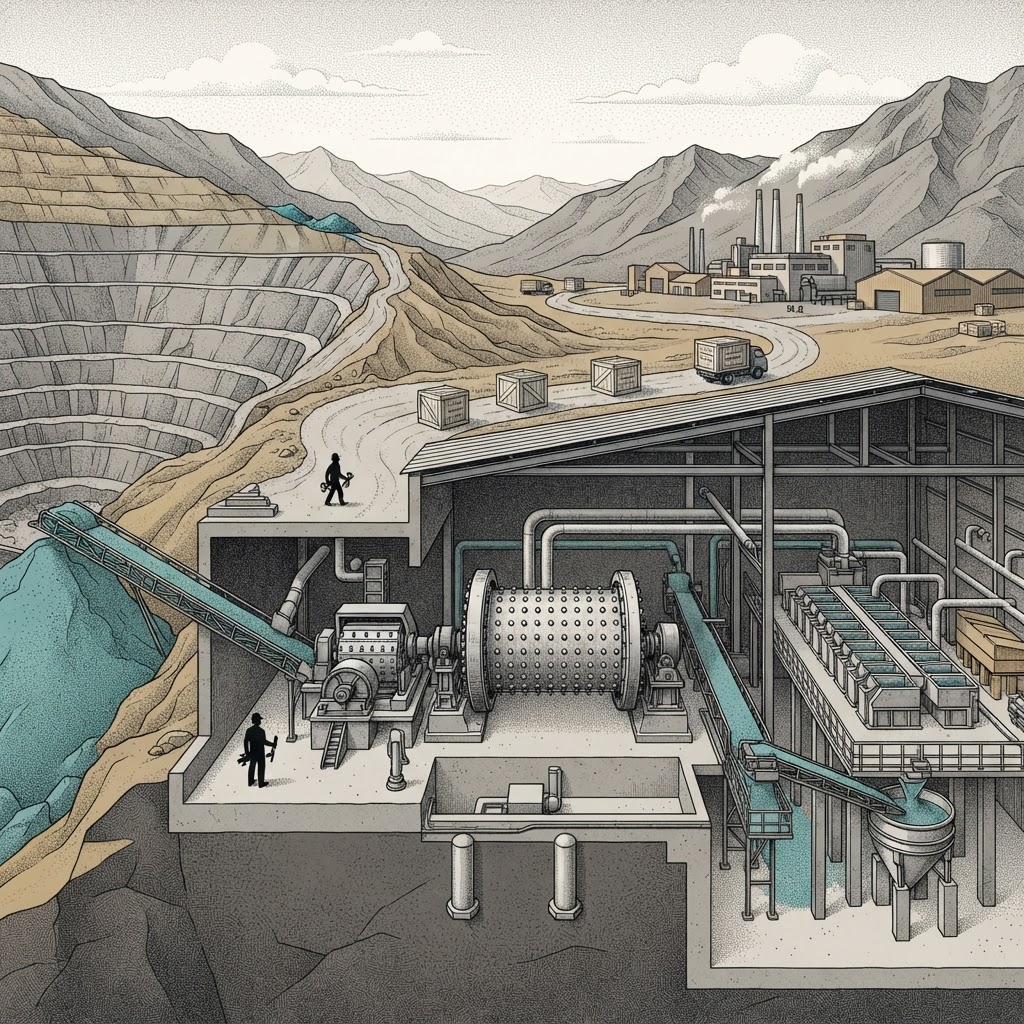
FLSmidth has secured a DKK 175 million order to supply the grinding equipment for a new processing line at a copper mine in Chile, extending a relationship with the operator while positioning the project around two large machines: a high-pressure grinding roll and a gearless ball mill.
DIG Analysis — 2026-10-09: The order gives FLS a defined equipment and service package tied to a mine expansion scheduled for 2027. Its commercial significance will depend on the project’s eventual throughput and operating performance, details that were not provided in the announcement.
According to the company release carried by GlobeNewswire, the contract includes a 24/17 High-Pressure Grinding Roll, or HPGR, and a 19.6-megawatt gearless ball mill. FLS also will provide installation, commissioning and long-term spare parts support. The package combines equipment delivery with services that continue after the machinery reaches site, although the company did not state the duration or value of the support component.
Equipment at the center
The two machines occupy important stages in mineral processing. An HPGR compresses ore between rotating rolls, reducing particle size before further processing. The ball mill then grinds material using steel balls inside a rotating cylinder. Together, the technologies are intended to support the new line’s processing requirements, but FLS disclosed no capacity figures, ore characteristics or design benchmarks with which to assess the expected operating result.
FLS described the order as part of the operator’s effort to improve energy efficiency and throughput. Those goals can pull in different directions at a mine: operators need to process more material, while power consumption, ore hardness and maintenance schedules shape the cost of each tonne. The announcement does not quantify anticipated energy savings or production gains, and it does not identify a baseline against which the new line will be measured.
“The order builds on a long-standing partnership between FLS and the mining operator.” FLSmidth, as described in its announcement
The contract’s structure matters as much as the equipment list. Installation and commissioning expose the supplier to the practical demands of integrating large machinery at an operating mine, while spare parts support can sustain a relationship beyond the initial delivery. For the mine operator, the package may reduce coordination across suppliers, though the release does not say whether FLS has responsibility for broader plant integration or performance guarantees.
Limited visibility on project economics
The DKK 175 million headline value establishes the order’s scale, but not its margin or timing of revenue recognition. FLS did not disclose the customer, the mine, the project’s total capital cost or the share of the contract represented by equipment, services and parts. Nor did it say whether the order was included in an earlier forecast or how it would affect the company’s annual results.
That gap limits comparisons with other mining equipment awards. A large mill and HPGR package is a material industrial commitment, but order value alone does not show how much profit the supplier can retain after engineering, manufacturing, logistics and site work. The project’s 2027 schedule also leaves room for changes in construction progress, commissioning timing or mine plans before the equipment is operating.
FLS’s established relationship with the operator may help the company compete for follow-on work, particularly where the mine is expanding an existing process route. It also places the supplier’s reputation against execution at a specific site. Equipment performance will be judged in conditions that depend on the ore and plant design, neither of which the company described in the release.
Delivery remains the next test
For FLS, the award is evidence of demand for major grinding equipment in a copper expansion, while the services portion offers a route to remain involved after delivery. For the project, the immediate milestones are manufacturing, installation and commissioning. The company has not said when shipment is expected, whether construction has reached a particular stage or when the new line is scheduled to begin production.
Those omissions are material. The release identifies the intended equipment and a 2027 project schedule, but leaves the mine’s expansion economics and operational targets undisclosed. The next public indication of progress is likely to come as the equipment moves from order book to site work and commissioning.