
Powered by Google TranslateTranslate
Markets
CATCaterpillar$510.45-5.01%•
DEDeere & Co.$609.25-2.50%•
CNHCNH Industrial$10.74-2.98%•
AGCOAGCO Corp.$100.93-1.91%•
URIUnited Rentals$973.43-8.13%•
ALTGAlta Equipment$4.33-8.46%•
TTCToro Company$100.82-1.70%•
HRIHerc Holdings$133.55-11.54%•
MGRCMcGrath RentCorp$113.45-6.38%•
MTWManitowoc$20.31-5.58%•
Back to Newsdealership

Foley’s Compact-Only Store Targets the Small Contractor

Jon RossiJon RossiFounder & Editor-in-Chief October 18, 2026 4 min read

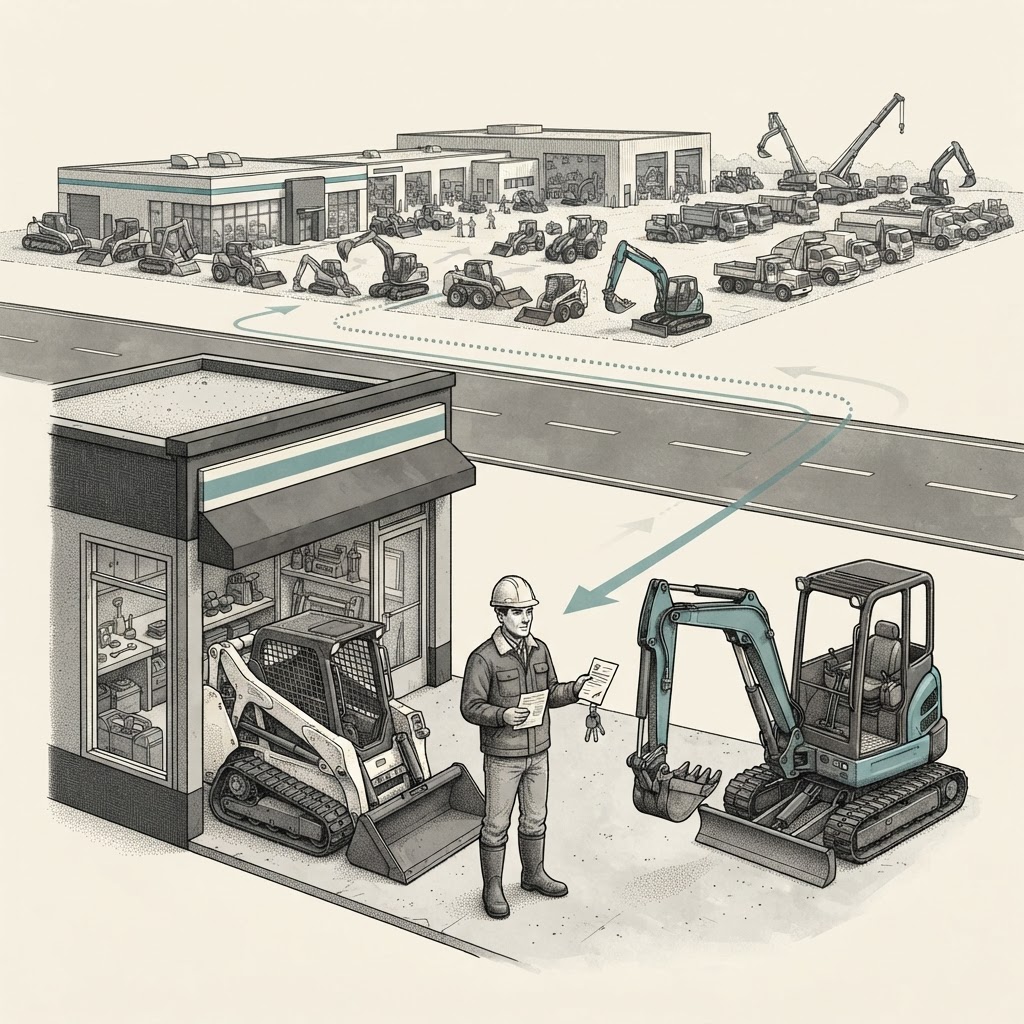
Foley Equipment has opened a retail concept focused on Caterpillar compact construction equipment, aiming to give smaller contractors a more direct route to purchases and rentals. The move tests whether a narrower store format can serve a distinct customer base without duplicating the full-service dealership model.

Foley’s Compact-Only Store Targets the Small Contractor

Foley Equipment is separating compact construction equipment from the broader dealership floor with a new store aimed at small contractors, a customer group whose buying and rental needs can differ sharply from those of large fleets. The concept is devoted to Caterpillar compact equipment and is intended to streamline access for smaller-scale operations.

DIG Analysis — 2026-10-18: The store is a targeted adjustment to dealer distribution, not evidence of a wholesale shift away from full-line branches. Its commercial test will be whether a focused location can reduce friction for compact-equipment customers while generating enough sales, rental activity and service work to support its own footprint.

A narrower format

Equipment World reported Foley’s launch as a retail concept built specifically around compact construction equipment. The description points to a more specialized customer experience than a conventional branch, where compact machines may sit alongside larger earthmoving equipment, parts, service operations and fleet offerings. Foley has not publicly detailed the store’s location, size, staffing, inventory depth or financial targets in the information available for this report.

The product focus matters because compact machines often serve contractors with different constraints than large fleet operators. A small contractor may need a skid steer, compact track loader or mini excavator for a specific job, and may weigh rental against ownership as work changes. A store organized around that category could make comparisons and transactions more direct. But the concept’s stated emphasis on purchasing and rental does not establish how service, parts availability or financing will be handled.

That distinction will shape the economics. A compact-only operation still requires inventory, trained sales staff and a way to support machines after delivery. If customers rely on a nearby full-line branch for parts or repairs, the new location may function more as a sales and rental channel than as a standalone dealership. Foley has not said how responsibilities will be divided between the concept store and its existing network.

Dealer economics

For a dealer, a specialized storefront can focus staff and merchandising on a defined customer segment. It may also give compact equipment greater visibility than it receives in a branch built around larger machines and fleet accounts. The trade-off is fixed cost: a separate location must attract enough transactions to justify rent, labor and inventory, while avoiding sales migration from nearby Foley branches.

Rental could help smooth demand, though it adds operational requirements. Machines must be available when customers need them, maintained between jobs and priced to cover utilization risk. Purchase activity, meanwhile, can be uneven for small contractors whose equipment decisions depend on project timing and cash flow. Foley has not disclosed whether the store will use a dedicated rental fleet or draw inventory from other locations.

The format may also affect how customers enter the dealer relationship. A compact-equipment buyer who starts with a rental could later purchase a machine or seek additional equipment as the business grows. That progression is plausible, but the company has not reported conversion targets or customer data. Without those measures, it is too early to know whether the store is designed primarily to build new relationships, capture transactions that already flowed through Foley, or do both.

What remains untested

The launch fits a broader dealer pattern: tailoring facilities and sales processes to particular products or customer groups rather than asking every buyer to use the same branch model. A focused footprint can make sense where product lines have distinct purchasing cycles and service needs. It can also create a more complicated network if inventory and technicians are split across locations.

For Caterpillar, Foley’s experiment gives a dealer-level route to test how compact equipment is presented and sold to smaller operators. The available account does not describe a broader Caterpillar program or a formal change in the manufacturer’s channel strategy. Nor does it establish whether other dealers will adopt a comparable format.

The operating evidence to watch is straightforward: customer traffic, rental utilization, sales conversion and the share of business coming from new customers rather than existing Foley accounts. Those measures will indicate whether specialization adds demand or simply relocates it. For now, Foley has put a compact-only retail concept into the market; its capacity to support customers beyond the initial transaction remains the central unanswered question.

“The store focuses exclusively on Caterpillar compact construction equipment, streamlining the purchasing and rental experience for smaller-scale operations.”

Equipment World, reporting on Foley Equipment’s new concept

Who This Affects

OEM Impact

Caterpillar channel managers gain a dealer-level test of whether compact equipment merits a dedicated retail format. They will want to distinguish incremental demand from sales shifted out of Foley’s existing branches before treating the concept as a model for other territories.

Dealer Impact

Dealer principals and branch managers can assess whether a focused location improves compact sales and rental utilization enough to cover added facility and staffing costs. If parts and service remain centralized, they will also need clear handoffs so the new store does not create customer confusion or duplicate inventory.

Contractor Impact

Small contractors may get a simpler place to compare compact machines and rental options, particularly when a job requires equipment for a limited period. Their practical benefit will depend on local inventory, rental availability and access to parts and repair support, details Foley has not disclosed.

Startup Impact

Construction-equipment software and rental startups should watch whether the format depends on dedicated digital inventory, booking or customer-management tools. A single dealer launch does not establish broad demand, but measurable rental utilization could sharpen the case for products serving compact-equipment transactions.

Dealmaker Impact

Private-equity investors and equipment-dealer dealmakers should treat the store as an operating experiment rather than evidence of a proven new unit model. Due diligence should test whether revenue is incremental, how much capital is tied up in compact inventory, and whether service costs are borne by the concept or nearby branches.

Back to News
Foley EquipmentCaterpillarCompact equipmentSmall contractorsEquipment rentalDealer strategy