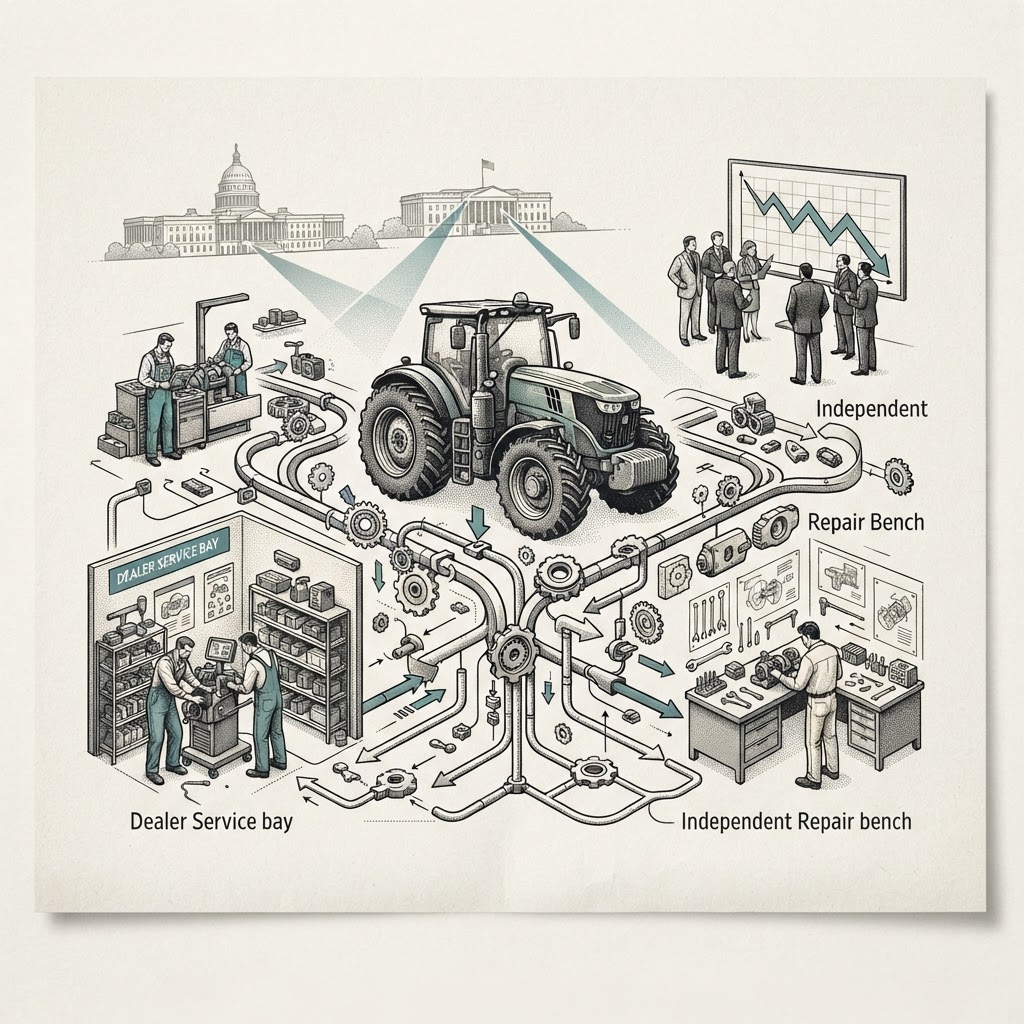
A joint federal inquiry is seeking public comment on repair limits, pricing and barriers to entry in agricultural equipment. Deere shares fell about 5% after the announcement, as investors weighed the prospect of closer oversight.
Federal regulators have opened a joint inquiry into how agricultural equipment is manufactured and sold, putting repair restrictions, pricing practices and barriers to market entry before a public review. Deere & Company shares fell approximately 5% after the announcement, a sign that investors see potential business consequences even though the inquiry has not produced findings or proposed rules.
DIG Analysis — 2026-10-07: The inquiry brings the Federal Trade Commission and the U.S. Department of Agriculture into a sector where equipment design, software access, dealer networks and farm repair costs intersect. Its immediate significance is procedural: regulators are asking for evidence, not announcing an enforcement action. The scope and direction of any later steps remain uncertain.
The questions before regulators
The FTC and USDA said they are seeking public comment on competitive practices in agricultural equipment manufacturing and distribution. The stated topics include restrictions on repair, pricing strategies and barriers that may make it harder for new firms to enter the market. The agencies framed the inquiry around possible effects on farmers and rural economic resilience.
That breadth matters. Repair access can turn on more than whether a machine can be physically opened. Diagnostic software, parts availability, service documentation and authorization rules may shape who can complete a repair and how quickly. Pricing questions could involve equipment, parts or service, but the announcement does not specify a particular practice or company conduct that regulators have found unlawful.
The agencies’ request for comment gives farmers, dealers, manufacturers, independent repair businesses and other market participants a channel to describe how those practices operate. Their submissions may help officials distinguish between constraints imposed by product design or safety requirements and restrictions that limit competition without a corresponding benefit. The inquiry itself does not establish where that line falls.
“The investigation seeks public comment on issues including repair restrictions, pricing strategies, and market entry barriers.” Federal Trade Commission and U.S. Department of Agriculture announcement
Market reaction, limited answers
Deere’s roughly 5% share decline followed the announcement, according to the verified account of the market reaction. The move reflects uncertainty about the possible costs of greater oversight, but it does not establish that Deere is the target of an enforcement case. The agencies announced a sector-wide inquiry, and the available announcement does not identify a specific allegation against the company.
For manufacturers, the exposure could depend on what regulators ultimately examine and whether they pursue guidance, rulemaking or enforcement. Changes to repair policies or access to technical information could require revisions to service systems and dealer arrangements. Those adjustments could carry costs, while broader access might also alter how authorized service and parts revenue are distributed. No timetable or policy outcome is specified in the announcement.
There is also a distinction between investor concern and a regulatory conclusion. A one-day share move captures expectations about risk; it does not measure the likely financial effect of any eventual government action. The inquiry could end with recommendations or no further action, or it could identify practices that invite additional scrutiny. The public record will need to develop before those possibilities can be separated.
Evidence will shape the next stage
The central test will be whether public comments document recurring restrictions and measurable effects on competition, repair costs or equipment availability. Regulators will also need to weigh the economics of a capital-intensive business, where machines combine mechanical systems with increasingly sophisticated software and where downtime can affect farm operations.
For now, the agencies have opened a fact-finding process, not a new compliance regime. The FTC’s announcement is the primary source for the inquiry’s scope; it does not provide detailed evidence, identify specific remedies or say when officials will decide whether to take another step. Those omissions leave manufacturers and investors with a defined set of questions, but no answer yet about what federal scrutiny will ultimately require.
 Translate