
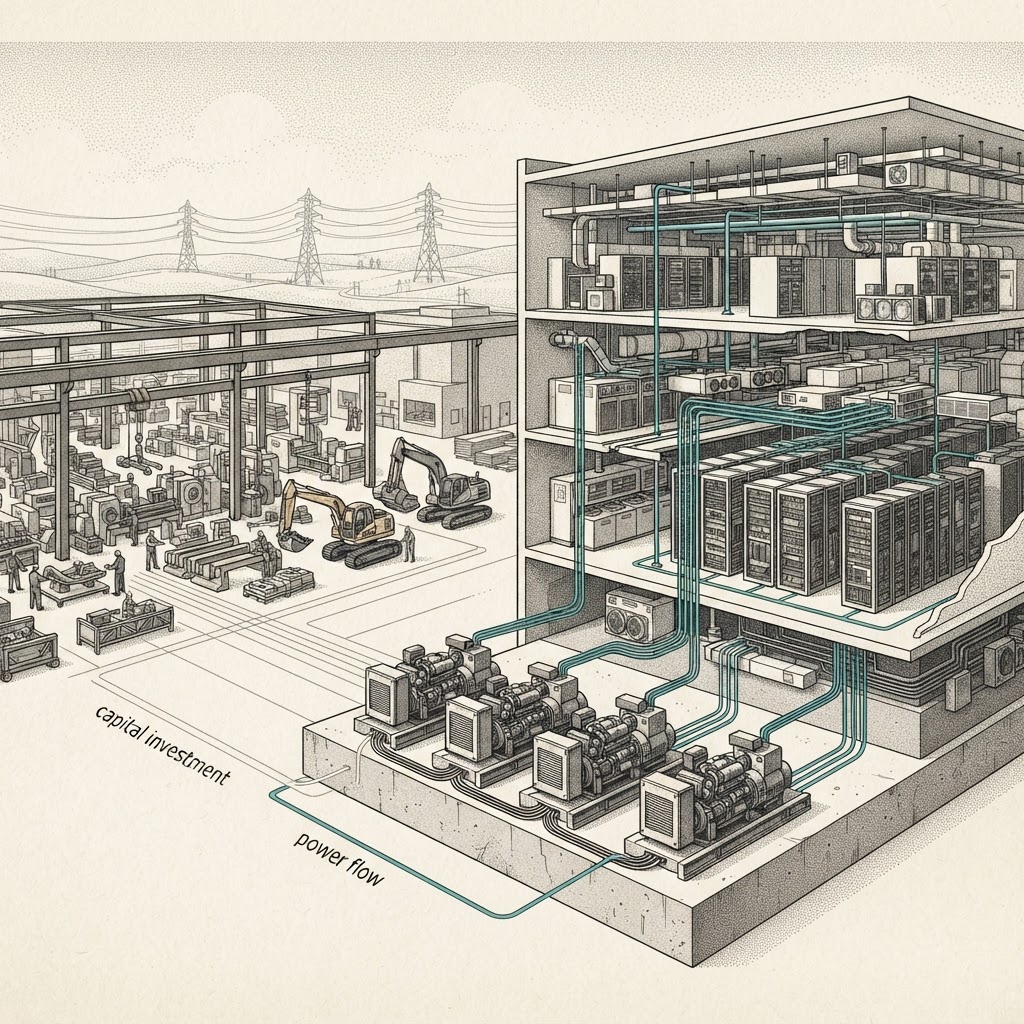
HD Hyundai Construction Equipment has won a $276 million contract to supply gas-fueled power-generation engines to ERock, a U.S.-based power infrastructure provider, moving the equipment maker further into a market shaped by data centers’ appetite for dependable electricity.
DIG Analysis — 2026-10-11: The agreement is a meaningful industrial order, but its larger significance lies in where the engines will be used. Data-center developers are seeking power capacity amid rapid growth in computing demand, and suppliers that can provide generation equipment may gain access to spending beyond conventional construction and machinery cycles. The contract’s size alone, however, does not establish how much revenue HD Hyundai will recognize, when shipments will occur, or whether ERock’s projects are backed by long-term power contracts.
Seoul Economic Daily reported the deal, citing the $276 million value and identifying ERock as the customer. The companies’ announcement, as summarized in the report, does not specify engine quantities, delivery schedules, project locations or whether the equipment will serve as primary generation, backup capacity, or both. Those details matter in a sector where equipment orders can precede permitting, grid interconnection and final investment decisions by months or years.
A new demand channel
For HD Hyundai Construction Equipment, the order extends the commercial reach of its engine business into critical infrastructure. Gas-fueled engines can be deployed in modular power installations, where operators need capacity close to a facility or a bridge while utility supply is expanded. Data centers place a premium on continuity: outages can interrupt services and damage costly operations, while grid queues in some markets complicate plans to bring new campuses online.
The commercial opportunity is not limited to data centers. Power providers and industrial customers also use distributed generation where grid access is constrained or reliability requirements are high. But a large data-center contract carries its own execution demands. The supplier must deliver equipment on schedule, support commissioning and provide parts and service over operating lives that can span decades. A deal that expands the addressable market also raises expectations for a service network suited to power applications, not only construction equipment.
HD Hyundai has not disclosed whether the contract includes installation, maintenance or follow-on service. Nor has it said how the order will affect production capacity or margins. Without those terms, investors and competitors cannot yet judge whether this is primarily an equipment sale or an entry point into recurring service revenue.
“The agreement marks a significant expansion for the OEM into the critical infrastructure energy market.”
Seoul Economic Daily, reporting on the ERock contract
Execution and economics
The data-center buildout is drawing capital from developers, utilities and infrastructure providers, but power supply remains a complex part of project delivery. Gas generation may offer a dispatchable source of electricity, yet projects still depend on fuel access, emissions rules, permitting and the timing of grid connections. Local regulations and customer requirements can determine whether on-site generation is a lasting source of power or a temporary measure while utility capacity catches up.
That leaves uncertainty around ERock’s role in the projects and the timing of its customers’ demand. The contract value indicates a substantial commitment, but it does not reveal whether orders are tied to one site or several, or how much of the value depends on options and future delivery milestones. If construction schedules move, engine shipments and revenue recognition may move with them. If power infrastructure providers face shortages in other components, engines alone will not bring a facility online.
The order also puts HD Hyundai in a more direct contest for attention with established power-generation suppliers. Its position will depend on more than the headline contract value: customers will weigh performance, fuel efficiency, emissions compliance, service coverage and the ability to deliver at scale. The company has secured a foothold with ERock. The next test is whether that agreement becomes a repeatable business line rather than a single large order.
Neither HD Hyundai nor ERock disclosed a shipment timetable in the report, leaving the first delivery milestones as the clearest near-term measure of execution.