 Translate

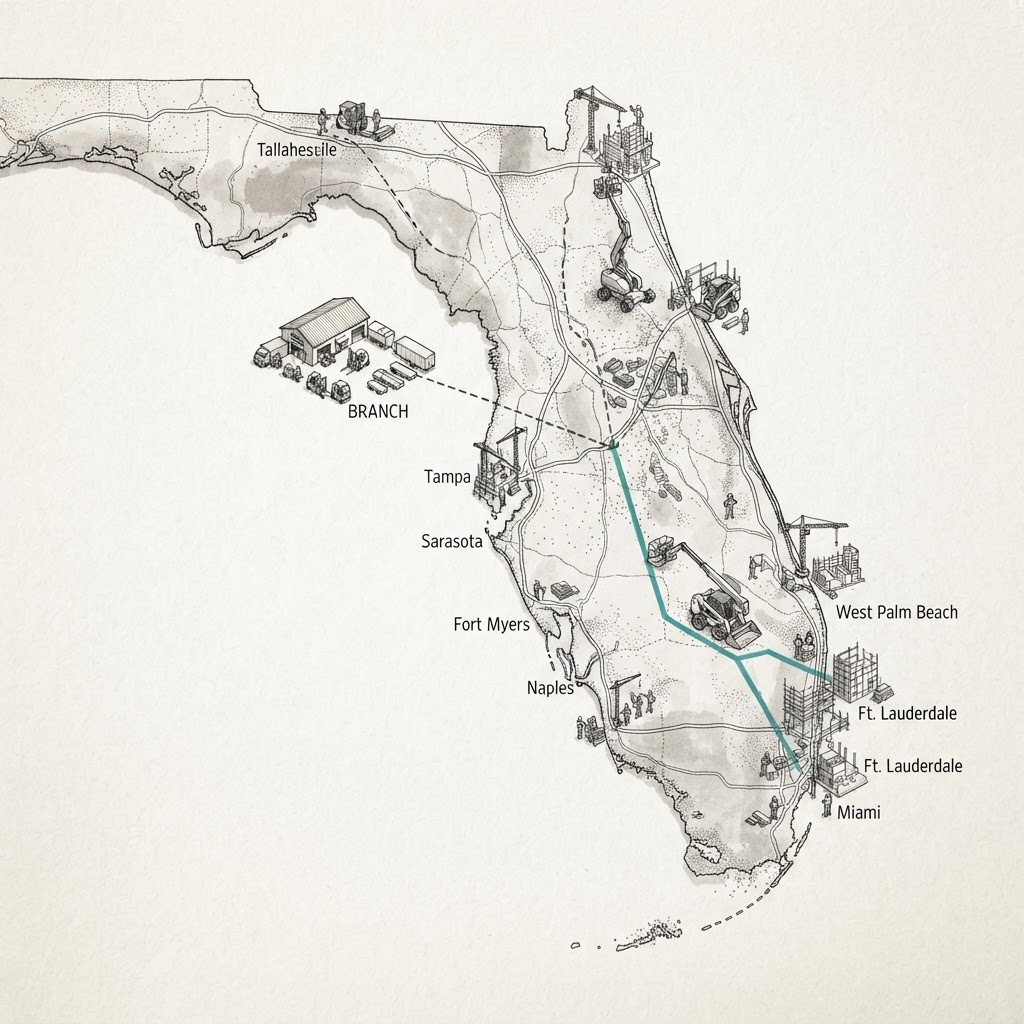
H&E Equipment Services has acquired a regional rental fleet and associated branch facilities in Florida, adding aerial work platforms and earthmoving equipment to its existing network as the equipment-rental company builds density across the Southeast. The transaction gives H&E more local inventory and operating sites in a state where construction demand is spread across fast-growing coastal markets.
DIG Analysis — 2026-11-04: The acquisition is a network-positioning move as much as a fleet purchase. Branch locations can improve delivery times and service reach, but the value depends on how well H&E integrates the facilities, retains customers and keeps the added equipment earning through the construction cycle.
Local density, broader reach
Rental Equipment Register reported that H&E finalized the acquisition of the regional fleet and its branch facilities. The published summary identifies aerial work platforms and earthmoving equipment as the principal additions, but does not disclose the seller, purchase price, fleet count, branch locations or the transaction’s financing. H&E also has not, in the available announcement details, provided a schedule for integrating the assets or quantified the expected contribution to revenue.
Those omissions make it difficult to assess the deal’s scale against H&E’s existing Florida operation. Still, acquiring facilities alongside equipment gives the company a practical route to add capacity: it can place machines near customers without relying solely on transfers from more distant branches. For rental customers, proximity can matter when a project requires equipment quickly or a machine needs field service. For H&E, more local inventory may support utilization and reduce the distance traveled for deliveries and maintenance.
The rationale is consistent with the company’s stated effort to densify service coverage in high-growth coastal regions. That strategy has limits. Branches require people, maintenance capacity and working capital, while fleet additions create carrying costs whether or not demand materializes. A denser network can make each location more useful, but only if enough customers and jobs sit within its service radius.
Utilization is the test
Aerial platforms and earthmoving equipment serve different work, but both are exposed to the timing of construction activity. Aerial units are used across building, industrial and maintenance projects; earthmoving machines depend more directly on site preparation and civil work. Adding both categories broadens the potential customer base, yet it also leaves H&E with more equipment whose returns will vary by type, age, condition and local rental rates.
The core operating question is whether the acquired fleet complements H&E’s existing inventory or overlaps with it. Complementary units could fill gaps in availability and give branch staff more chances to meet a customer’s equipment needs. Overlap, by contrast, could put pressure on utilization and pricing if the added machines arrive in markets where competitors already have sufficient supply. The company has not disclosed equipment condition or the proportion of the fleet that will require refurbishment, information that could affect the cost and speed of deployment.
