
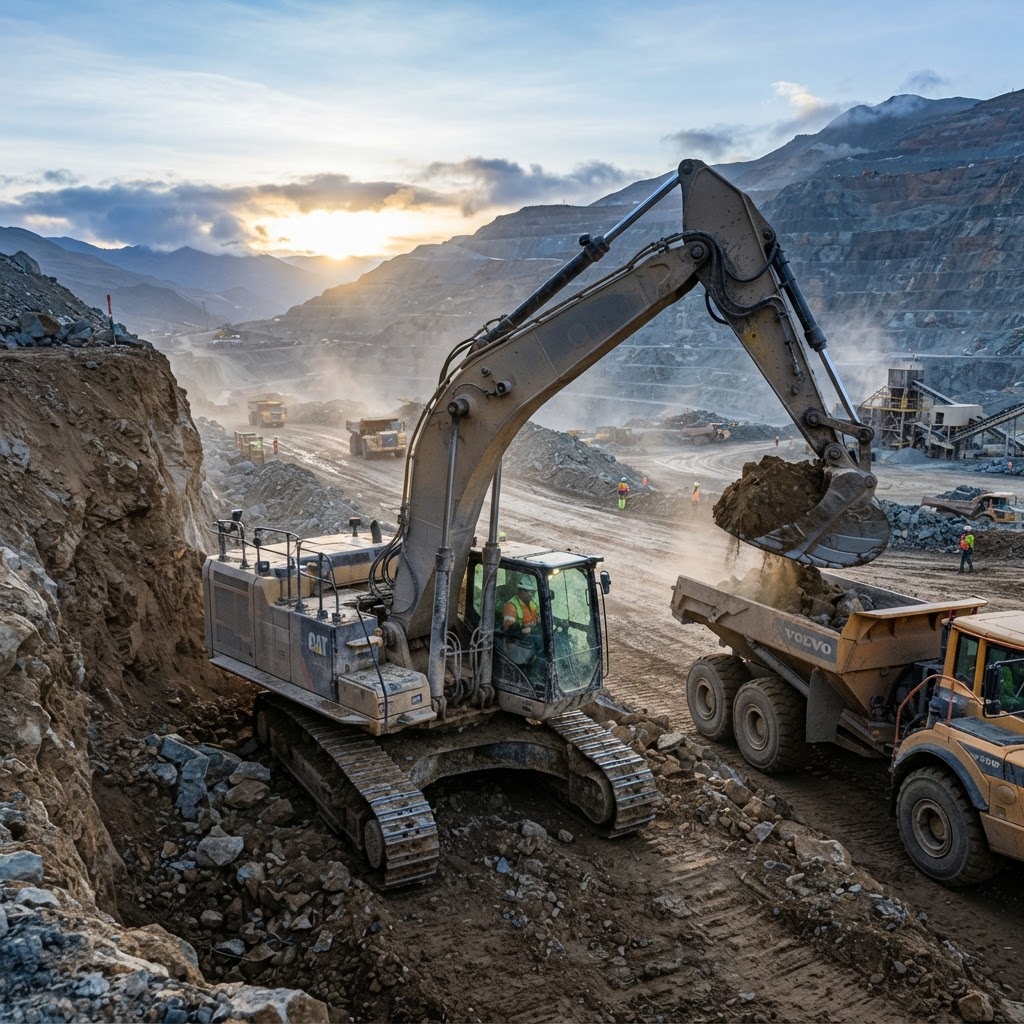
Hitachi Construction Machinery is putting human operating judgment at the center of its next excavator autonomy program. Beginning in October 2026, the company will work with Jizai Inc. and the Nara Institute of Science and Technology to develop Physical AI that can learn hydraulic excavator skills from lever inputs, video, and written work instructions. The program was selected for Japan’s Generative AI Accelerator Challenge, backed by the Ministry of Economy, Trade and Industry and the New Energy and Industrial Technology Development Organization.
DIG Analysis — 2026-09-09: This is not simply an effort to automate repetitive machine movements. Hitachi is targeting the harder layer of equipment autonomy: interpreting operator intent, adapting to site conditions, and recovering after an operational error. That puts real-world behavior, rather than an idealized sequence of commands, at the center of the training data.
From Machine Controls to Operating Decisions
Traditional automation typically depends on predefined routes, fixed work envelopes, sensors, and narrowly defined tasks. Excavation and loading rarely remain that predictable. Ground conditions change, debris shifts, visibility deteriorates, and the machine must respond to an imperfect sequence of decisions.
Hitachi’s announced system is intended to analyze hydraulic lever operations alongside video feeds and work instructions. That combination matters because the same lever movement can have a different purpose depending on the bucket position, material, surrounding equipment, or stage of the job. A video record can show the physical context, while the controls reveal how an experienced operator translated that context into action.
The inclusion of recovery maneuvers following operational errors is especially significant. A system trained only on successful cycles may fail when a bucket binds, a load is misplaced, or the machine reaches an awkward position. Capturing correction behavior gives the model examples of diagnosis and recovery, not just execution.
“The program will develop Physical AI capable of learning the skills of hydraulic excavator operators from lever operations, video, and work instructions.” Source: Hitachi Construction Machinery
Why the GENIAC Selection Matters
GENIAC provides more than a public endorsement. The METI and NEDO framework places the project inside Japan’s national effort to strengthen generative AI capabilities, while giving the partners a defined research structure and access to expertise spanning heavy machinery, AI development, and academic robotics research.
For Hitachi Construction Machinery, the partnership also addresses a practical bottleneck: collecting and interpreting enough high-quality operating data to train systems for difficult field conditions. Jizai brings startup expertise in AI, while NAIST contributes research capability. The arrangement allows the OEM to pursue a program that would be difficult to build through equipment engineering alone.
The initial task set is concrete. The system is intended to support autonomous debris clearing, excavation, and loading at construction and mining sites. Those applications create a useful progression from irregular material handling to more structured production cycles. They also expose the system to different levels of risk, visibility, and coordination with nearby personnel and machines.
The Next Test Is Field Reliability
The announcement does not mean commercially autonomous excavators are ready for broad deployment. The difficult work begins with data quality, simulation, safety validation, edge-case testing, and proving that a learned behavior remains reliable outside the conditions in which it was recorded.
Hitachi will also need to define how the system communicates confidence and when it hands control back to a human. A recovery capability is valuable only if the machine can recognize when a situation exceeds its training or sensor coverage. For mining and construction customers, productivity gains will be judged against exclusion zones, mixed fleets, weather, maintenance condition, and site-specific procedures.
The program nevertheless signals a meaningful change in the autonomy race. The competitive question is moving beyond whether an excavator can repeat a cycle. It is whether an OEM can encode the judgment that experienced operators apply when the cycle breaks down. If Hitachi and its partners can demonstrate that capability safely, operator data and field learning will become central strategic assets in heavy equipment manufacturing.