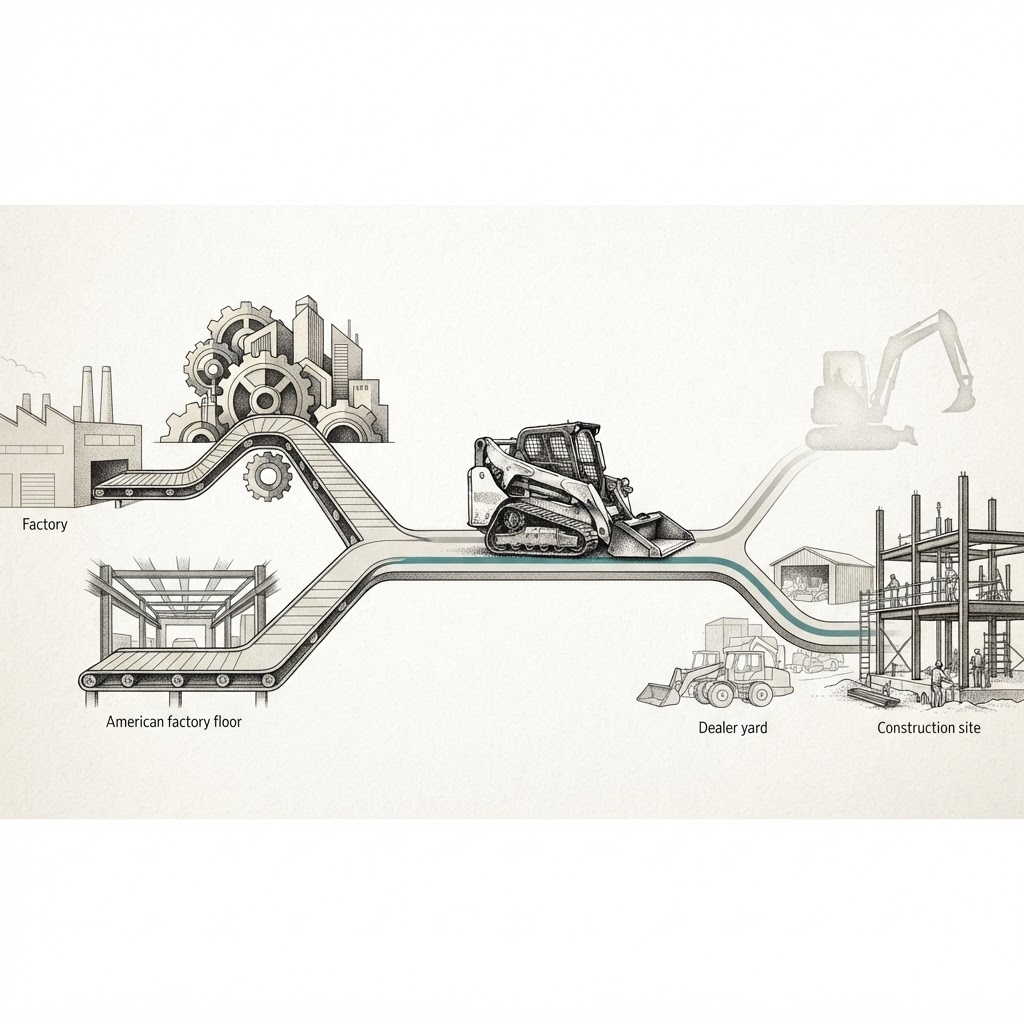
A manufacturing agreement puts Yanmar in the production role for Hitachi’s compact track loaders, which will carry the Landcros name from 2027. The companies are also discussing whether to extend the arrangement to mini excavators, though neither has disclosed volumes or timing.
Hitachi Construction Machinery Americas will rely on Yanmar to produce compact track loaders in the United States, a move that gives Hitachi a manufacturing partner for a product line it plans to rebrand as Landcros in 2027. The companies are discussing a broader arrangement covering mini excavators, but have not announced a decision.
DIG Analysis — 2026-10-29: The agreement combines Hitachi’s product and brand plans with Yanmar’s manufacturing capacity. Its commercial significance will depend on details not yet disclosed: output, plant location, investment, distribution responsibilities and how the machines will differ from equipment already sold by either company.
A production arrangement
The announcement, reported by Equipment World, establishes a U.S. production path for Hitachi-branded compact track loaders without identifying the factory or setting a start date. Hitachi Construction Machinery Americas did not disclose expected production volumes, model specifications, pricing or whether the agreement includes a commitment to buy a minimum number of machines.
Those omissions matter in a category where utilization, dealer coverage and attachment compatibility can influence a buyer as much as the name on the machine. Local production could shorten supply lines or improve availability, but the announcement alone does not establish that either outcome will follow. That will depend on where production occurs, how components are sourced and how the partners schedule output against demand.
The Landcros name adds a second layer to the deal. Hitachi says it will officially adopt Landcros for its compact equipment line in 2027. Until then, dealers and customers will have to understand how the new name relates to existing Hitachi products and whether branding changes coincide with revisions to the machines themselves. The companies have not described a product-transition plan.
“The companies are also in discussions to expand this manufacturing partnership to include mini excavators.”
The reported discussions are a possibility, not a commitment. Mini excavators would widen the scope of cooperation, but the available information does not indicate whether the same facility, production process or commercial terms would apply. Nor has either company said when it expects to reach a decision.
What remains unsettled
Manufacturing agreements can take several forms, from contract production to deeper coordination on engineering and sourcing. The announcement does not specify which model Hitachi and Yanmar have chosen. It also does not say whether the machines will be based on an existing Yanmar platform, a Hitachi design or a jointly developed product.
That distinction affects the economics. If production uses an established platform, the partners may be able to bring machines to market with less capital and a shorter development cycle. If Hitachi expects substantial design changes, the arrangement could involve more engineering work, additional tooling and a longer path to consistent output. No investment figures or development milestones were provided.
The partnership also sits within a competitive market in which manufacturers use compact equipment to reach customers outside traditional large-construction fleets. Contractors and rental businesses often compare machines through local dealer support, parts access and operating costs. A U.S. production base could be useful, but it will not by itself settle those comparisons.
Yanmar, for its part, adds another production relationship to a segment where manufacturers must balance factory capacity across products and markets. The agreement could provide additional work, though there is no public estimate of its scale or evidence that it will displace other production. Hitachi’s choice of partner also leaves open how much control it will retain over component sourcing, quality processes and future model changes.
The next test
The Landcros transition gives Hitachi a defined date for the compact-line rebranding, but the operating details will determine how it lands in the market. Dealers will need clear guidance on product identity, warranty terms, parts inventories and the treatment of current Hitachi models. None of those arrangements was detailed in the reported announcement.
The mini excavator talks may be the clearest indicator of whether the agreement is intended as a focused production solution or the start of a broader manufacturing relationship. For now, the confirmed scope is compact track loaders, with Landcros branding planned for 2027 and a possible extension still under discussion.