
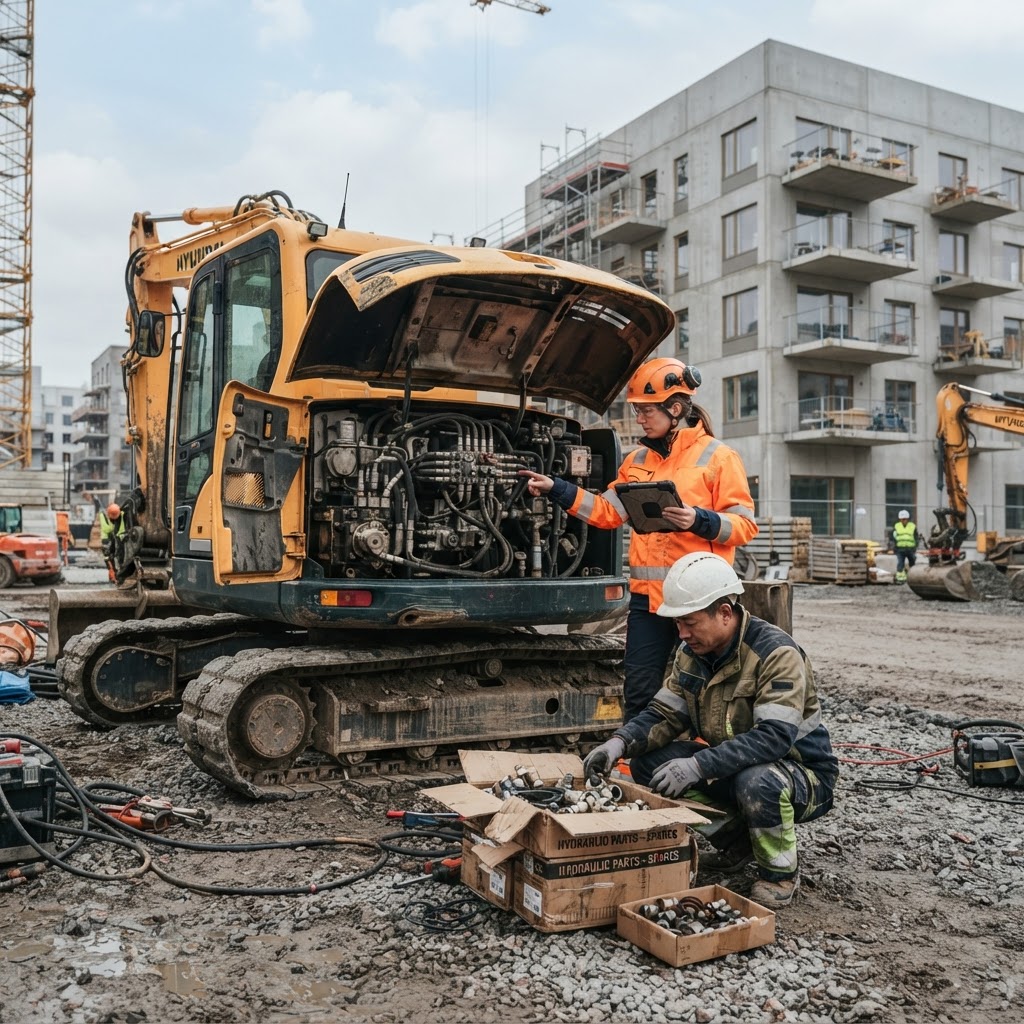
Hyundai Construction Equipment Europe has a clear line in the sand. Six months after taking the helm, CEO Sanho Shin has announced an ambition to drive €8.7 billion in growth and placed an all-new hydraulic system at the center of that plan. The announcement, made in an interview with Industrial Vehicle Technology International, signals a focused product-first strategy intended to raise machine performance and operating efficiency across Hyundai’s compact and medium excavator ranges.
DIG Analysis — 2026-08-06: Hyundai is using a hardware upgrade, not a marketing campaign, as the lever to accelerate European expansion. The new hydraulic package is designed to improve cycle times, fuel use, and uptime. Execution will hinge on supplier capacity, dealer service readiness, and rapid certification in multiple EU jurisdictions.
What Hyundai announced and why the hydraulic system matters
Shin framed the hydraulic investment as the technical backbone of a wider commercial push. The new system aims to deliver higher flow control, better response, and longer service intervals. Those outcomes address three persistent buyer priorities in Europe: lower operating cost per hour, predictable uptime for tight project schedules, and resale value tied to service history and parts availability. The company discussed the development and rollout in an interview with Industrial Vehicle Technology International.
For OEMs in this segment, hydraulics are not optional. Improvements to pump efficiency, valve logic, and thermal management directly reduce fuel consumption and cycle time on repetitive tasks such as digging and grading. That arithmetic converts to measurable lifecycle cost advantages for owner-operators and rental fleets. Hyundai’s approach appears to be to translate incremental mechanical gains into a commercial claim set that dealers can sell to price-sensitive European customers.
How this shifts competition, supply chain, and dealer economics
Placing product capability at the front of a growth target forces attention on three operational areas. First, supplier control. To scale a new hydraulic platform across machine lines Hyundai must secure components and manage assembly tolerances at volume. Sourcing and logistics decisions will determine whether the company hits delivery and warranty targets or slips into backorder-driven discounts.
Second, dealer network readiness. New hydraulics mean different parts inventories, diagnostic tools, and technician training. Dealers that move quickly will convert the change into higher service revenue and shorter sales cycles. Dealers that lag will face warranty exposure and customer churn to rivals offering comparable uptime assurances.