
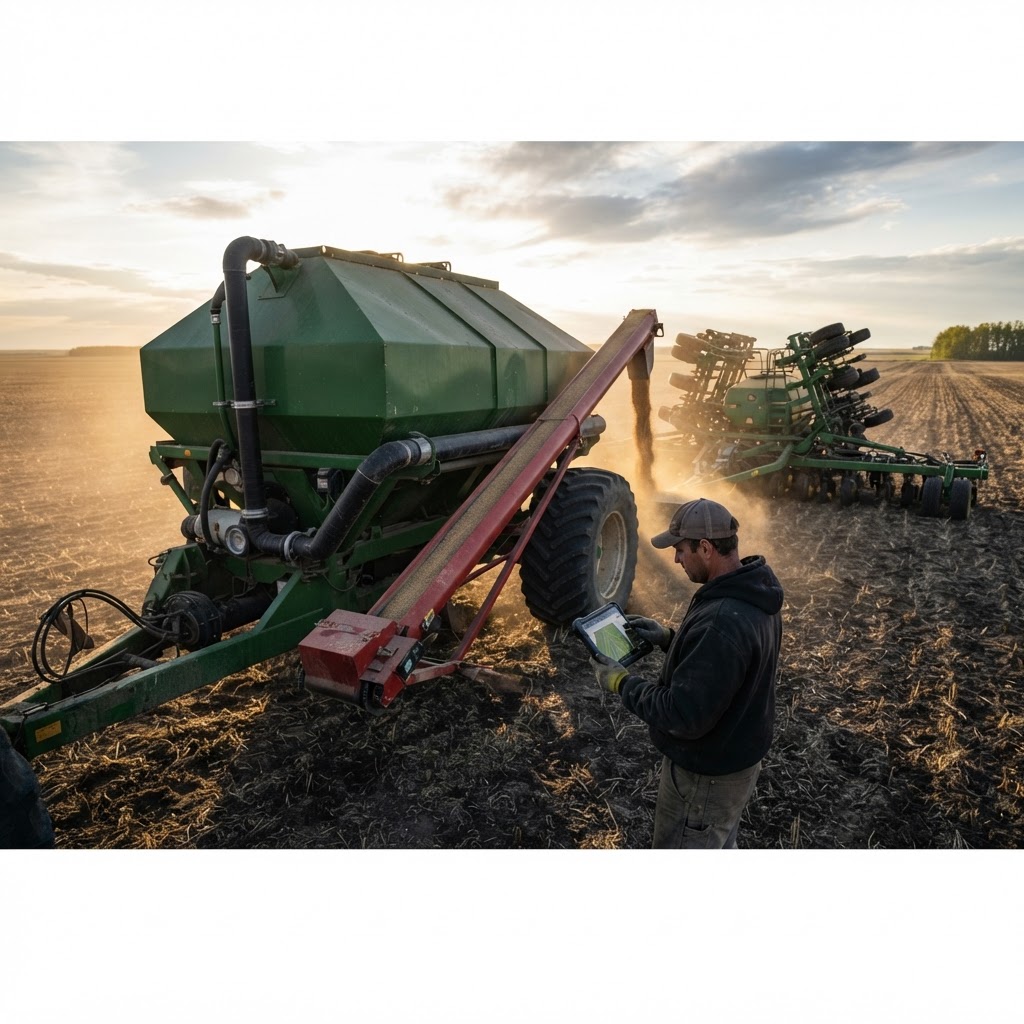
John Deere has lifted capacity and on‑board blending in its C‑Series air cart line with the new C1450T, a model designed to keep seeding rigs moving through tight planting windows. High Plains Journal reported the C1450T pairs a 105-bushel Flex Tank with a separate fifth tank for carrying and blending up to five products, a 16-inch hydraulic conveyor for faster loading, and full integration into the John Deere Operations Center.
DIG Analysis — 2026-08-02: The C1450T is a clear response to customer demands for fewer load stops and more flexible in-field product management. The combination of larger primary capacity, a dedicated fifth tank for concentrates or microboosters, and faster load conveyance reduces downtime during narrow seeding periods and raises the value of precision-logistics software for large acreage operators.
What changed: capacity, tanks, and load handling
The headline specification is the 105-bushel Flex Tank. That capacity increase alone lengthens time between refill cycles for high-acreage operations. More consequential for application strategy is the fifth tank. Operators can now carry four distinct commodities plus a dedicated carrier for a concentrated input or a small-volume specialty product. That makes single-pass blending feasible without manual mixing or an extra tender vehicle.
John Deere also sized up the loading hardware. The C1450T uses a 16-inch hydraulic conveyor that the company says speeds product transfers during loadout. Faster conveyance reduces the nonproductive minutes each time carts are refilled. For farms running multiple carts or a large tender, that per-load time savings scales across the entire seeding operation.
Why integration with operations software matters
The C1450T is fully integrated with the John Deere Operations Center for data and logistics management. Integration lets operators plan loadouts, track remaining product in each tank, and align fill schedules with field maps and machine locations. That shifts some logistics decisions from the rig operator to the planning layer, allowing dispatch of tenders and refills with fewer radio calls and less guesswork.