
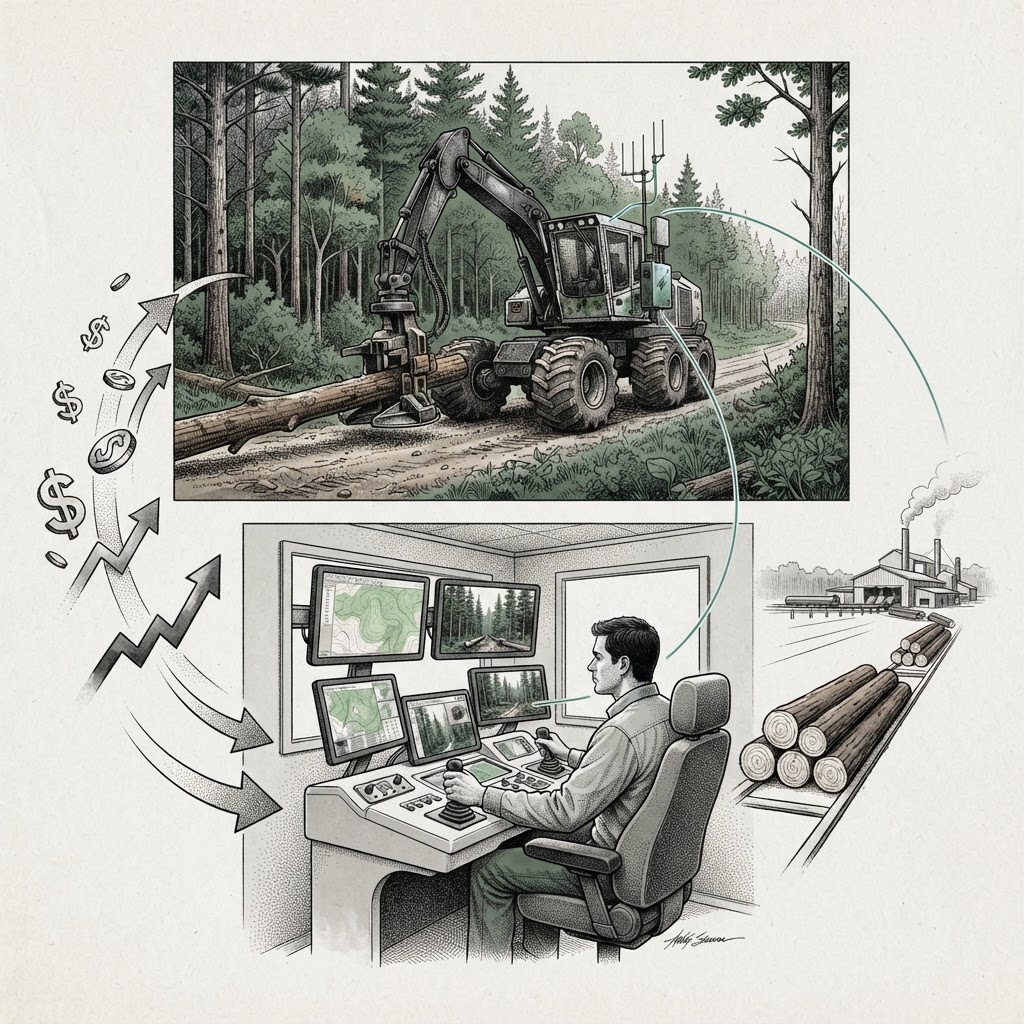
Kodama has raised $7 million to expand a forestry robotics business built around existing logging equipment, rather than a new fleet of autonomous machines. The round, co-led by Konvoy Ventures and Breakwater Ventures, brings the company’s total capital raised to $14 million and places its next challenge in the field: turning early operating experience into broader commercial deployments.
DIG Analysis — 2026-10-20: The financing reflects investor interest in applying physical AI to industries where labor is scarce and equipment is expensive to replace. But logging is a demanding proving ground. A system must work across uneven terrain, changing timber conditions and machines that were not necessarily designed for remote operation.
The retrofit case
Kodama retrofits forestry equipment with teleoperation and supervised autonomy technology. The approach lets operators control machines remotely or supervise automated functions, while leaving the underlying equipment in service. The company says its technology has been used to move more than 100,000 tons of timber in the southeastern United States.
That operating figure gives investors and prospective customers a measure of field use, though it does not establish how many machines were involved, how long they ran or what the system cost per ton. Nor does the disclosed information specify which tasks are performed autonomously and which still require direct human control. Those distinctions matter: a system that assists an operator in selected conditions has a different labor and productivity profile from one that can handle a full shift with limited supervision.
Retrofitting may lower the adoption barrier for logging contractors, many of whom rely on equipment purchased years before autonomy systems became available. It could also give Kodama a route to market without requiring customers to replace machines outright. The trade-off is technical complexity. Integrating controls, communications and safety systems into varied equipment can make installation and support less uniform than selling a purpose-built machine.
Scaling beyond early use
The company said the new capital will support commercial deployments and deeper partnerships with original equipment manufacturers. The two priorities are related but not identical. More deployments can produce operating data and customer references; OEM relationships could help standardize installation, improve machine integration and introduce the technology through established sales channels.