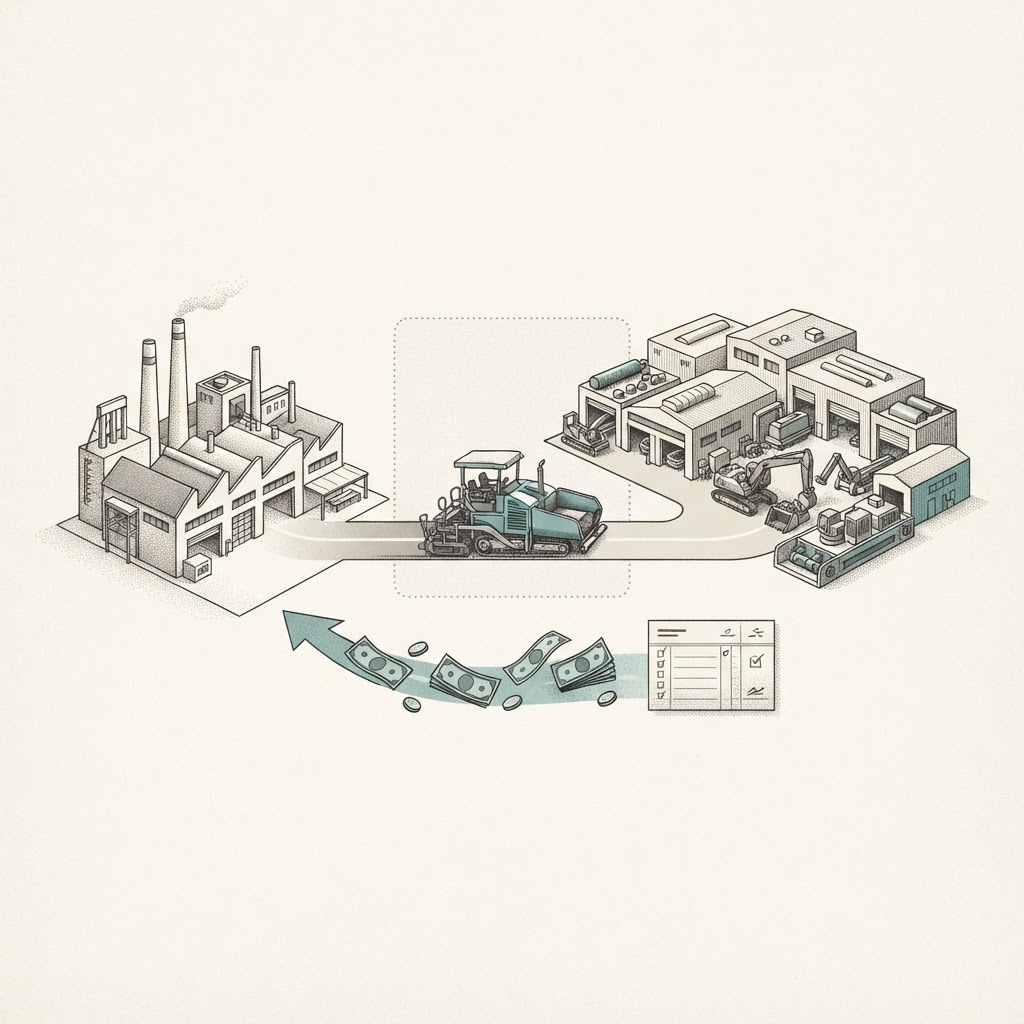
Astec Industries agreed to sell its road construction equipment business to Komatsu America for $75 million. The transaction gives Komatsu a broader paving lineup while offering Astec about $65 million in expected cash proceeds and tax benefits.
Komatsu America will acquire Astec Industries’ road construction equipment business, including the Roadtec and Carlson brands, for $75 million, giving the Japanese manufacturer a larger position in highway and commercial paving while Astec steps back from a named equipment category.
DIG Analysis — 2026-11-13: The announced price is only part of the transaction’s significance. Astec expects about $65 million in total cash proceeds and tax benefits, while Komatsu gains established paving products and brands. The announcement does not specify how the business will be integrated, how many employees or facilities are involved, or whether the purchase price is subject to adjustments.
A portfolio change
The deal shifts ownership of Roadtec and Carlson from Astec to Komatsu America, the U.S. arm of Komatsu. Astec’s announcement, as reported by RTTNews, describes the asset sale and expected proceeds, but provides limited detail on the operating perimeter. It does not say whether the transaction includes all related manufacturing sites, intellectual property, service operations, or dealer agreements.
Those details matter because road equipment is sold through a network of dealers and supported over long machine lives. A change in ownership can affect parts supply, warranty administration, product development and the terms under which dealers represent a brand. Until the companies disclose transition arrangements, customers and channel partners have a clear ownership change but not a full account of how day-to-day responsibilities will move.
For Komatsu, the acquisition adds paving equipment to a broader construction portfolio that already spans machines used in infrastructure projects. Roadtec and Carlson give it product lines associated with asphalt paving and related work, extending its reach in a segment where contractors often buy equipment as part of a fleet rather than as a stand-alone asset. The strategic fit is apparent; the financial contribution is not. The companies have not disclosed revenue, earnings, order backlog or expected cost savings for the business.
“The transaction gives Komatsu a broader position in highway and commercial paving while Astec steps back from a named equipment category.”
DIG Analysis
Cash, with open questions
Astec said the sale is expected to generate approximately $65 million in total cash proceeds and tax benefits against a $75 million stated purchase price. The difference is not, by itself, a measure of the transaction’s final net value: the announcement does not break out the tax component, transaction expenses, working-capital provisions or any other adjustments. Nor does it explain how Astec plans to use the proceeds.
For Astec, the sale may simplify its portfolio and provide cash, but it also removes a business with established product identities from its range. Investors will want to see whether the proceeds are directed toward debt reduction, investment in retained operations, or another use. They will also need financial detail to judge what earnings or cash flow Astec is giving up in exchange.
For Komatsu, the $75 million price is a modest disclosed entry point relative to the strategic breadth of the assets, but price alone says little about the eventual return. Integration costs, investment needs and the acquired operation’s profitability remain undisclosed. The terms also leave unanswered how Komatsu will preserve brand recognition while fitting the products into its existing sales and service structure.
Integration will set the value
The transaction’s commercial result will depend on execution after closing. Komatsu will need to maintain support for existing Roadtec and Carlson machines while deciding how the brands, product planning and dealer coverage fit within its organization. A transition that unsettles parts access or service relationships could weaken the value of an otherwise established product base; continuity would help protect it.
Astec, meanwhile, will have to show how the remaining portfolio performs without the road construction unit and whether the expected proceeds improve its financial position. The announcement offers no closing date, regulatory timetable or further operating commitments, leaving the next milestones to future company disclosures. RTTNews reported the agreed $75 million sale and Astec’s estimate of approximately $65 million in cash proceeds and tax benefits.