LeadX is building the company record behind every UCC filing
Jon RossiFounder & Editor-in-Chief October 26, 2026 12 min read
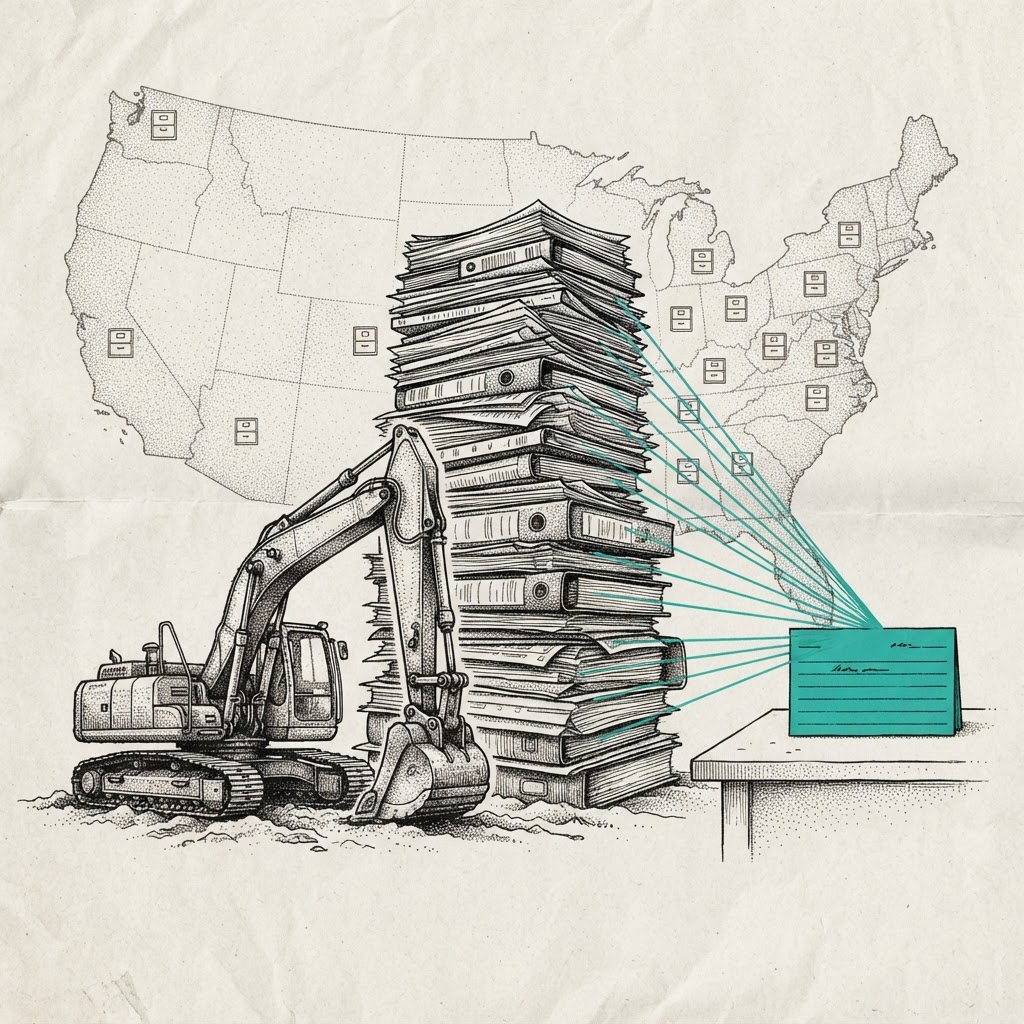
Public filing records say which businesses own which machines and who financed them, but they are scattered across fifty states and written in whatever words the filer chose. LeadX collects them, cleans them up and ties each one to a real company with people to call. Here is what the platform does, who uses it, and what it found when pointed at Florida's excavator market.
Every time a lender finances a machine for a business, it files a public notice with the state. Across fifty states, that adds up to one of the most detailed records of who owns what equipment and who paid for it. It is also one of the hardest to use. Each state publishes on its own schedule and in its own format, the equipment is described in whatever words the person filing chose, and the same company can appear under half a dozen spellings.
LeadX Technologies was built to fix that. Founded in 2022, with offices in Irvine, California and West Creek, New Jersey, the company connects UCC filings to company, contact, equipment and reputation data and makes the result searchable in one place.1 It started as a prospecting tool for equipment lenders. John Sokol, who founded the company and runs it as chief executive, told Equipment Finance News in June that he widened the platform after hearing from clients that scattered UCC data was one of their biggest problems.3
We spent time with the platform, the research LeadX has published from it and the founder behind it. This piece covers what the company has built, what makes it different, what the data shows when you point it at a real market, and where we think it could go.
A data scientist who came up in equipment finance
Sokol is a technical founder. LeadX describes him as having eight years of data science and leadership experience across equipment finance, working capital, equipment dealers and machinery manufacturing.6 That combination is unusual in this market. Most data companies selling into equipment finance are run by people from sales or from general-purpose data businesses, and most people who understand equipment finance from the inside don't build pipelines.
It shows in how the company was started. LeadX didn't set out to be a UCC platform. It began as a way to help equipment lenders find borrowers, and the filing record came in because customers kept asking for it. Sokol still works directly with customers on how the data sets fit together in practice.6 LeadX is also a member of both the National Equipment Finance Association and Associated Equipment Distributors.1
What the platform holds
LeadX describes itself as a B2B data platform, and the UCC record is the part that sets it apart. The company holds more than 50 million UCC-1 and UCC-3 filings with the secured party, the collateral and the status of each.1 Around that sit five other data sets: company profiles built from dozens of sources, decision-maker contacts with emails and mobile numbers, equipment ownership broken down by category, make, model and fleet size, Google review data, and Better Business Bureau records.
The point is the connection between them. A filing on its own tells you that a lender has an interest in something a business owns. Joined to a company profile, a fleet and a list of people who work there, it becomes a reason to pick up the phone.
Figure 1 · How LeadX assembles a company record, and where it goes
Sources
State UCC filings
UCC-1 and UCC-3
Company and web data
firmographics, sites, socials
Contacts
emails, mobiles, LinkedIn
Google reviews
ratings and review counts
BBB records
ratings and complaints
→
LeadX
One resolved record
per operating company
01Collect from each state on its own schedule
02Parse free-text collateral into make and model
03Resolve name variants into one company
04Attach contacts, reviews and BBB signals
→
Delivered through
Platform search
filings, collateral, contacts
CRM export
HubSpot, Salesforce, Zoho +2
REST API
OpenAPI 3.1 specification
Bulk files
scoped fields and refresh
MCP server
query through Claude or ChatGPT
Data categories and delivery options as LeadX describes them on its website and in coverage by Equipment Finance News. Source: LeadX.1
Why a filing needs work before it is useful
A UCC-1 financing statement is a thin document. It carries the debtor's name and address, the secured party, a free-text description of the collateral and a filing date. It does not carry a dollar amount, a rate, a term or a required serial number. Everything LeadX sells starts with getting the most out of those four fields, and that takes three separate pieces of work.
Figure 2 · What a financing statement supports, and what it cannot
Financed amount · rate · term · mandatory serial number · proof of delivery · proof of continued ownership
The four fields on the left are the entire analytical surface of a financing statement. The panel below lists what no filing-derived analysis can claim without another source.
Collection. Every secretary of state sets its own release schedule, format and price. Sokol gave Equipment Finance News the range: California data is procured weekly, while "Oregon is monthly. Florida is daily."3 Keeping a national record current means running fifty of those relationships at once.
People assume the hard part is the technology. The hard part is fifty relationships, fifty formats, and the fact that none of those offices care whether your file is current. You are never finished collecting. You are current or you are not, state by state, on any given morning.
John Sokol, founder and chief executive, LeadX
Reading the collateral. The equipment description is typed by whoever prepared the filing, with no required format. One filing says CAT 336 excavator, the next says Caterpillar hydraulic excavator model 336, and a third just says excavator. Older filings survive as scans, and text read off a degraded fax often can't be matched by keyword at all. LeadX parses that text for common misspellings and errors and, when the error rate crosses a threshold, runs it through a large language model to correct it.3 The result is a structured equipment field that sits alongside the original wording, so a user can search for a machine type rather than a phrase.
That detail is where much of the value sits. In a September piece, LeadX showed how a single line such as "Used 2021 Hyundai 25LC-7A forklift" gives a lender or dealer the equipment type, the model and the year, which is a much more specific reason to research a business than a filing count.5
Matching filings to companies. Filings key on typed names, so Cable Construction LLC and Cable Construction at the same address stay two records until something reconciles them. Across five years, one contractor running fourteen machines can look like several small operators with two or three units each. LeadX resolves filings to a single operating company and attaches the firmographics, contacts and reputation signals to that company.
If you cannot tell that Cable Construction and Cable Construction LLC at the same address are one contractor, you do not have a fleet. You have fourteen strangers who each happen to own one machine.
John Sokol, founder and chief executive, LeadX
Figure 3 · What a resolved record looks like
Search: construction finance + active UCC + verified contact
Rochester Insulated Glass, Inc.
73 Merrick Circle, Manchester, NY 14504
Profile
26 employees · $8.5M revenue · 54 years in business
Industry
NAICS 327215 · glass product manufacturing
Contacts
13 matched · 2 owners · 9 in sales
UCC
38 filings · 6 active · latest January 2024, New York
Collateral across filings
Moffett M8-55.3-NX forkliftPNC Bank
JCB 506-23TC telehandlerJCB Finance
Atlas Copco GR200A2 compressorLEAF Capital
LISEC edge sealer and butyl lineLISEC America
Example record published on the LeadX homepage. One company, four machines, four different lenders, and the people to call about them. Source: LeadX.1
Who it is built for
Equipment finance is where LeadX started, and lenders remain a core market, but the customer list has widened to anyone who sells to, lends to or services businesses that own equipment. On the platform, customers use it for prospecting by industry, geography and filing activity, for lookalike discovery that uses machine learning to find companies resembling their best customers, for monitoring portfolios for new filings and changing risk, and for credit research before a deal goes to underwriting.1
Who uses it
What they use LeadX for
Equipment finance brokers and lenders
Prospect by business type, location and UCC activity
Equipment dealers
Find owners by make, model and territory for sales, trade-ins and service
Rental companies
Build lists of equipment users in a service area
Auctioneers and equipment brokers
Research consignors, owners of specific machines and likely buyers
Parts, attachments and service shops
Target businesses by the machines they run
Banks, risk and underwriting teams
Research borrowers and monitor portfolio filing activity
Data and API teams
Feed LeadX records into internal tools, CRMs and products
How customers get the data
Some customers work in the LeadX platform directly, searching filings by debtor, secured party or collateral text, filtering by status, and exporting the results. Others never log in. The same records are available through a REST API published against an OpenAPI 3.1 specification, through bulk files where the coverage, fields and refresh schedule are agreed in advance, and through direct exports into HubSpot, Salesforce, Zoho, Pipedrive and Microsoft Dynamics.1 The company has also set up a model context protocol server, which lets customers ask questions of the data in plain language through Claude or ChatGPT.
The customers who stay longest built something on top of us. If the data sits in a campaign, we are a line item. If it sits inside an underwriting model or a product they sell, we are infrastructure, and nobody rips out infrastructure over a renewal conversation.
John Sokol, founder and chief executive, LeadX
What makes LeadX different
There is no shortage of B2B data in this market, and several companies already sell equipment filing data. What sets LeadX apart is less any single data set than the way they are put together.
It runs its own pipelines. LeadX collects filings from each state on that state's schedule, resolves companies and ties equipment back to the operating business itself, rather than reselling a file bought from someone else.6 That means the team can answer questions about coverage, refresh timing, sourcing and matching directly, which matters to a lender putting the data into an underwriting model.
The record is joined, not stacked. Most teams that use filing data today buy it from one provider, contacts from another and firmographics from a third, then try to match them in a spreadsheet. LeadX does that matching before the customer sees the record, so a filing arrives already attached to a company, a fleet and the people to call.
Search works at the level of the machine. Because collateral text is parsed rather than sorted into fixed categories, a user can look for a specific make, model or equipment type named only by trade name, instead of being limited to the categories a vendor picked in advance.
The sources stay visible. LeadX keeps filing facts, web context and validation signals on the record for inspection, which is what lets a credit team check the work rather than take a score on trust.6
Typical B2B contact database
LeadX record
Starts from
A company and its contacts
A company, its contacts and every financing statement filed against it
Equipment detail
Industry codes
Make, model and year parsed from collateral text
Financing relationships
Rarely covered
Secured party on each filing, active or lapsed
Timing signals
Job changes, funding news
Filing dates, new liens and the five-year lapse date
Where the data comes from
Varies by provider
Pipelines LeadX runs itself, state by state
Delivery
Platform and CRM
Platform, CRM, API, bulk files and MCP server
In practice: KLC Financial
KLC Financial, a Minnesota equipment lender, started using the platform in early 2026. Chris Ellis, who works in business development at KLC, told Equipment Finance News that the company used LeadX's search to find and close a deal with a nut processing business generating more than $100 million a year, and a few weeks later closed another with a fast-growing aerospace equipment manufacturer.3
Before I even reach out, I know what equipment they acquired on LeadX, when they acquired it and who financed it. I'm not cold calling the so-called tire kickers; I'm getting proven borrowers.
Chris Ellis, business development, KLC Financial, speaking to Equipment Finance News, June 2026
What the record shows: Florida excavators
The best test of the platform is what it produces when pointed at a market. In September, LeadX published an analysis of every Florida UCC filing secured by an excavator since January 2021, 16,392 filings in all.4
Nationally, equipment finance is on course for a record year, with ELFA putting year-to-date new business volume 11.3% ahead of 2025.2 Florida's excavator filings are pacing about 11% below last year. The two readings measure different things, and the filing record is the one that shows which machines, in which counties, aren't being bought.
The funnel below shows the work described earlier, applied to that population. Of the 16,392 filings, 94.2% were matched to a named manufacturer, and 58.6% carry at least one contact at the borrowing business. That last figure is the share of the public record a sales team can act on directly.
Figure 4 · From raw filing to callable account, using the Florida excavator population
16,392 filings retrievedFlorida, excavator collateral, 2021 to date
15,443 attributed to a named manufacturer
94.2%
Debtors resolved to operating companiesfleet rollup possible
9,606 filings with a matched contact
58.6%
Attribution and contact match rates are reported by LeadX for this population. The unit counts at the second and fourth stages are derived from those rates: 94.2% and 58.6% of 16,392 filings. The resolved-entity stage carries no published rate. The drop between stages is where most internal attempts at this analysis end.
With brands and lenders identified, the analysis could set each manufacturer's filings against those held by its own finance arm. Four captives, led by Deere entities and Cat Financial, hold about 73% of the state's excavator paper between them. Kubota Credit finances 96.4% of Kubota's filings. Cat Financial finances 80.9% of Caterpillar's, which leaves 876 Caterpillar excavators financed by someone else, more than the other three majors combined.4
Manufacturer
Brand filings
Captive lender
Captive filings
Financed elsewhere
Capture rate
Kubota
3,438
Kubota Credit
3,314
124
96.4%
John Deere
4,005
Deere entities
3,763
242
94.0%
Komatsu
1,331
Komatsu Financial
1,189
142
89.3%
Caterpillar
4,581
Cat Financial
3,705
876
80.9%
Figure 5 · Capture rate against units financed outside the captive
Capture rate
Kubota
96.4%
John Deere
94.0%
Komatsu
89.3%
Caterpillar
80.9%
Units financed outside the captive
124
242
142
876
Deere, Komatsu and Kubota combined: 508 units
Capture rate divides a captive lender's filings by that manufacturer's brand filings over the same period. A captive financing another brand's machine listed on the same filing would inflate the numerator slightly. Source: LeadX.
Debtors have shifted too. Since 2021, 21.8% of filings name an individual rather than a company, against an all-time figure nearer 15%, which means more owner-operators borrowing on personal credit.4
Where this could go
The size of the opportunity follows from the size of the market underneath it. ELFA expects total equipment finance deal volume to reach a record $129 billion in 2026,2 and much of that leaves a filing behind. Every one of those filings is a fact about a business: what it bought, when, and who paid for it. LeadX is one of very few companies trying to turn that record into a working data set, and the uses so far, prospecting and account research, are only the first layer.
From what we have seen of the platform, these are the directions we think carry the most long-term value.
Machine lifecycles. No serial number is required on a financing statement, so tracking one machine from its original filing through a refinancing, a resale and a disposal depends on whether a serial appears in the collateral text and survives parsing. Done at scale, that turns a record of purchases into a record of how long owners keep equipment, a number the industry has never had.
Replacement and refinance timing. A filing lapses five years after it's filed unless it is continued. Across a territory, those dates are a forward calendar of when financing on specific machines runs out, which is when owners start thinking about trade-ins, refinancing and new equipment.
Residual values. Hold times paired with used-market and auction data would give lenders and dealers a far better basis for pricing residuals than the assumptions most of them work from today.
Market share at the county line. Filing counts by equipment class and county give a dealer a measure of share that doesn't depend on manufacturer reporting, updated every quarter instead of argued about once a year.
Early warning for lenders. Portfolio monitoring already flags new filings against existing borrowers. Built out, that becomes a live view of when a customer takes on new debt elsewhere, which matters as much in working capital as in equipment.
A data layer for AI tools. The MCP server is a small feature today. As lenders and dealers build their own AI assistants, a clean, current business record that those tools can query directly may turn out to be the most valuable way to deliver the data.
Everybody in this industry has an opinion about how long people keep machines. Nobody has a number. The filing record can produce one, and that is the work I care about most.
John Sokol, founder and chief executive, LeadX
About this article
Florida filing figures are from LeadX's analysis of Florida excavator UCC filings, published September 6, 2026. Product, platform and founder details are from LeadX and from coverage in Equipment Finance News. The long-term directions described near the end are Digital Iron Group's view, not LeadX product commitments.
Sources
LeadX Technologies, company, product and platform information. leadx.com
Equipment Leasing & Finance Association, CapEx Finance Index: June 2026, released July 28, 2026. elfaonline.org
Quinn Donoghue, "LeadX organizing UCC data to boost user sales," Equipment Finance News, June 1, 2026. equipmentfinancenews.com