
Powered by Google TranslateTranslate
Markets
CATCaterpillar$510.45-5.01%•
DEDeere & Co.$609.25-2.50%•
CNHCNH Industrial$10.74-2.98%•
AGCOAGCO Corp.$100.93-1.91%•
URIUnited Rentals$973.43-8.13%•
ALTGAlta Equipment$4.33-8.46%•
TTCToro Company$100.82-1.70%•
HRIHerc Holdings$133.55-11.54%•
MGRCMcGrath RentCorp$113.45-6.38%•
MTWManitowoc$20.31-5.58%•
CATCaterpillar$510.45-5.01%•
DEDeere & Co.$609.25-2.50%•
CNHCNH Industrial$10.74-2.98%•
AGCOAGCO Corp.$100.93-1.91%•
URIUnited Rentals$973.43-8.13%•
ALTGAlta Equipment$4.33-8.46%•
TTCToro Company$100.82-1.70%•
HRIHerc Holdings$133.55-11.54%•
MGRCMcGrath RentCorp$113.45-6.38%•
MTWManitowoc$20.31-5.58%•
Back to Newsmarket-intelligence

Mexico’s Equipment Market Enters a New Competitive Cycle

Jon RossiJon RossiFounder & Editor-in-Chief September 16, 2026 3 min read

Infrastructure spending, nearshoring and urban growth are expanding Mexico’s construction equipment opportunity through 2031. Chinese OEMs and compact electric machine makers are positioning to capture the next wave of demand.

Mexico’s Equipment Market Enters a New Competitive Cycle

Mexico’s construction equipment market is moving into a higher-growth phase as infrastructure investment, industrial nearshoring and urban expansion increase demand for machinery through 2031. A market report cited by GlobeNewswire points to a more competitive field, with Chinese OEMs gaining ground while buyers show greater interest in compact electric equipment and advanced machines for large industrial and mining projects.

DIG Analysis — 2026-09-16: The important shift is not simply higher unit demand. Mexico is becoming a test of whether equipment manufacturers can combine competitive pricing, reliable parts support, financing and application-specific technology in a market where industrial investment is broadening beyond traditional construction centers.

Nearshoring Is Rewriting the Demand Map

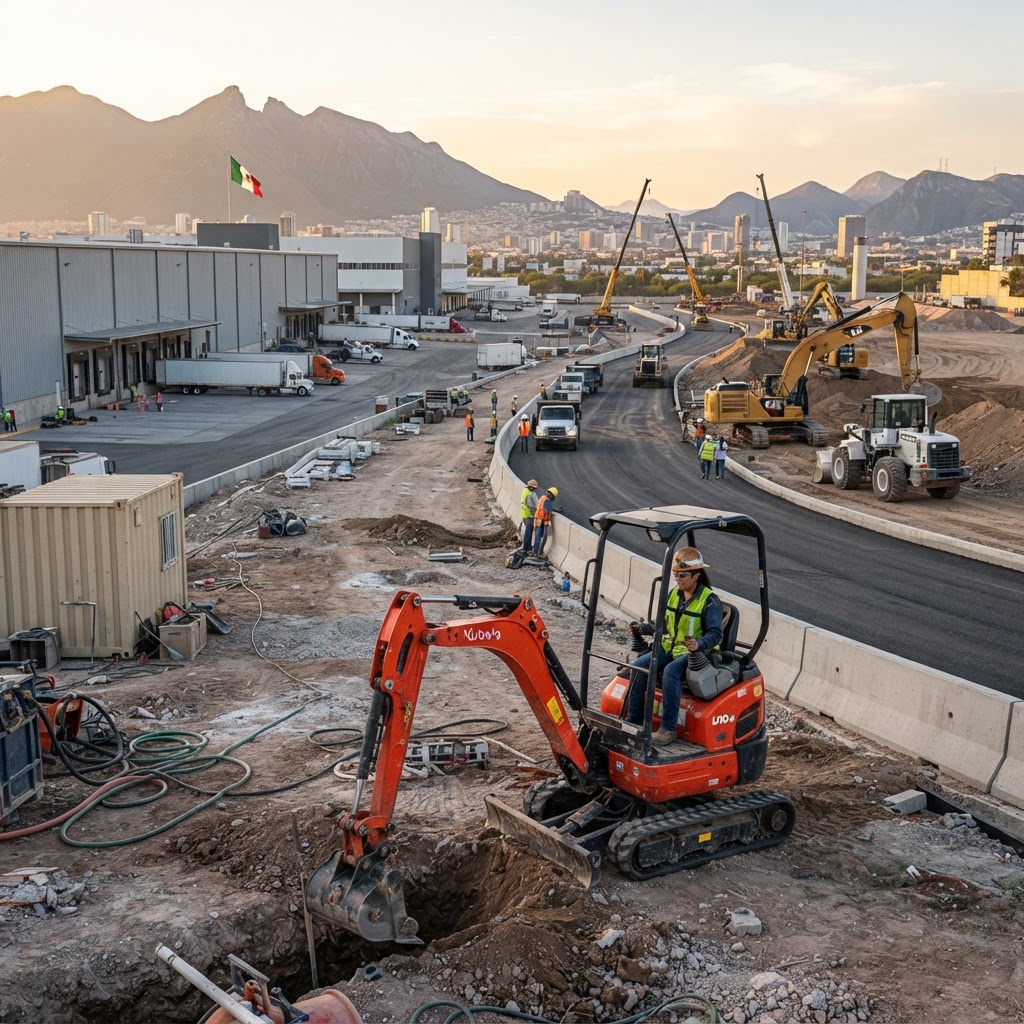
Nearshoring is creating sustained construction activity around factories, logistics parks, warehouses, roads, utilities and supporting housing. The result is a demand profile that extends beyond public works and large civil contractors. Industrial developers and project owners need equipment that can move quickly between constrained sites, operate efficiently and support tight construction schedules.

Urbanization reinforces that trend. Expanding metropolitan areas require transportation links, water systems, power infrastructure and commercial development, while smaller machines become valuable where projects must operate in dense or partially built environments. Compact excavators, loaders, lifts and other lower-footprint equipment can address applications where conventional machines are expensive or difficult to deploy.

For manufacturers, this creates a market with multiple entry points. Large infrastructure and mining projects can support higher-capacity equipment, while urban and industrial work favors maneuverability, fuel efficiency and simpler logistics. Product portfolios that cover both ends of that spectrum will be better positioned than companies relying on a narrow category or a single buyer segment.

Chinese OEMs Gain Leverage, but Support Will Decide Share

The report’s reference to rising Chinese OEM participation is significant because price is only one part of the competitive equation. New entrants can use attractive acquisition costs to open accounts, especially when contractors face financing pressure or need to expand fleets quickly. But the durability of those gains will depend on uptime, parts availability, technician coverage, resale values and the quality of local dealer relationships.

Established brands retain advantages in installed base, customer familiarity and service infrastructure. Those advantages are not permanent. If Chinese manufacturers build credible distribution and support networks, they can convert initial purchases into repeat fleet decisions. Conversely, weak aftermarket execution could limit them to opportunistic sales and prevent deeper penetration among demanding industrial and mining customers.

“Mexico’s next equipment cycle will be decided as much by service capacity and total cost of ownership as by the opening price of the machine.”
Digital Iron Group analysis

Electrification Moves From Pilot Use Toward Practical Deployment

Demand for compact electric machinery is another marker of market maturity. Electric equipment can offer lower noise, reduced local emissions and potentially lower operating costs in urban construction, indoor work and projects subject to environmental restrictions. Its strongest near-term applications are likely to be defined by duty cycle, charging access and utilization rather than broad fleet replacement.

That makes deployment planning critical. Contractors and rental businesses will need to assess charging infrastructure, battery handling, operator training and machine availability before scaling electric fleets. OEMs that provide clear productivity data, battery support and financing options can reduce the adoption barrier. Those that treat electrification as a product launch without field support may struggle to convert interest into volume.

Through 2031, Mexico’s market will reward manufacturers and channel partners that align equipment with specific project economics. Infrastructure and nearshoring provide the demand, but execution in distribution, service, financing and technology will determine who captures the value.

Who This Affects

OEM Impact

OEM channel managers must treat Mexico as a service-and-finance market, not only a volume opportunity. Chinese OEMs can gain initial share through pricing, but weak parts availability or limited technician coverage could cap repeat sales; established OEMs face pressure to defend installed-base loyalty with faster support and more flexible compact and electric offerings.

Dealer Impact

Dealer principals should prepare for a wider brand mix and more demanding support requirements as Chinese manufacturers seek local coverage. Inventory, technician training, financing referrals and used-equipment valuation will become key differentiators, while dealers tied to legacy brands may face margin pressure and customer requests for lower-cost alternatives.

Contractor Impact

Fleet operators and equipment managers will see more purchase and rental options across compact, conventional and electric machines. They will need to compare total cost of ownership, charging access, parts lead times and resale risk rather than relying on acquisition price, especially on urban and industrial projects with strict schedules.

Startup Impact

Series A founders building fleet software, charging services, battery support or equipment-finance tools can target a growing base of mixed-brand machines in Mexico. The second-order opportunity is solving fragmented service and utilization data, but startups will need local operating partners and proof that their products reduce downtime or financing risk.

Dealmaker Impact

PE dealmakers and corporate development teams should track Mexican dealers, rental fleets, component suppliers and service networks as beneficiaries of the market expansion. Valuations will increasingly reflect recurring parts and rental revenue, brand concentration, technician density and exposure to Chinese OEM growth, not just equipment sales volume.

Back to News
Mexicoconstruction equipmentnearshoringChinese OEMselectric equipmentinfrastructuremarket outlook