
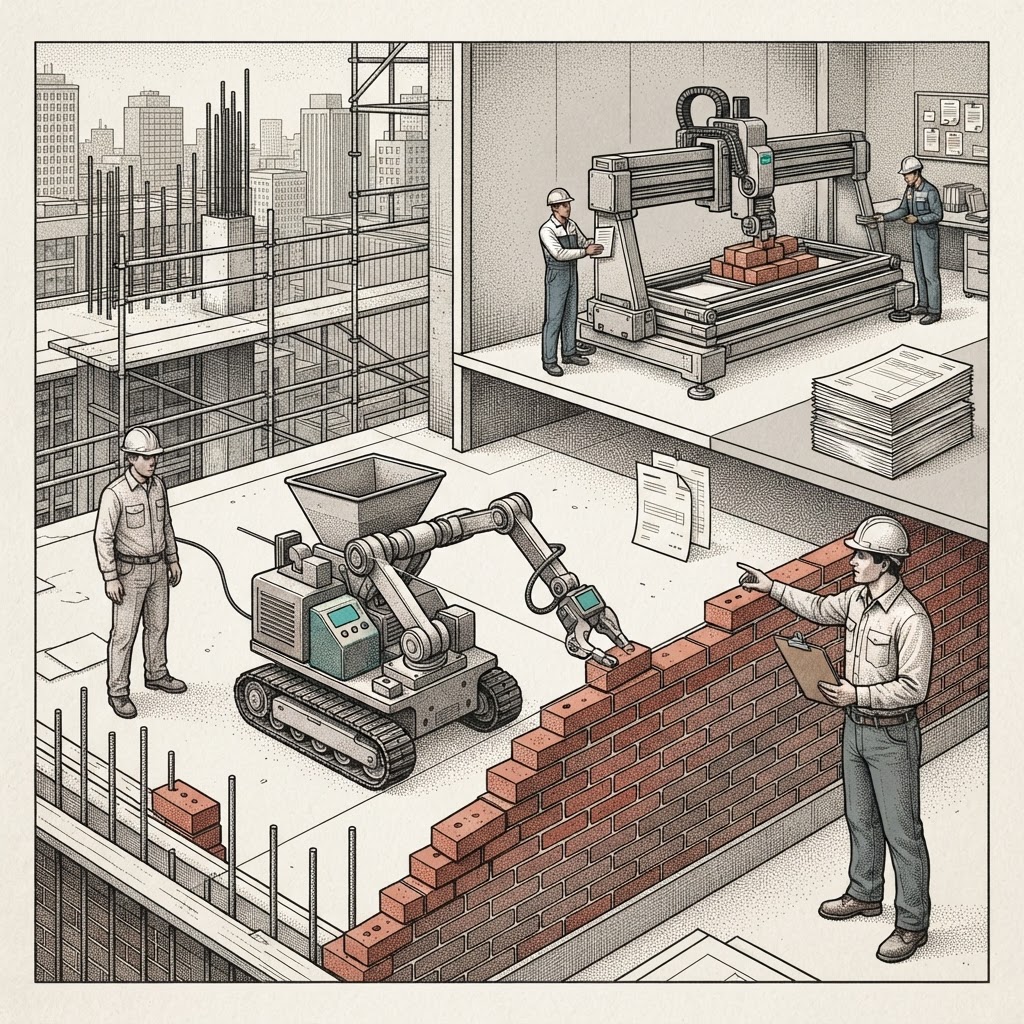
Monumental is expanding its autonomous bricklaying robot service, offering contractors access to the machines on a per-wall basis instead of requiring them to buy equipment. The arrangement moves the initial capital cost away from the builder and toward a service fee tied to work performed, a commercial distinction that could matter as masonry firms contend with labor shortages and uncertain project pipelines.
DIG Analysis — 2026-10-08: The notable development is not only the robot’s ability to lay brick. It is the attempt to sell automation as a jobsite service rather than a piece of equipment. That puts Monumental in the position of financing and deploying machinery while contractors pay for production, though the economics will depend on utilization, price and the reliability of each installation.
A different purchase decision
Contractors evaluating specialized equipment typically weigh the purchase price against expected use, financing costs, maintenance and resale value. A per-wall service can avoid much of that upfront commitment. It may be attractive to a masonry company that has work for a limited period, lacks the balance sheet for a new machine or does not want to assume the risk of owning technology that is still developing.
The model also changes who carries the operating burden. If Monumental supplies and manages the robot, it must keep the equipment working across jobs and find enough projects to cover its investment. Contractors, meanwhile, need to judge the service against the cost and availability of conventional crews, not simply against a machine’s purchase price. A fee that appears manageable on one wall could be less compelling on a larger project if mobilization, site preparation or downtime adds expense.
Equipment World reported the expansion of the service but did not provide a per-wall price, deployment count, productivity benchmark or details on how the fee is calculated. Those omissions make it difficult to compare the offer with labor costs or owned equipment. The service’s appeal will ultimately turn on measurable output and schedule performance, as well as on whether the robot can be used across enough jobs to keep its cost per wall competitive.
Jobsite fit is the test
Monumental says the technology is designed to fit into existing jobsite workflows. That is an important condition for adoption. Masonry work depends on materials arriving in sequence, walls being prepared to specification and crews coordinating around other trades. A robot that can lay brick at speed but requires extensive site changes, specialized support or close supervision may shift labor rather than reduce it.
Construction sites also vary in access, layout and operating conditions. The source material does not specify which tasks remain with human workers, how the system handles irregular conditions or what happens when a project falls behind schedule. Nor does it establish whether the service is available broadly or concentrated in a limited service area. Contractors considering a deployment will need those details before treating the robot as dependable capacity.
“The commercial proposition is access to automated bricklaying without owning the machine.”
Digital Iron Group analysis
That proposition could widen the pool of potential customers. Smaller contractors, which may be unable to justify buying a dedicated machine, could gain access if the service can be scheduled around real project demand. The same structure, however, gives Monumental responsibility for placing equipment where it can earn revenue. Travel between jobs, idle time and the cost of field support can erode the economics on both sides.
The provider’s balance sheet
Equipment ownership gives contractors control but concentrates financial risk on the buyer. A service arrangement reverses part of that equation: the provider must fund the fleet and sustain utilization, while customers pay for access. That can make adoption easier, but it does not remove cost. It relocates it, and makes the service provider’s ability to deploy machines efficiently central to the offer.
Monumental’s expansion signals a broader commercial test for construction automation: whether companies can sell output and availability, rather than hardware alone. The approach has a clear use case where labor is scarce and project volume supports repeat deployments. Its limits will become clearer through actual pricing, utilization and performance data, which the company has not disclosed in the report. For now, contractors are being offered a way to hire the robot by the wall, not a published basis for calculating the savings.