
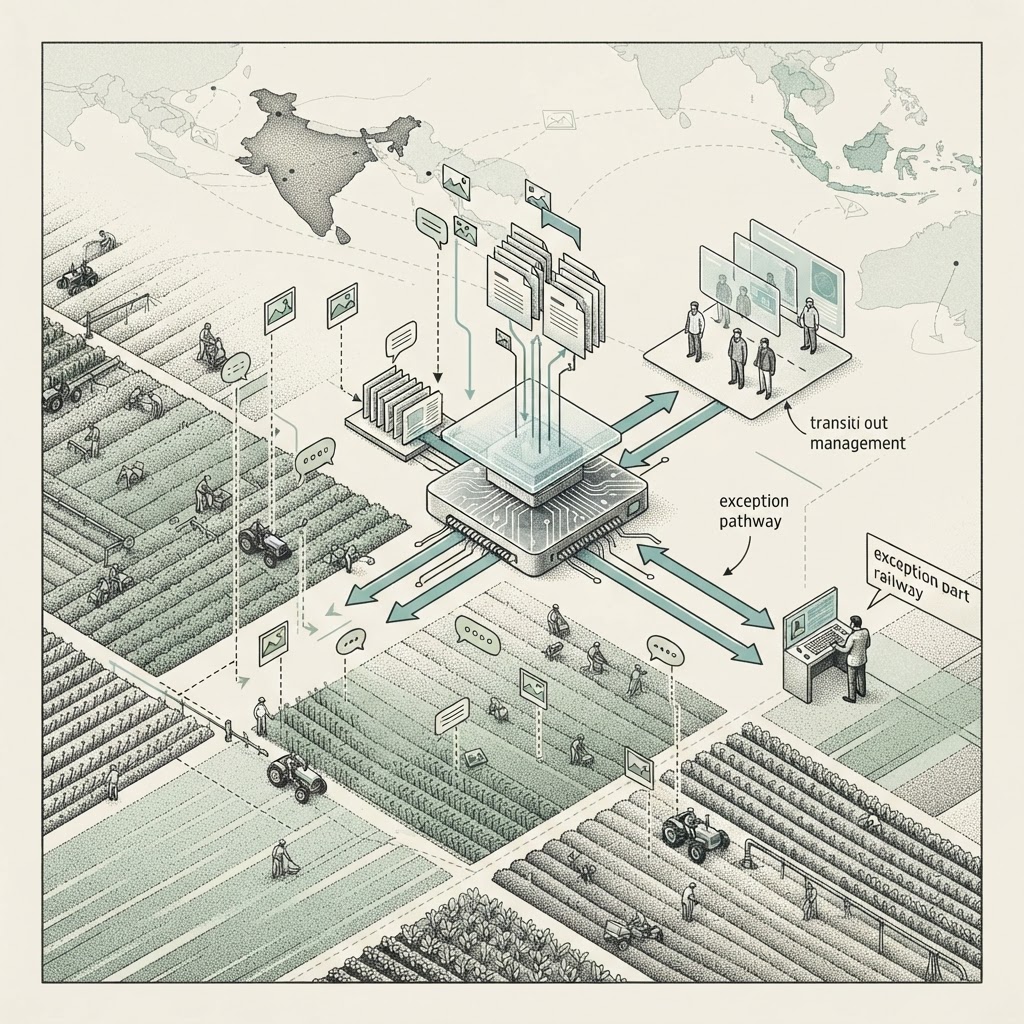
Myca, an India-based startup, has raised $1.3 million in pre-seed funding to build AI agents that turn field reports into operational workflows for large agribusinesses. The round, led by Kriscore Capital with participation from Eximius Ventures and Indigram Labs Foundation, backs a model that could shift some coordination work from human managers to software.
DIG Analysis — 2026-10-08: Myca is targeting a persistent operating cost in agriculture: information arrives from dispersed field teams in messages, calls and photos, while decisions and record-keeping remain centralized. Automating the handoff may reduce delays, but the investment case depends on whether agents can handle exceptions without adding another layer of oversight.
Turning field reports into workflows
According to AgFunderNews, Myca’s platform uses AI agents to convert unstructured field data into structured workflows. The company is aiming at large-scale agribusiness operations, where managers must coordinate activity across farms and communicate with teams that may not use standardized reporting systems.
The product proposition is more operational than conversational. A message or photograph could become a recorded task, a status update or an item requiring escalation. In principle, that could give headquarters a more consistent view of work in progress without requiring every field employee to enter data into a dedicated system.
But the difficult cases are likely to determine whether the software saves money. Field reports can be incomplete, contradictory or shaped by local practices. An agent that misreads a crop condition, misses a delayed input delivery or closes a task prematurely could create costs that outweigh the time saved. Myca’s announcement, as reported, did not disclose customer numbers, deployment results, pricing or the degree of human review built into its workflows.
“The company utilizes AI agents to convert unstructured field data from messages, calls, and photos into structured workflows for large-scale agribusiness operations.”
AgFunderNews, describing Myca’s platform
Replacing a management layer
Myca says it wants to replace traditional manual management layers. That is a consequential claim for businesses whose field operations rely on supervisors to collect updates, resolve exceptions and relay instructions between farm teams and central offices. The software may absorb routine coordination, but it cannot remove the need for accountability when instructions conflict or conditions change.
The commercial test is whether agribusiness customers trust the platform enough to let it assign, track or escalate work, rather than merely summarize incoming information. Adoption may also require integration with existing farm-management tools and clear rules for who can override an agent. Those implementation demands are likely to vary by crop, country and operating model.
Myca’s approach could be attractive where field teams already communicate through familiar channels but headquarters lacks timely, structured data. It could be less compelling where a company has invested in standardized systems, or where local managers provide judgment that cannot be reduced to a workflow. The startup has not said how it will measure the boundary between automating administration and substituting for management decisions.
Funding and expansion
The new capital is intended to support expansion across Southeast Asia, Latin America, Africa and India. Those regions offer a broad addressable market, but they also bring differences in connectivity, language, labor practices and farm organization. A workflow that performs reliably in one setting may need substantial adaptation in another.
For a pre-seed company, the financing is an early vote of confidence rather than evidence of product-market fit. The named investors provide backing, while the next milestones will be operational: paid deployments, repeat usage and proof that customers can reduce coordination costs without losing control of field decisions. Myca has not disclosed its expansion timetable or the amount of capital reserved for each market.
The company is entering a market where software providers have long promised better visibility into farm operations, but data collection and daily use remain difficult. Its distinction is to begin with channels workers already use and let agents organize the resulting information. The announced expansion will test whether that design can travel beyond its home market.