
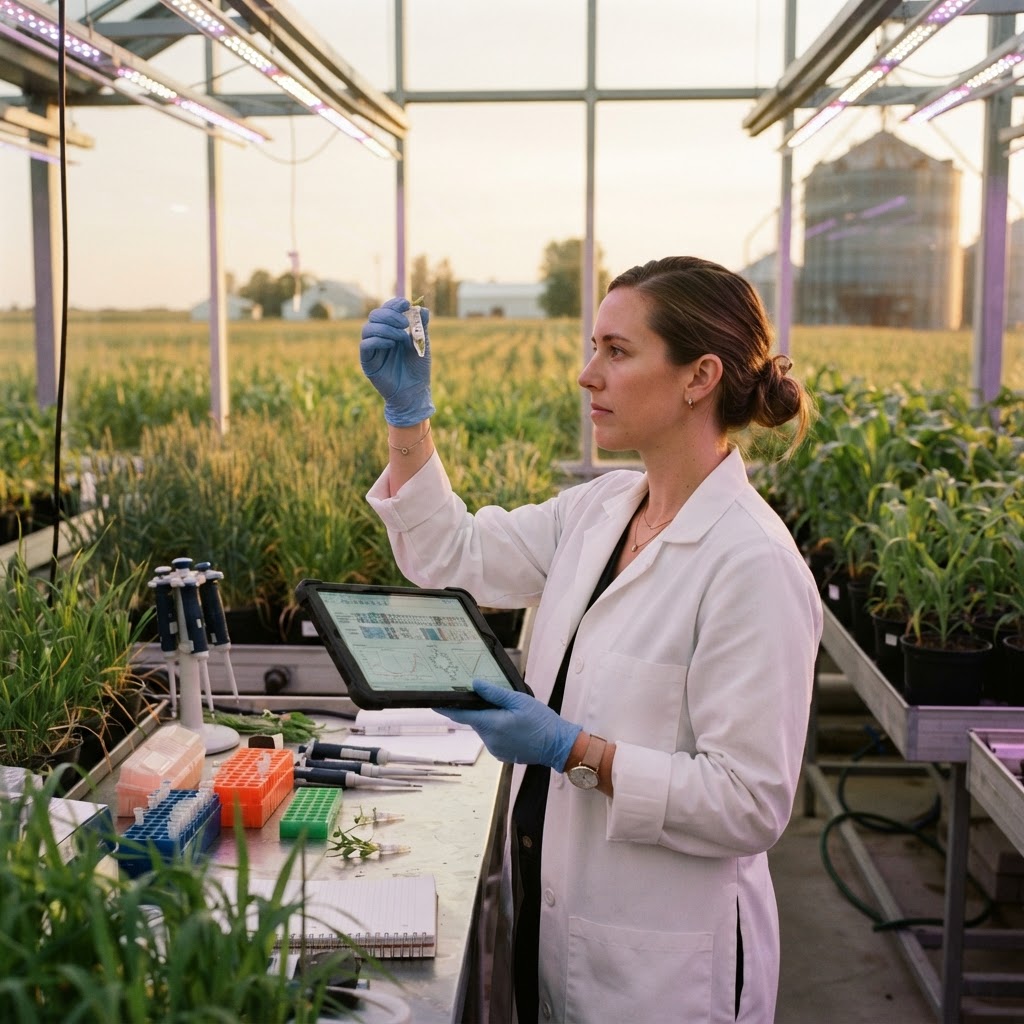
Quercus Biosolutions announced an oversubscribed $5 million seed round on July 29, 2026 to advance a platform that designs short, AI-generated proteins intended to suppress or control herbicide-resistant weeds. The financing, led by Serra Ventures with participation from Flyover Capital and the Iowa Corn Opportunities Fund and reported by AgFunderNews, underwrites a rapid experiment cycle that moves candidate molecules from computational design straight into greenhouse testing.
DIG Analysis — 2026-07-30: This raise signals investor willingness to pay for speed and precision in agricultural biology. Quercus is betting that smaller, engineered proteins can be discovered and validated far faster and cheaper than traditional biologicals, and early backers are validating that timing and cost matter to ag supply chains facing accelerating resistance issues.
What happened
Quercus uses generative artificial intelligence to design compact protein sequences that the company calls mini proteins. These are not full size enzymes or microorganisms. They are short chains engineered to bind specific targets in plant physiology. The startup says its platform iterates computational design, synthesis and greenhouse validation on a compressed timeline, shortening the discovery loop that has historically stretched for years and required large R and D budgets.
The seed round closed with lead investor Rob Schultz at Serra Ventures, plus Flyover Capital, the Iowa Corn Opportunities Fund, Rootstock Capital and Starshot Capital in the cap table. According to AgFunderNews, Schultz highlighted that the approach addresses prior investor concerns about cost and pace when bringing new biology into agriculture. The company will use proceeds to expand design throughput and scale validation pipelines.
"The core issue in ag biology has been the time and cost to find useful molecules. Quercus is making that timeline measurable and repeatable." Rob Schultz, Serra Ventures
Why it matters
Herbicide resistance has been rising globally and is a practical constraint on yield for row crop farmers. Chemical options are thinning as weeds evolve and regulatory pressures tighten. Biological approaches have seen growing interest as an alternative or complement, but adoption stalled when discovery costs and timelines were long and outcomes uncertain.
Quercus addresses that equation by focusing on small, designable proteins that can be iteratively optimized in silico and then synthesized and tested at scale. If the company can reliably convert computational candidates into greenhouse-validated activity, agricultural input companies will have a faster source of novel modes of action to pair with chemistry or to use in integrated weed management packages.
Market pathways and near-term obstacles
Near term the company needs to prove two things: repeatable efficacy across multiple weed targets and a regulatory pathway that keeps development time and cost manageable. Biologicals face distinct registration and manufacturing challenges compared with small molecules. Mini proteins lie between biologics and chemistry, which could complicate regulatory classification but could also offer a faster route if the molecules avoid traits that trigger high regulatory hurdles.
Commercial traction will likely come first through partnerships. Seed and crop protection firms that want to hedge against resistance will be natural collaborators. The other likely route is licensing assets for integration with existing herbicide programs where a novel binding protein can restore or extend the life of current chemistries. Investors who backed Quercus are effectively betting on partnership deals and outlicensing milestones rather than near-term direct sales.
Reporting by AgFunderNews provided the foundation for the fundraising details. For farm-level impact, adoption will depend on cost parity with chemical options, clear modes of action, and straightforward delivery methods compatible with planter, sprayer and seed treatments. Quercus has closed a seed round that buys it time to answer those operational and regulatory questions. The next 12 to 24 months of greenhouse and field validation will determine whether AI-designed mini proteins move from proof of concept to deployable tools for resistant weeds.