
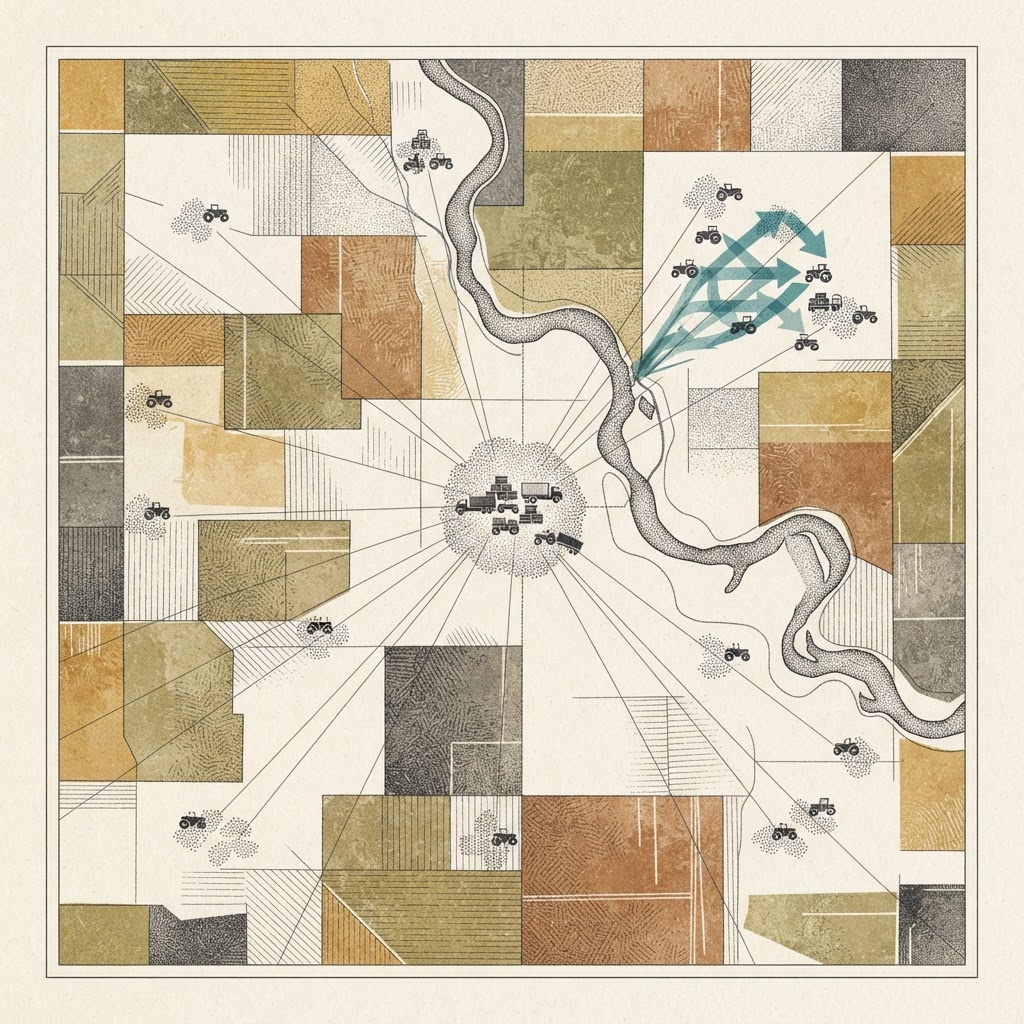
RDO Equipment Co. has agreed to acquire True North Equipment’s John Deere agricultural dealership locations in northern North Dakota and northwestern Minnesota, extending its reach across a region where farm equipment support is part of the production infrastructure. The agreement shifts dealership assets between two established operators, with consequences for service coverage and parts access that will depend on how the locations are integrated.
DIG Analysis — 2026-10-31: This is a regional consolidation, not evidence on its own of a broader acquisition wave. RDO gains additional positions in the Red River Valley, while True North exits the specified John Deere agricultural locations. The strategic case rests on whether a larger network can improve service availability without weakening local responsiveness. The companies have not disclosed the purchase price, closing date, affected locations or staffing plans.
Scale in a concentrated market
The Red River Valley, spanning eastern North Dakota and northwestern Minnesota, is one of North America’s most productive agricultural areas. Equipment dealers in such markets compete on more than machine sales: parts inventories, technicians and the ability to respond during narrow planting and harvest windows all shape customer choice. A dealership’s value therefore depends on local execution as much as the brand on its signs.
RDO’s acquisition would add locations to an existing regional presence and could allow the company to coordinate inventory and service resources across a broader territory. Greater scale can help a dealer stock a wider range of parts or assign technicians across nearby branches. Those benefits are not automatic. If consolidation changes staffing, inventory placement or decision-making, farmers may experience longer waits even when the buyer has more total resources.
Farm Equipment reported the agreement in its coverage of dealer transactions. The available announcement describes a definitive agreement for True North’s John Deere agricultural locations, but does not specify whether the transaction includes other business lines, real estate or support operations. Nor does it detail any planned changes to the locations’ names or customer arrangements.
What remains undisclosed
The absence of financial terms makes it difficult to assess how RDO valued the business or what returns it expects. The agreement also leaves open the practical questions that matter to customers and employees: when ownership changes, whether existing service teams remain in place, and how parts distribution will be organized. Those details will determine whether the transaction produces a denser service network or simply a larger ownership footprint.
For True North, the sale narrows its John Deere agricultural presence in the named areas, though the company’s broader operations and rationale for the transaction have not been described in the reported information. The move could reflect portfolio priorities, succession or a decision to concentrate capital elsewhere. Without a statement explaining the sale, those possibilities remain unconfirmed.