

The White House is preparing an executive order that would expand the availability and use of red-dyed diesel, seeking relief from high fuel costs without directly changing the supply of diesel in the market. The proposed directive would ask the Treasury Department to review diesel taxes, encourage states to waive selected fuel levies and establish a policy of non-enforcement of current limits on dyed-fuel use.
DIG Analysis — 2026-10-05: The proposal targets the tax and enforcement framework around diesel, not the physical supply imbalance driving prices. Because dyed diesel is chemically identical to standard diesel, wider access could shift who pays which taxes and which rules are enforced, but it would not itself increase refinery output, imports or available inventories.
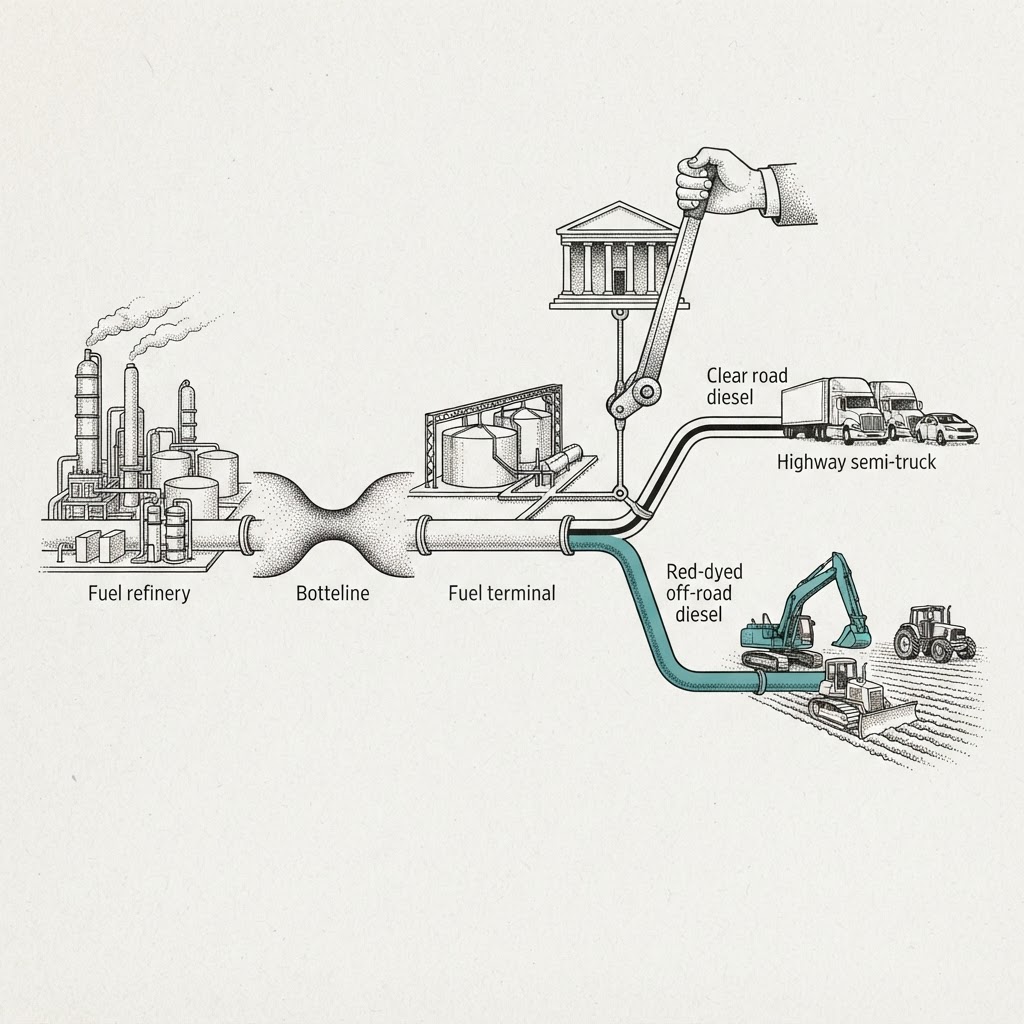
A tax and enforcement lever, not a supply fix
Red-dyed diesel is generally used in off-road applications such as farming and construction. Its dye identifies fuel that is typically exempt from certain road-use taxes, and regulations limit its use in vehicles operating on public roads. The planned order would put those rules under pressure by signaling non-enforcement while directing federal officials to examine tax treatment.
That distinction matters. If the fuel itself is not different, expanding its permitted use does not create a separate, cheaper source of energy. Any near-term savings would depend on tax changes, state decisions and how distributors and buyers respond. A federal request that states waive levies is not the same as a uniform national reduction; state governments would have to decide whether to act and how to administer relief.
The order could also leave practical questions for fuel sellers and buyers. A non-enforcement policy may reduce the immediate risk of penalties, but it does not necessarily rewrite state statutes or federal tax rules. Until the details are published, businesses would need to distinguish a change in enforcement posture from a formal change in legal obligations. That uncertainty can complicate purchasing, recordkeeping and compliance decisions precisely when fuel budgets are under strain.
Why the market response may be limited
Analysts cited in POLITICO’s report are skeptical that the measure can bring down market prices, pointing to the mismatch between the proposal and the cause of high costs. Diesel prices reflect the balance of supply and demand, alongside crude prices, refining capacity, logistics and inventories. Tax relief can lower the total cost borne by a buyer, but it does not resolve a shortage or rebalance the wholesale market.
Even the savings from a tax change would vary. The value would depend on which levies are waived, where a buyer operates and whether relief reaches the purchaser rather than being absorbed elsewhere in the supply chain. A patchwork of state responses could produce different effective costs across neighboring jurisdictions, complicating fuel procurement for companies that run equipment across state lines.
“The tax-relief measure does not address the underlying supply imbalances driving market prices.”
Source: POLITICO reporting and analyst assessment
The proposal’s political and economic effect will therefore depend less on the headline promise of broader red-diesel use than on the language of the order and the follow-through. Treasury’s review could clarify the federal tax position, while state decisions would determine whether proposed levy relief becomes real savings. Neither step, on its own, guarantees more diesel at the rack.
What to watch next
For the equipment and agriculture markets, the immediate questions are operational: whether the order is issued as described, how broadly non-enforcement applies, and whether states take up the call to waive fuel taxes. Businesses will also need clarity on documentation and eligibility before treating dyed fuel as interchangeable in their purchasing plans, even if the fuel is chemically identical.
The larger test is whether the administration pairs tax relief with measures that affect supply. Without changes that increase available volumes or ease constraints in refining and distribution, the policy is more likely to alter the bill at the point of purchase than the underlying market price. That could offer targeted breathing room, but it should not be mistaken for a durable answer to high diesel costs.