
Markets
CATCaterpillar$510.45-5.01%•
DEDeere & Co.$609.25-2.50%•
CNHCNH Industrial$10.74-2.98%•
AGCOAGCO Corp.$100.93-1.91%•
URIUnited Rentals$973.43-8.13%•
ALTGAlta Equipment$4.33-8.46%•
TTCToro Company$100.82-1.70%•
HRIHerc Holdings$133.55-11.54%•
MGRCMcGrath RentCorp$113.45-6.38%•
MTWManitowoc$20.31-5.58%•

Scag Targets the Last 35.5 Inches of the Jobsite

Jon RossiJon RossiFounder & Editor-in-Chief September 20, 2026 3 min read

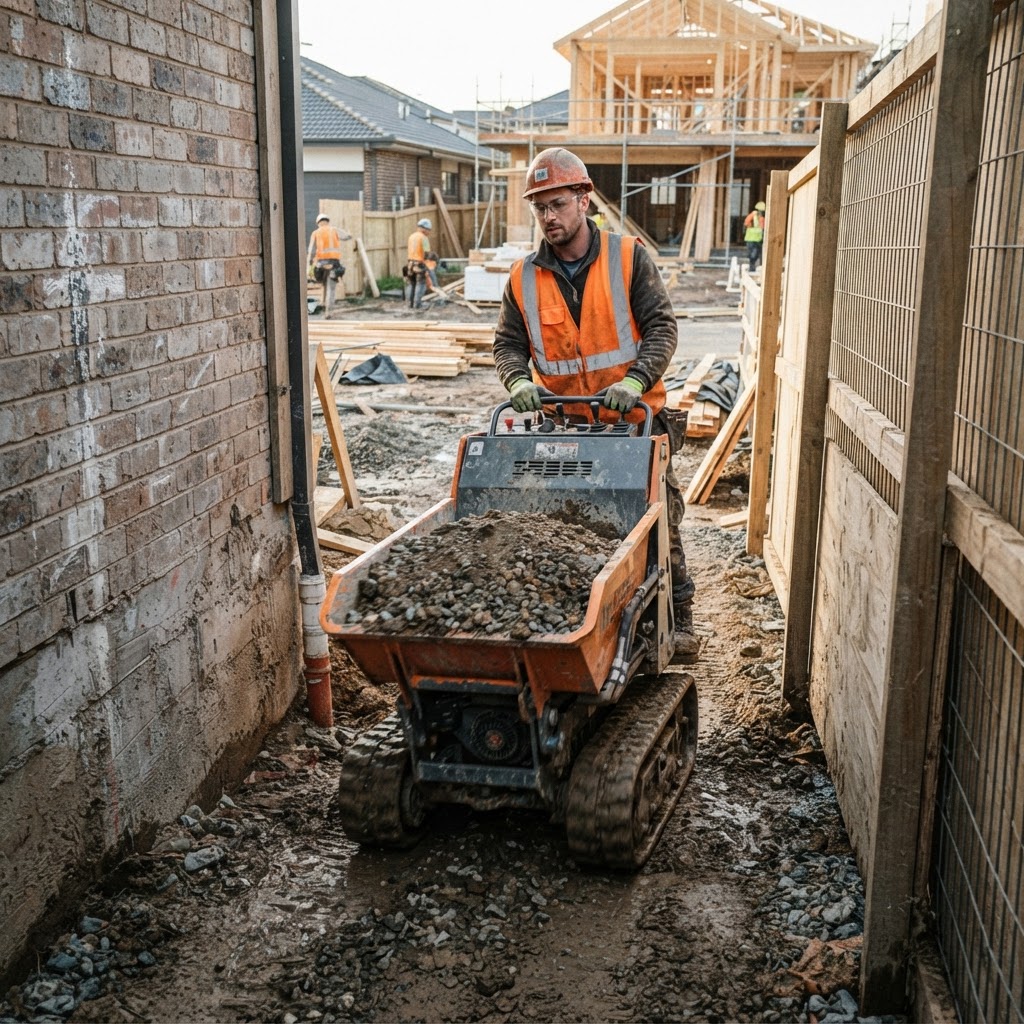
Scag’s 2500X tracked power buggy brings 2,500-pound hauling capacity into access-constrained work areas. The launch highlights a practical equipment gap: moving more material without bringing in a full-size machine.

Scag Targets the Last 35.5 Inches of the Jobsite

Scag is moving deeper into compact material handling with the 2500X tracked power buggy, a 35.5-inch-wide machine built to carry up to 2,500 pounds where conventional equipment cannot easily fit. The launch, reported by Equipment World, addresses a familiar jobsite constraint: contractors often need meaningful hauling capacity in spaces defined by narrow gates, tight corridors, landscaping, renovation work, and urban access limits.

DIG Analysis — 2026-09-20: The 2500X is less about adding another small machine to a crowded category than about targeting the cost of restricted access. A power buggy that can enter areas closed to wider compact loaders or site dumpers may reduce hand labor, shorten material moves, and limit the need to dismantle fencing, remove gates, or reposition larger equipment.

Capacity Without the Width Penalty

The central specification is the relationship between footprint and payload. At 35.5 inches wide, the 2500X is positioned for routes that routinely exclude standard compact equipment. Its 2,500-pound carrying capacity gives contractors a materially different option from wheelbarrows, carts, and smaller walk-behind carriers, particularly when the work involves aggregate, soil, demolition debris, concrete, or landscaping materials.

That combination matters because access problems are rarely isolated to one task. A narrow entry can affect excavation, backfill, slab preparation, drainage installation, and cleanup. If crews can use one tracked carrier across those phases, the value comes from fewer manual transfers and less dependence on temporary access work. The machine’s tracked configuration should also support travel over uneven or soft ground, although productivity will still depend on surface conditions, slope, loading practice, and site layout.

“The 2500X is aimed at the point where material still needs to move efficiently, but the jobsite does not have room for a conventional machine.”

Why Contractors Will Measure It by Labor Saved

For contractors, the relevant comparison is not simply purchase price against another buggy. It is the total cost of moving material through a constrained site. A narrow carrier can change crew allocation by keeping skilled workers on installation tasks instead of assigning them to repeated manual hauling. It can also reduce exposure to lifting and carrying demands, an increasingly important consideration as contractors manage labor shortages, injury risk, and schedule pressure.

The strongest applications are likely to be specialty and project-specific: residential construction, hardscaping, utility work, demolition, basement access, municipal repairs, and interior or backyard renovation projects. In these settings, transport distance and access geometry can determine whether mechanization pays back quickly. Contractors will need to verify payload requirements, loading height, turning space, ramp access, and transport arrangements before treating the machine as a universal replacement for larger site equipment.

A Compact Category With Practical Commercial Stakes

Scag’s move also places greater attention on the compact power buggy segment. Buyers are likely to compare the 2500X against narrower dumpers and established tracked carriers on uptime, controls, service access, ground pressure, operator visibility, attachment or bed configuration, and resale value. A machine can meet the width requirement and still underperform if loading, unloading, or routine maintenance slows the crew.

For Scag, the launch extends its relevance from turf and outdoor power equipment into a construction use case where dealer support and application guidance will matter. The sales opportunity will depend on showing contractors exactly where the machine fits into existing workflows. Demonstrations at active jobsites may be more persuasive than static specifications, especially for buyers deciding whether reduced manual handling justifies another equipment payment.

The 2500X arrives at a clear operational pressure point. Jobsites are getting more constrained, while customers still expect faster completion and tighter control of labor. A 35.5-inch machine carrying 2,500 pounds does not eliminate those pressures, but it gives contractors another way to attack one of the most expensive bottlenecks: getting material from the delivery point to the work area.

Who This Affects

OEM Impact

Scag product managers and OEM channel managers will need to define the 2500X by application, not just payload and width, with demonstrations that prove labor savings in constrained work. The launch also raises service-parts, operator-training, and resale-value expectations as Scag expands beyond its traditional outdoor power customer base.

Dealer Impact

Dealer principals and compact-equipment sales managers gain a product for contractors who cannot justify or physically place a larger dumper. Second-order effects include the need for tighter jobsite qualification, rental-fleet utilization tracking, and technician readiness for tracked material-handling equipment.

Contractor Impact

Fleet operators, landscape contractors, sitework firms, and residential builders can reduce manual hauling where access is narrower than conventional equipment allows. They will still need to calculate loading height, route width, ground conditions, transport cost, and whether utilization is high enough to support ownership rather than rental.

Startup Impact

Series A founders building compact-jobsite logistics, operator-assist, or fleet-utilization software may find a larger addressable base of narrow material carriers. The second-order opportunity is data capture around payload cycles, route productivity, maintenance intervals, and labor avoided, but hardware integration and fragmented dealer channels remain barriers.

Dealmaker Impact

PE dealmakers and equipment-focused investors should treat the launch as a signal that compact material handling is competing on labor efficiency and access, not only machine volume. Acquisition diligence should examine dealer coverage, recurring parts revenue, rental penetration, customer concentration, and whether new product sales can expand beyond Scag’s established channel.

Back to News
Scagpower buggycompact equipmentmaterial handlingtracked equipmentjobsite access