
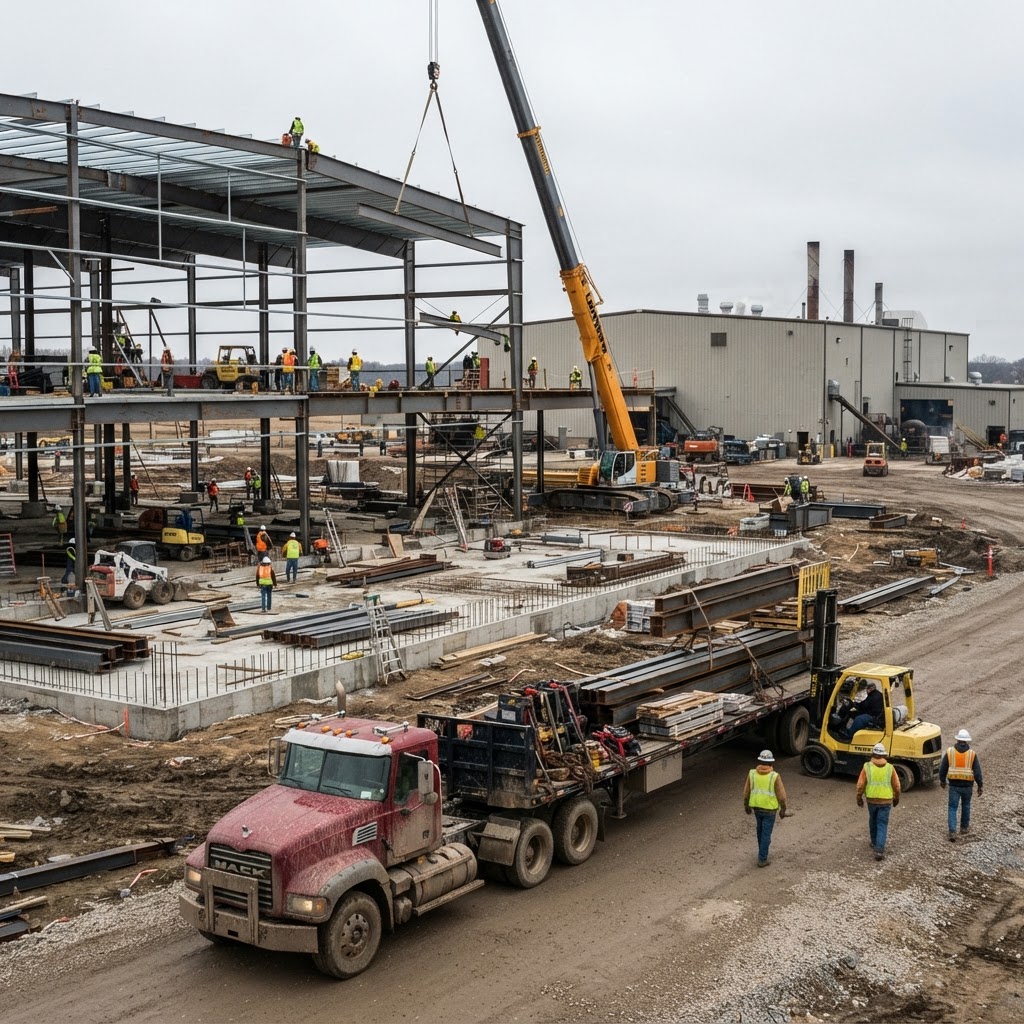
Schutt Industries has broken ground on a 90,600-square-foot expansion in Clintonville, Wisconsin, marking a substantial capacity investment by a manufacturer serving severe-duty trailer, cargo-handling, military, and commercial markets. Alliance Construction & Design is leading the construction, according to The Business News. The project places industrial construction activity directly alongside continued demand for equipment built to operate under demanding payload, terrain, and mission requirements.
DIG Analysis — 2026-09-17: The significance is not simply the size of the building. Schutt’s expansion points to a manufacturing strategy built around more throughput, greater integration capacity, and room to support specialized orders that cannot be handled efficiently in a constrained footprint. In heavy equipment, that kind of investment often reflects a backlog that management expects to persist, not a short-term increase in shipments.
Capacity Is the Core Signal
Schutt operates across several product categories that require more than conventional assembly. Severe-duty trailers and cargo-handling systems must be engineered around payload, durability, hydraulics, mounting interfaces, and field-service requirements. Military applications add another layer of qualification, documentation, configuration control, and delivery discipline. A larger facility can allow the company to separate fabrication, assembly, finishing, testing, and integration work while reducing bottlenecks between stages.
That matters because specialized manufacturers are often constrained by floor space before they are constrained by market demand. Crowded production areas increase material movement, limit work-in-process visibility, and make it harder to add tooling or parallel production cells. The new building should give Schutt more options to organize production around product families and customer requirements rather than forcing every order through the same limited sequence.
“The expansion is a physical commitment to supporting the next phase of Schutt Industries’ manufacturing and integration work.”
Alliance’s Role Extends Beyond the Building Shell
For Alliance Construction & Design, the project is a meaningful industrial assignment in a market where construction performance is measured against operational readiness. The contractor’s work will need to coordinate building systems, production utilities, material flow, safety requirements, and the realities of an active manufacturing operation. A facility can be delivered on schedule and still fall short if equipment placement, service access, loading patterns, or future expansion provisions are poorly resolved.
Industrial projects of this type also carry a different risk profile from ordinary commercial construction. Long-lead electrical equipment, structural steel, specialized ventilation, concrete sequencing, and site logistics can all affect the date when production can begin. Coordination between the contractor, Schutt’s plant leadership, equipment vendors, and engineering teams will be central to converting square footage into usable capacity.
What the Project Says About the Market
The expansion reinforces a broader pattern in heavy equipment support manufacturing: investment is flowing toward companies that build the trailers, handling systems, attachments, and integrated platforms required by defense, infrastructure, logistics, and commercial operators. These products may not carry the same visibility as a complete machine, but they are essential to moving, loading, protecting, and deploying equipment in the field.
Schutt’s mix of military and commercial work also provides some diversification across end markets. Defense-related programs can involve extended qualification cycles and procurement timing, while commercial customers may respond more quickly to fleet replacement, freight, construction, or specialized hauling demand. Additional capacity will help the company pursue both channels, provided it can maintain quality control and manage the engineering variation that comes with custom work.
The next indicators will be practical: construction milestones, hiring, supplier activity, production-line commissioning, and evidence of new program awards. If those signals follow the groundbreaking, the Clintonville project will represent more than a local construction event. It will be evidence that specialized equipment manufacturing continues to justify long-lived investments in American production capacity.