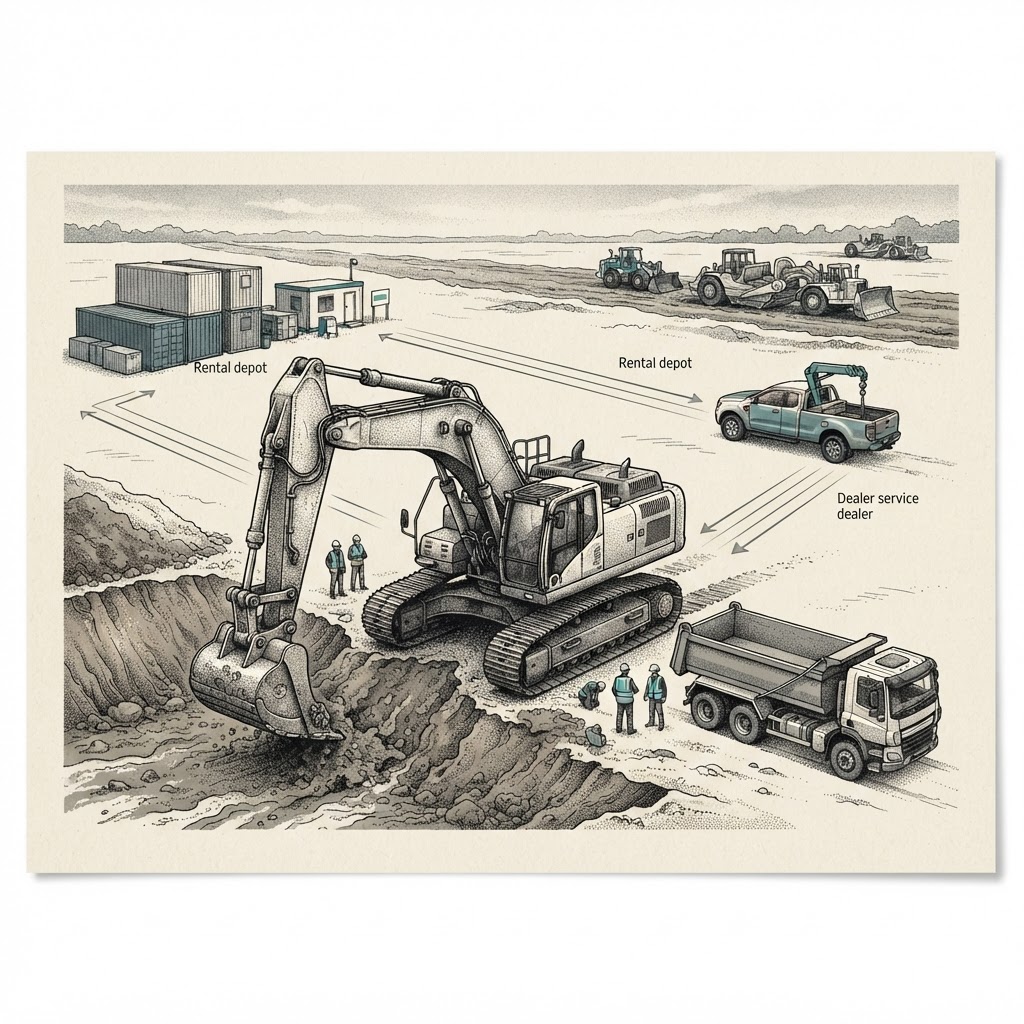
Stevens Equipment Rental has taken delivery of its first Caterpillar 374, a 75-tonne excavator supplied by Finning UK & Ireland. The purchase gives the rental company a higher-capacity option as it continues to renew and expand its fleet, though the economics will depend on utilization and customer demand.
Stevens Equipment Rental has added its first 75-tonne excavator, a Caterpillar 374 supplied by Finning UK & Ireland, extending the company’s capacity at the upper end of the UK rental market. The purchase is a visible step in a broader fleet renewal and expansion, but the company has not disclosed the machine’s price, financing terms or expected utilization.
DIG Analysis — 2026-11-17: The 374 gives Stevens access to larger excavation work without requiring customers to own equipment that may be needed only intermittently. For the rental firm, however, a machine of this scale concentrates more capital in a single asset. Its return will depend on winning enough suitable work and moving the excavator efficiently between sites.
A higher capacity tier
The 75-tonne machine represents a substantial increase in capacity for Stevens, whose latest investment follows a period of fleet renewal and expansion. International Rental News reported the purchase and identified Finning UK & Ireland as the supplying dealer. The announcement did not specify when the excavator entered service or which projects will use it first.
Large excavators are typically deployed where earthmoving volumes, reach or cycle times make smaller machines less productive. A rental fleet with a 374 can therefore bid for work that would otherwise require a larger supplier or a contractor-owned machine. That expands the range of jobs Stevens can serve, while leaving the business exposed to the uneven schedules of major construction projects.
Capacity alone does not establish demand. A 75-tonne excavator needs appropriate haulage, operators and site access, and it may require more planning than a mid-size machine. If customers seek high-capacity equipment only for short or sporadic periods, the rental company must account for idle time, transport and maintenance against the revenue earned while the machine is working.
“The 75-tonne machine represents a significant upgrade in capacity for the rental firm.”
International Rental News, reporting on Stevens Equipment Rental’s purchase
The dealer’s role
Finning’s involvement places the dealer at the point where a major equipment investment becomes an operating asset. Supply is only one part of that relationship. For a large excavator, support can include parts availability, field service and technical assistance, all of which affect how quickly a rental fleet can return a machine to work after a fault.
The purchase also illustrates how dealers can benefit when rental companies add capacity rather than rely solely on replacement cycles. But a delivery is not evidence of a broader order pipeline, nor does the report identify any service agreement or other terms between Finning and Stevens. The value of the relationship will be tested over the machine’s working life, particularly if utilization is high and downtime costly.
For Caterpillar, the order is a placement of a large excavator in a rental fleet, where the machine can be exposed to multiple customers and operating conditions. That can broaden product visibility, but rental use may also mean more frequent changes in operators and duty cycles. The report did not provide specifications beyond the model and stated weight class, or say whether Stevens plans further purchases in the same category.
Utilization is the test
The central commercial question is whether demand for high-capacity equipment is strong and predictable enough to support the added capital. Stevens is responding to what it describes as rising demand in the UK construction market, but no order book, utilization forecast or rental rate was disclosed. Those omissions make it difficult to judge how quickly the investment could pay back.
Fleet expansion can strengthen a rental company’s offering and reduce reliance on a narrow set of machine classes. It can also increase exposure to project delays, seasonal pauses and shifts in construction spending. The 374’s economics will depend less on its headline capacity than on the number of productive days it records, the cost of keeping it ready and the resale value it retains.
For now, Stevens has established a new upper tier in its fleet with its first Caterpillar 374, supplied by Finning UK & Ireland. Whether that becomes a platform for additional heavy excavators remains unstated.