
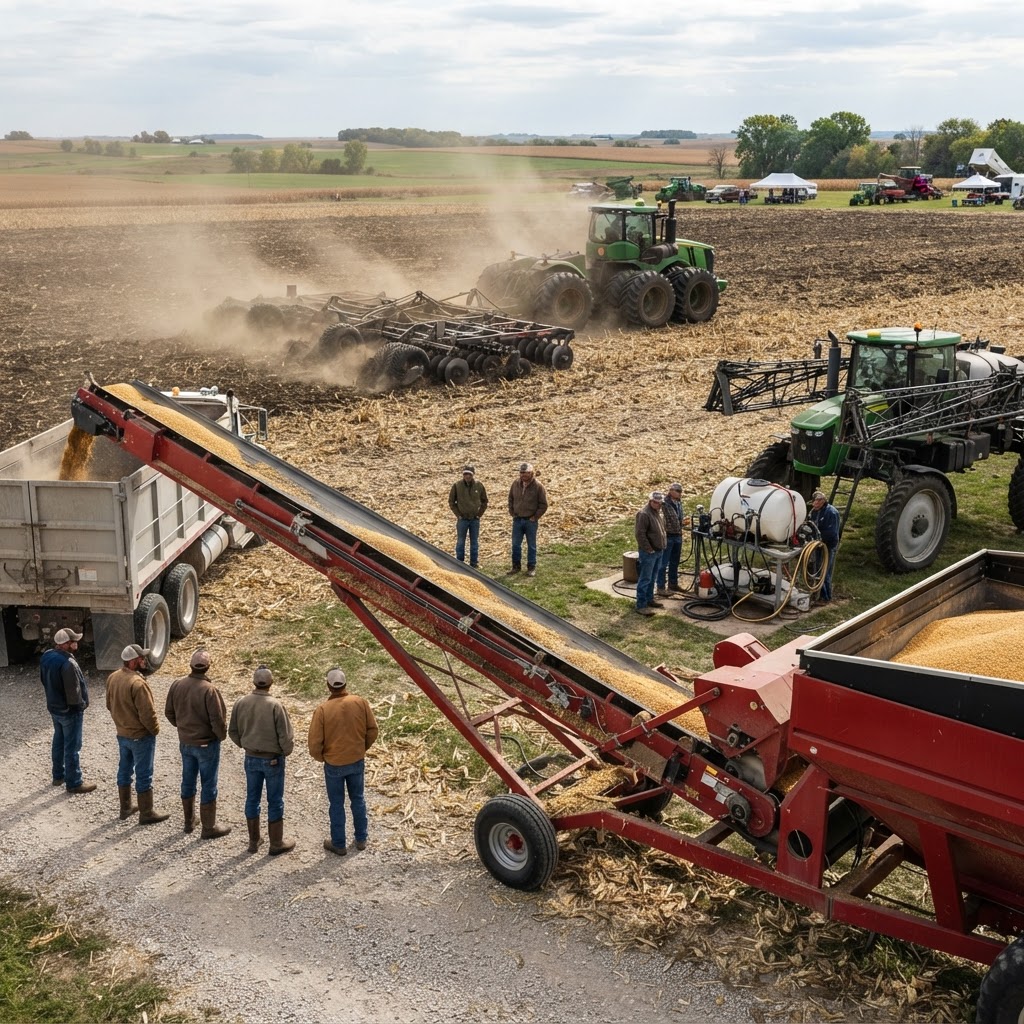
Summers Manufacturing used the 2026 Farm Progress Show in Boone, Iowa, to put a broad but tightly focused product message in front of farmers and equipment professionals: move grain more efficiently, fill sprayers faster and manage difficult tillage conditions with greater control. The company showcased its new 1648 Field Belt conveyor and two additions to the Spray Fill Xpress line, then backed the launch with live demonstrations of the Elite Chisel Samurai, Disk Ripper and Renegade VRT.
DIG Analysis — 2026-09-17: Summers is not presenting a single headline machine. It is expanding around several recurring operating constraints that directly affect field hours, labor utilization and timeliness. The significance is less about product count than about how the equipment addresses separate stages of a farm’s grain-handling, spraying and tillage workflow.
Conveying capacity becomes a labor and timing issue
The 1648 Field Belt is aimed at grain movement, where bottlenecks often appear between storage, loading and transport rather than in the combine itself. A conveyor that can handle demanding transfer work gives operators another option when augers create excessive wear, require more repositioning or limit loading flexibility.
For producers, the buying question will center on throughput in actual operating conditions, setup time and compatibility with existing bins, trucks and handling equipment. Dealers will also need to explain where the Field Belt fits against competing conveyors and augers, especially for farms balancing seasonal capacity with limited labor. The product’s commercial opportunity will depend on clear specifications, field support and a service plan that keeps grain moving during narrow harvest windows.
Spray Fill Xpress additions target application readiness
Summers also introduced two new models for the Spray Fill Xpress line. The focus is the fill stage, a part of spraying that can consume valuable time through repeated water and chemical handling, long travel distances or inefficient staging. Faster and more controlled filling can improve daily machine utilization, but only if the equipment fits the operator’s tendering process and site layout.
That makes model selection important. Operators will likely compare capacity, pump performance, connection requirements, portability and cleanout procedures rather than treating the new models as interchangeable upgrades. For custom applicators, a fill system can affect how many acres a sprayer reaches in a day and how consistently crews maintain application schedules. The practical test will be whether the equipment reduces idle time without adding complexity, maintenance points or training demands.