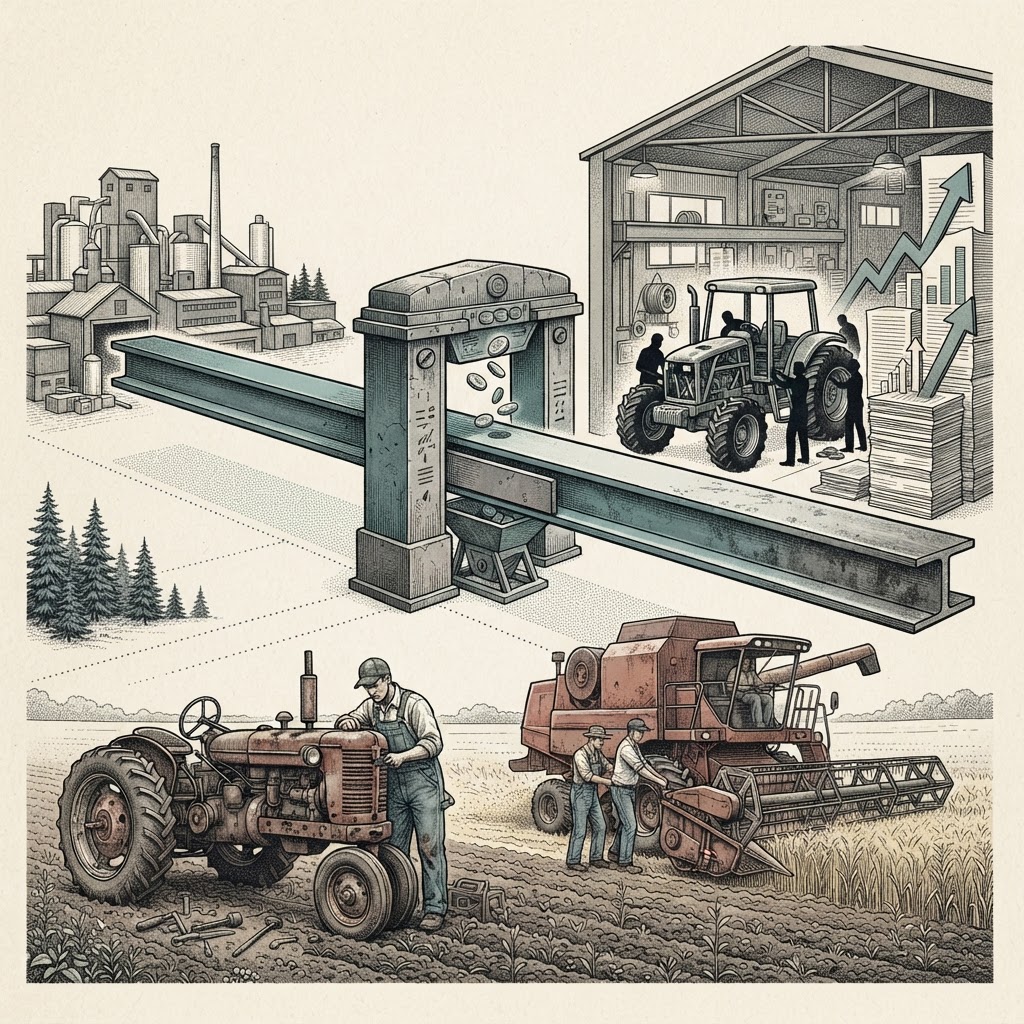
Retaliatory duties on steel, aluminum and iron could raise input costs for U.S. agricultural equipment manufacturers already facing cautious farm spending. The size and timing of any increase remain uncertain, but the dispute adds another reason for farmers to defer purchases.
A new trade dispute between the United States and Canada threatens to raise the cost of materials used in agricultural equipment, adding pressure to manufacturers as farmers hold back on purchases. Retaliatory tariffs of 50 percent on steel, aluminum and iron could increase expenses for companies including John Deere, though the effect will depend on sourcing, contract terms and how long the duties remain in place.
DIG Analysis — 2026-10-08: The immediate risk is not simply a higher invoice for metal. If manufacturers cannot absorb added costs or pass them through without weakening demand, tariff exposure could squeeze margins on equipment sold into a market where customers are already extending replacement cycles.
Costs meet weaker demand
Brownfield Ag News reported that the trade measures could lift production costs for agricultural equipment makers. The duties target basic industrial inputs that move through multiple stages of manufacturing, from fabricated components to finished machinery. That makes the ultimate impact difficult to calculate from the tariff rate alone: a manufacturer’s exposure depends on where its materials and parts originate, how suppliers price them, and whether existing inventory was purchased before the measures took effect.
The cost threat arrives at an awkward point in the farm-equipment cycle. Economists cited by Brownfield said manufacturers such as John Deere are already contending with reduced farmer investment and high material costs. Farmers’ willingness to spend is shaped by more than equipment prices, including crop receipts, financing costs and expectations for future income. Higher input costs could therefore meet a customer base with limited appetite for absorbing another increase.
John Deere’s position illustrates the two-sided pressure facing manufacturers. If it absorbs some of the tariff-related expense, profitability may come under strain. If it raises prices, buyers may postpone orders, particularly for machines that can be kept in service with maintenance or repairs. The available reporting does not specify Deere’s direct tariff exposure, the share of its inputs affected, or whether the company has announced pricing or sourcing changes.
“Farmers are increasingly looking to maintain existing machinery or share equipment with neighbors to delay new purchases.”
Brownfield Ag News, describing responses to the pressure on farm equipment costs and investment
Replacement cycles stretch
Farmers’ response is already visible in the decisions described by Brownfield: maintaining existing machinery and sharing equipment with neighbors rather than buying new units. Those choices can defer a purchase, but they do not eliminate the eventual need to replace aging assets. The timing matters to manufacturers because a delayed order can move revenue out of one selling season and into a later period, or disappear if farm economics remain weak.
Maintenance can also shift spending rather than erase it. Older machines may require more service, parts and downtime management, while shared equipment requires coordination around schedules and field conditions. Still, those costs may be easier for a farm to manage than the financing and cash commitment of a new machine. That makes the used-equipment market and repair demand relevant counterweights to weaker new-equipment sales, although the source report does not quantify either effect.
For manufacturers, the key question is whether the trade dispute proves temporary or becomes a lasting feature of the cost base. Short-term sourcing changes can be constrained by supplier capacity, qualification requirements and the time needed to redesign components. Meanwhile, tariffs can affect competitors and suppliers differently, depending on their cross-border flows and contractual arrangements. The available facts do not establish how much of the 50 percent duties will be reflected in equipment prices or when buyers would see any change.
Unclear pass-through
Tariff costs do not pass automatically from a border crossing to a farmer’s invoice. Suppliers and manufacturers may absorb part of the increase, renegotiate contracts, draw down inventory or seek alternative sources. Each option has a cost, and the room to use it varies by component. If manufacturers pass through the increase, dealers may face more difficult sales conversations with customers already stretching replacement intervals. If they hold prices, margins become more exposed to materials and other production expenses.
The dispute also complicates planning. Equipment production is scheduled well ahead of delivery, while tariff policy can shift faster than factories and supply chains can adjust. That uncertainty makes it harder to determine whether a higher quote reflects a durable cost change or a temporary policy shock. Brownfield’s account points to a risk rather than a quantified forecast; it does not report a specific price increase, production cut or company response.
For now, the clearest signal is on the farm: buyers are trying to make current machinery last longer, or share it, as the cost of replacing equipment faces another potential source of pressure.