
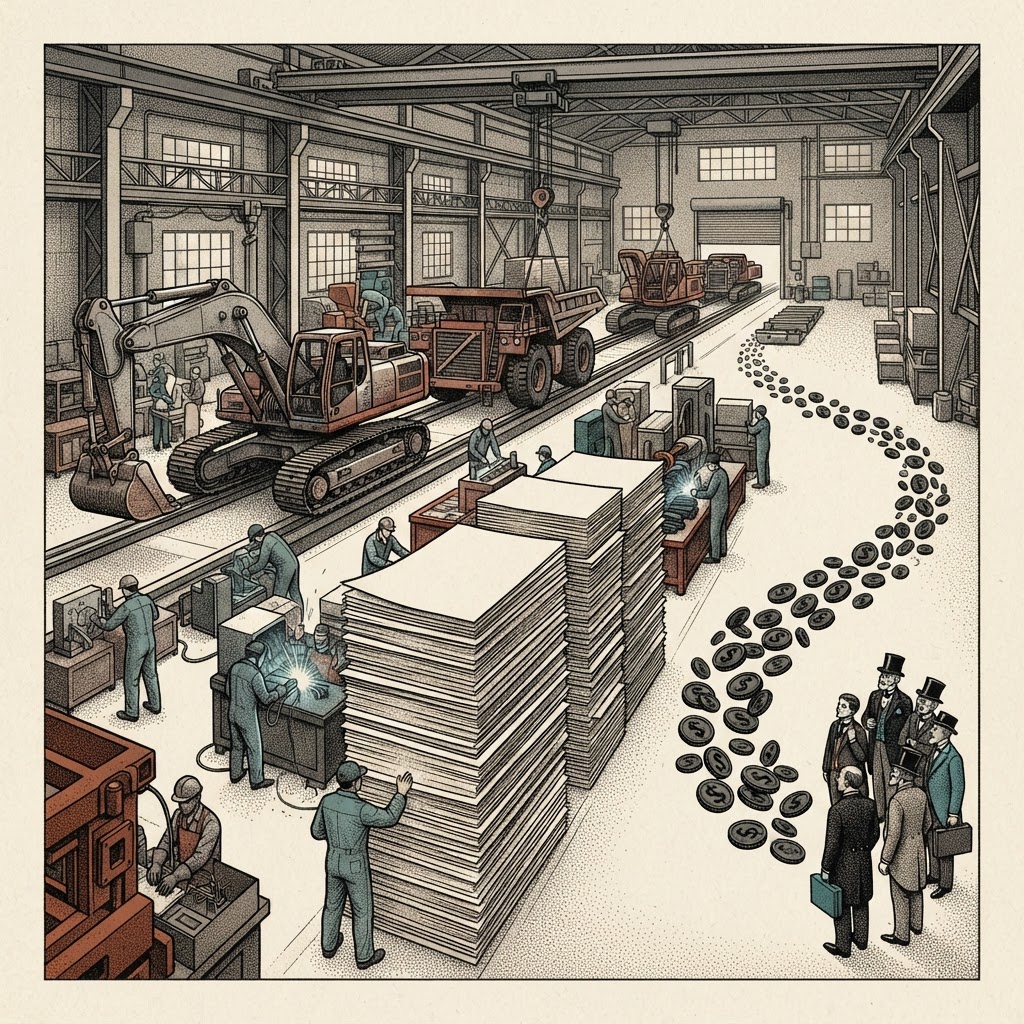
Terex Corporation reported third-quarter 2026 net sales of $2.2 billion, up 11.6% on a pro forma basis, and said its consolidated backlog had reached $7 billion. The company narrowed its full-year revenue guidance to a range of $8.0 billion to $8.2 billion, while authorizing another $500 million in share repurchases.
DIG Analysis — 2026-10-28: The results put two different signals side by side: a substantial order book and a commitment to return capital to shareholders. The backlog supports expectations for future production, but it does not establish when orders will convert to shipments or how profitable they will be. Terex’s guidance range leaves room for those execution questions.
Backlog and guidance
The $7 billion backlog is a measure of contracted demand, not revenue already earned. Its value to investors and suppliers depends on delivery schedules, customer readiness, cancellations and the company’s ability to build and ship equipment on time. Terex’s higher full-year revenue range indicates confidence in near-term conversion, but the figures disclosed in the summary do not specify how much of the backlog is expected to ship during the fourth quarter or in 2027.
The 11.6% pro forma sales increase also needs context. Pro forma comparisons can help account for changes in the company’s business portfolio, but they are not the same as a reported year-over-year comparison. The available results summary gives the growth rate and quarterly sales total, without a segment-level breakdown, pricing contribution or volume detail. Those omissions limit what can be inferred about which equipment categories are driving growth and whether the advance reflects more units, higher prices or a different mix.
For manufacturers, a large backlog can support factory planning and give component suppliers a clearer demand signal. It can also expose pressure points. If labor, parts or logistics constrain production, orders may sit in the book longer than expected; if customers defer purchases, scheduled deliveries can shift. Terex’s guidance sets a near-term financial target, but the backlog alone does not settle those risks.
Capital returns
Terex paired its operating update with adjusted earnings per share of $1.50 and a new $500 million share repurchase authorization. Buybacks can return cash to investors and reduce the share count over time, although authorization is not a commitment to spend the full amount on a fixed schedule. The company’s announcement, as summarized in its investor relations release, does not specify the pace of purchases or how repurchases will be balanced against investment, debt reduction and other uses of cash.
The decision matters because capital allocation competes with the demands of a growing order book. Building equipment for more deliveries may require working capital and investment in production capacity, while shareholders may favor cash returned promptly. The authorization signals that Terex sees room for repurchases, but the quarterly figures provided do not reveal the cash-flow outlook or the level of spending needed to support planned output. Adjusted EPS, meanwhile, is a non-GAAP measure; it should be read alongside reported earnings and cash generation rather than as a substitute for them.
“Consolidated backlog reaching $7 billion”
Terex Corporation, in its third-quarter 2026 results summary
What remains open
Investors will look for evidence that the backlog is converting into shipments and that higher sales are translating into cash and margins. Terex’s summary gives no segment-specific outlook, margin guidance or detailed explanation of the drivers behind the revised revenue range. Without those details, the results establish the scale of demand and the company’s stated sales target, but not the economics of every order.
The next test is the fourth-quarter delivery schedule. Terex has set full-year revenue guidance at $8.0 billion to $8.2 billion and authorized $500 million of repurchases; the results summary does not say how much of that authorization will be used before year-end.