
Powered by Google TranslateTranslate
Markets
CATCaterpillar$510.45-5.01%•
DEDeere & Co.$609.25-2.50%•
CNHCNH Industrial$10.74-2.98%•
AGCOAGCO Corp.$100.93-1.91%•
URIUnited Rentals$973.43-8.13%•
ALTGAlta Equipment$4.33-8.46%•
TTCToro Company$100.82-1.70%•
HRIHerc Holdings$133.55-11.54%•
MGRCMcGrath RentCorp$113.45-6.38%•
MTWManitowoc$20.31-5.58%•
CATCaterpillar$510.45-5.01%•
DEDeere & Co.$609.25-2.50%•
CNHCNH Industrial$10.74-2.98%•
AGCOAGCO Corp.$100.93-1.91%•
URIUnited Rentals$973.43-8.13%•
ALTGAlta Equipment$4.33-8.46%•
TTCToro Company$100.82-1.70%•
HRIHerc Holdings$133.55-11.54%•
MGRCMcGrath RentCorp$113.45-6.38%•
MTWManitowoc$20.31-5.58%•
Back to Newsdealership

Titan Adds Midwest Service Density With $45 Million Deal

Jon RossiJon RossiFounder & Editor-in-Chief October 30, 2026 4 min read

Titan Machinery has acquired a multi-location Midwest construction equipment dealership group for approximately $45 million. The transaction adds service centers to a network the company is using to consolidate regional share as construction demand shifts.

Titan Adds Midwest Service Density With $45 Million Deal

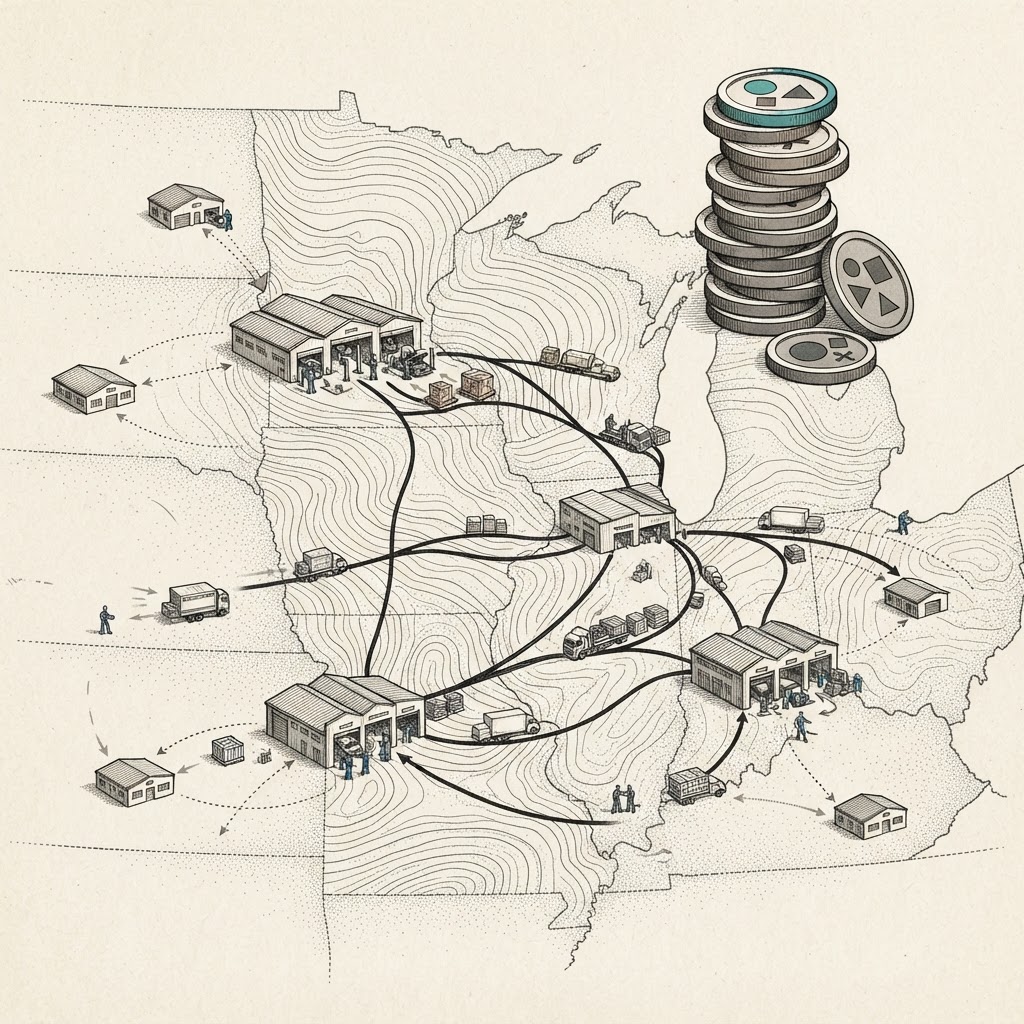
Titan Machinery has paid approximately $45 million for a multi-location construction equipment dealership group in the Midwest, adding service centers to a network where parts access and technician coverage can shape customers’ buying decisions. The acquisition expands Titan’s construction footprint as demand in the sector shifts, though the company has not disclosed the acquired locations, revenue, or expected contribution to earnings.

DIG Analysis — 2026-10-30: The transaction is a bet on local operating density rather than a broad change in product mix. More service points can improve response times and parts availability, but the return depends on retaining technicians, integrating inventory and systems, and generating enough work across the combined territory.

Construction Equipment Guide reported the finalized acquisition and approximate purchase price. Titan said the added centers would strengthen its existing network. The available details do not identify the seller, specify the allocation of the purchase price, or explain how the deal was financed.

Density as a competitive tool

For an equipment dealer, geographic coverage is valuable when it translates into shorter service calls and fewer delays waiting for parts. A nearby shop can support machines in the field, while a larger network may make it easier to move inventory to where demand is strongest. Those operational advantages matter in construction, where equipment downtime can interrupt a job and affect a contractor’s schedule.

But adding locations does not automatically add capacity. Technician recruitment and retention remain constraints across the industry, and acquired branches may have different service practices, inventory records, and customer relationships. Titan will need to bring the new centers into its operating systems without losing the local knowledge that helped them win business. The story as reported provides no integration timetable or staffing figures.

The deal also extends Titan’s exposure to construction equipment at a time when demand is uneven. Regional differences in infrastructure work, commercial building, and contractor spending can produce divergent results even within the same broad market. A denser footprint could help Titan defend share where demand holds up, but it also places more capital and operating responsibility in a segment whose outlook can change with project pipelines and financing conditions.

“The acquisition adds service centers to Titan’s existing network, with the stated aim of improving parts availability and technician density.”

Construction Equipment Guide’s account of the transaction

What the price leaves open

At approximately $45 million, the transaction gives investors a headline value but little basis to judge the purchase multiple. The number is not accompanied by disclosed revenue, operating profit, assets acquired, or a breakdown between real estate and other consideration. Without those figures, it is difficult to compare the price with prior dealership transactions or estimate how quickly the acquisition might contribute to cash flow.

Financing is another open point. The report does not say whether Titan used cash, borrowed funds, or another structure. That matters because the cost of capital affects the return threshold, particularly if the acquired branches require facility upgrades, additional inventory, or hiring before they can produce higher sales and service volume.

There is also a competitive trade-off. Consolidation can give a larger dealer more reach and purchasing scale, while independent operators may find it harder to match service coverage and parts depth. Customers could benefit if the expanded network improves response and availability; they could face fewer local alternatives if ownership becomes more concentrated. The transaction’s effect on competition will depend on the locations involved and the presence of other dealers, details not provided in the initial account.

Execution will set the return

Titan’s strategic rationale is clear: more centers can raise the density of its construction operation and extend the reach of its parts and service network. Whether that translates into stronger economics will depend on utilization, technician productivity, customer retention, and the cost of integrating the business. Those measures, rather than the number of branches added, will determine whether the acquisition earns its cost.

The company has not disclosed the acquired group’s identity or the specific locations, and it has not provided a forecast for revenue or profit from the deal. Until those details emerge, the $45 million purchase is best understood as an expansion of operating reach, with the financial payoff still to be demonstrated.

Who This Affects

OEM Impact

OEM channel managers will need to assess how Titan’s added locations affect territory coverage, service capacity, and parts distribution in the Midwest. Greater dealer density may strengthen customer support, while consolidation can reduce the number of independent channel partners and increase the importance of Titan’s execution.

Dealer Impact

Dealer principals in nearby markets may face a larger competitor with more service points and potential inventory-sharing capacity. For acquired managers and service leaders, retaining technicians and customers while adopting Titan’s systems will shape the branch’s performance and local autonomy.

Contractor Impact

Fleet operators and construction contractors may gain more nearby service access and improved parts availability if Titan integrates the centers effectively. Customers should also watch for changes in account coverage, response times, and local alternatives as ownership becomes more concentrated.

Startup Impact

Construction technology startups selling maintenance, parts, or fleet software may find a larger dealer network offers a more scalable channel partner, but procurement decisions could become more centralized. Early-stage vendors should expect integration requirements and longer validation cycles before new tools reach branch-level operations.

Dealmaker Impact

PE dealmakers and strategic buyers will view the transaction as evidence of continued appetite for regional dealership assets, but the undisclosed financials limit valuation comparisons. Future bids will turn on service mix, technician retention, real estate exposure, and whether buyers can substantiate density-related operating gains.

Back to News
Titan Machineryconstruction equipmentdealer acquisitionMidwestparts availabilitytechnician density