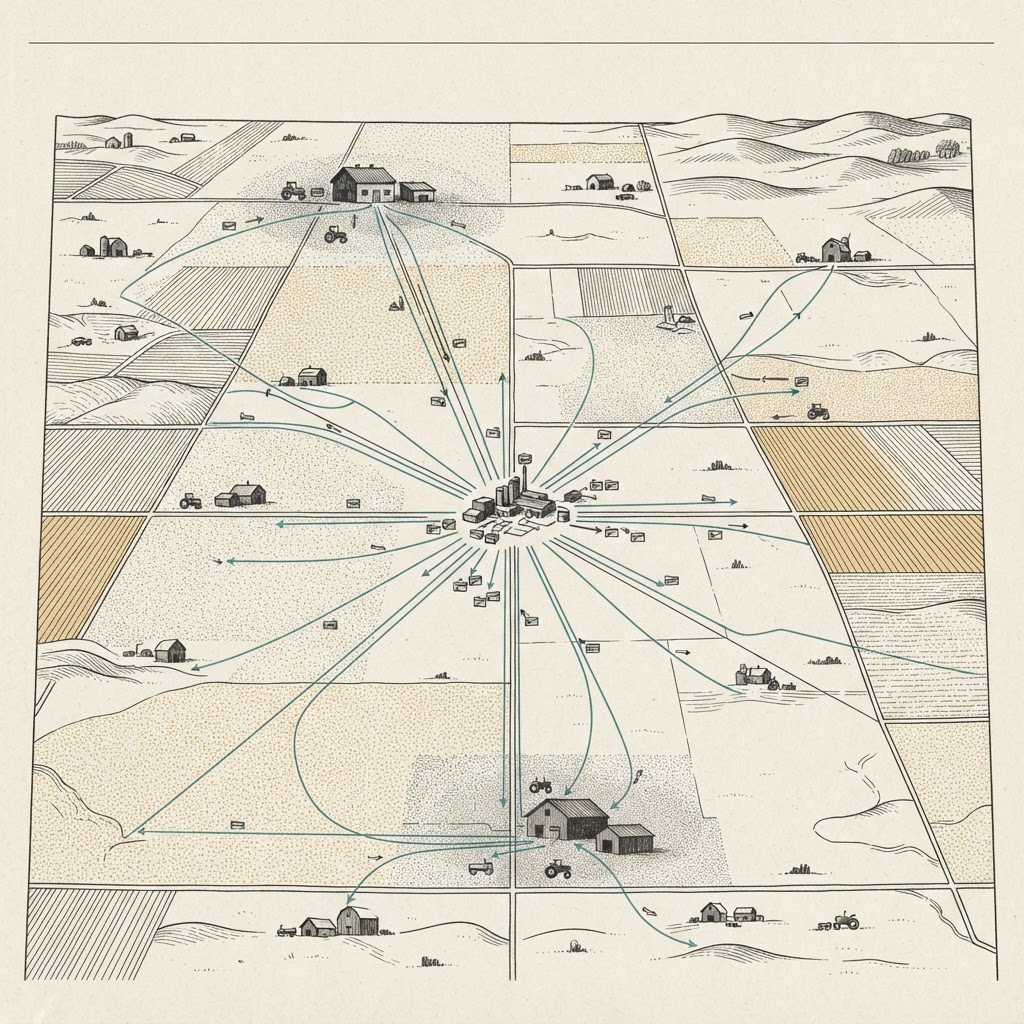
Titan Machinery has acquired two additional Case IH dealership locations in North Dakota, adding density to a regional network built around parts and service. The terms, locations and expected financial contribution were not disclosed in the source account.
Titan Machinery has acquired two additional Case IH agricultural dealership locations in North Dakota, extending a regional network whose value depends as much on service coverage as on equipment sales. The purchase adds stores to Titan’s Upper Midwest footprint, but the available account gives no purchase price, location names or timetable for integration.
DIG Analysis — 2026-10-27: The transaction is a small, practical move in a dealer market where local reach can determine how quickly a farmer gets parts, repairs and replacement equipment. Titan gains additional points of contact in a state where agricultural demand is central to its business. Whether the acquisition materially improves operating results will depend on details not yet reported, including the stores’ scale, staffing and overlap with existing Titan locations.
More local coverage
Titan Machinery said it had acquired the two Case IH dealership locations, according to Farm Equipment. The report describes the move as an expansion of Titan’s North Dakota presence and says the locations are expected to be integrated into the company’s existing operations. It does not identify the seller or disclose whether the transaction includes real estate, inventory or other assets.
For an equipment dealer, additional locations can shorten the distance between customers and service capacity. Agricultural equipment is costly to keep idle during planting and harvest, and a parts counter or service bay closer to a farm can matter more than a broad sales territory on a map. A larger network may also give Titan more opportunities to coordinate inventory and technicians across nearby stores.
Those benefits are not automatic. A store that adds geographic reach but lacks experienced technicians, adequate parts stock or a stable customer base may require investment before it contributes to service levels. The report provides no store-level figures, so it is not possible to assess how much new coverage Titan is actually gaining or whether the locations fill gaps between existing branches.
“The acquisition is expected to integrate seamlessly into Titan’s existing operational infrastructure.”
Farm Equipment, in its report on the acquisition
The expected integration points to Titan’s established operating platform as a rationale for the deal. But the source account does not specify whether staffing, branding, systems or inventory arrangements will change, nor does it quote company executives on the integration plan. The wording describes an expectation, not a disclosed operating result.
Scale, with limits
Titan has pursued a broader dealership footprint as major dealer groups compete for customers and manufacturer relationships. Adding two stores is consistent with that strategy, though the transaction alone does not establish a shift in market power. Its effect depends on the locations’ sales volume, the number of customers they serve and the proximity of competing dealerships.
For Case IH, the acquisition keeps the stores within the brand’s dealer channel while placing them under a larger operator. A scaled dealer may be able to fund parts availability and service infrastructure across a wider territory. At the same time, consolidation can reduce the number of independent businesses making local decisions. The report does not describe any change to Case IH’s channel terms or the stores’ customer-facing operations.
There is also an execution question. Bringing new locations into an existing group can require coordination of inventory, technology and service processes while preserving relationships built by local employees. Titan’s regional familiarity may ease that work, but the account offers no staffing or customer-retention data. It likewise does not say whether the acquisition will produce cost savings, increase revenue or require additional capital.
What remains undisclosed
The missing terms leave the transaction difficult to size. Without a purchase price or financial contribution, investors cannot compare the acquisition with Titan’s other expansion moves or estimate its return. For producers, the immediate practical test will be whether service access and parts availability improve at the two locations, rather than the change in ownership itself.
Farm Equipment’s report presents the deal as a continuation of Titan’s regional expansion. The next evidence will come from operating details: the stores’ names and locations, their staffing, and any subsequent disclosure from Titan about the acquisition’s scale. Until then, the confirmed facts are limited to two additional Case IH dealership locations in North Dakota joining Titan Machinery.