
Markets
CATCaterpillar$510.45-5.01%•
DEDeere & Co.$609.25-2.50%•
CNHCNH Industrial$10.74-2.98%•
AGCOAGCO Corp.$100.93-1.91%•
URIUnited Rentals$973.43-8.13%•
ALTGAlta Equipment$4.33-8.46%•
TTCToro Company$100.82-1.70%•
HRIHerc Holdings$133.55-11.54%•
MGRCMcGrath RentCorp$113.45-6.38%•
MTWManitowoc$20.31-5.58%•
CATCaterpillar$510.45-5.01%•
DEDeere & Co.$609.25-2.50%•
CNHCNH Industrial$10.74-2.98%•
AGCOAGCO Corp.$100.93-1.91%•
URIUnited Rentals$973.43-8.13%•
ALTGAlta Equipment$4.33-8.46%•
TTCToro Company$100.82-1.70%•
HRIHerc Holdings$133.55-11.54%•
MGRCMcGrath RentCorp$113.45-6.38%•
MTWManitowoc$20.31-5.58%•

U.S. Excavator Production Accelerates as John Deere and Volvo CE Localize Assembly

Jon RossiJon RossiFounder & Editor-in-Chief September 2, 2026 3 min read

John Deere and Volvo Construction Equipment are shifting excavator assembly to the United States, moving capacity from Japan and other locations to Pennsylvania and North Carolina. The moves, reported by ConstructConnect, mark an accelerating trend of reshoring within heavy equipment manufacturing that has real consequences for suppliers, dealers, and fleet operators.

U.S. Excavator Production Accelerates as John Deere and Volvo CE Localize Assembly

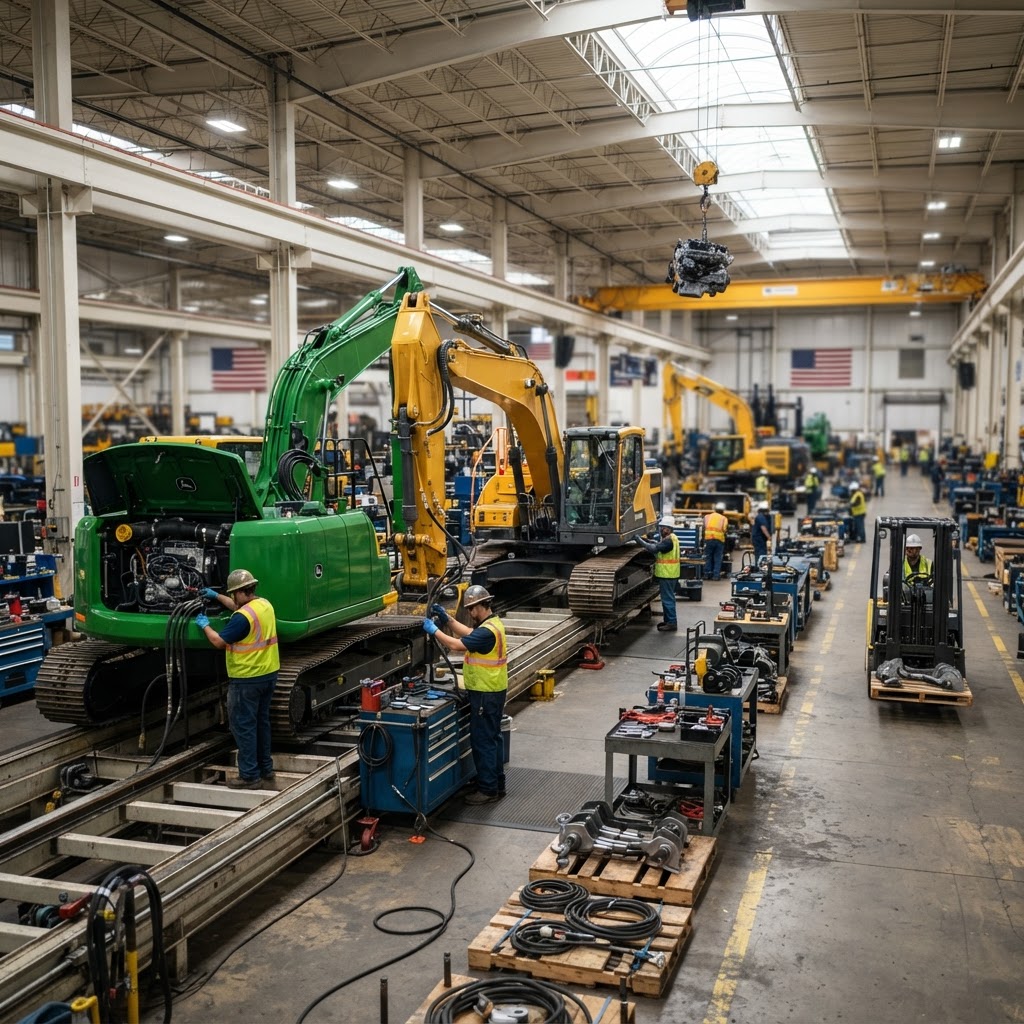
John Deere and Volvo Construction Equipment are accelerating a shift of excavator assembly into the United States, consolidating next generation lines closer to American customers and suppliers. Volvo CE has started assembling excavators and large loaders at its Shippensburg, Pennsylvania facility while John Deere is completing a $70 million expansion in North Carolina to move excavator production from Japan. The changes were reported by ConstructConnect and reflect a broader pattern among manufacturers expanding U.S. manufacturing footprints.

DIG Analysis — 2026-09-02: These investments shorten physical supply lines, reduce exposure to long ocean transit and foreign factory constraints, and reallocate capital and labour to North American operations. Expect near-term pressure on imported parts, rising demand for domestic subassembly, and a rebalancing of inventory strategies across dealer networks.

What happened

Volvo CE has already begun assembling excavators and large loaders in Shippensburg, Pennsylvania. John Deere is finalizing a $70 million factory expansion in North Carolina to relocate production that had been in Japan. ConstructConnect reported both moves and cited other OEMs such as JCB and SANY expanding American manufacturing as corroborating evidence that this is an industry trend rather than isolated investments.

The decisions combine explicit capacity shifts and capacity creation. Volvo CE placed final assembly at an existing U.S. plant. John Deere is adapting a facility for next generation lines. Both approaches reduce the distance between final assembly and the largest market for these machines. That matters because excavators are heavy, costly to ship, and depend on a complex web of subcomponents that have seen repeated interruptions since 2020.

Why this matters to supply chains and production economics

Reshoring assembly changes unit economics in three measurable ways. First, it cuts transit time and freight cost per machine, which improves price flexibility and part availability for dealers. Second, domestic assembly places higher value on local suppliers for subassemblies, wiring harnesses, hydraulics modules and cab components. Third, it reduces lead time variability, which lets OEMs and dealers lower finished goods safety stock or redirect working capital to other priorities.

Those gains come with tradeoffs. Labor and construction costs are higher in the United States than in Southeast Asia. OEMs are offsetting that with automation in assembly, tighter supplier agreements, and staging more value capture at later assembly stages. The net effect is a tilt toward predictability and proximity rather than chasing the lowest unit wage at the start of the value chain.

Near-term market consequences and what to watch

Expect immediate downstream effects in three areas.

  • Supplier demand. North American suppliers for hydraulics, electrics and cabins will see rising order volumes and will need to scale capacity or face price pressure.
  • Dealer inventory and service planning. Dealer principals and parts managers will need to reassess reorder points as lead times shorten and product variants arrive from nearby plants.
  • Fleet procurement. Large contractors and rental fleets can exploit shorter replenishment cycles and potentially negotiate tighter delivery commitments from OEM channel managers.
"Moving final assembly into the U.S. is not a cost-free decision. It is a bet on reducing variability and speeding response to customers," ConstructConnect

Monitor announcements from JCB and SANY for the pattern’s breadth. If additional OEMs follow, expect rising demand for skilled assembly technicians, localized parts distribution centers and new supplier investment in North America. For now, the shift is practical. It changes where the final value is captured and how OEMs, dealers and suppliers coordinate logistics and inventory.

Who This Affects

OEM Impact

OEM channel managers and manufacturing VPs will gain shorter lead times and tighter control over final assembly quality, enabling faster response to U.S. fleet demand. They must retool supplier contracts, invest in U.S. automation and manage higher domestic labor costs while capturing improvements in predictability and reduced freight exposure.

Dealer Impact

Dealer principals and parts managers will see more consistent inbound delivery windows and should recalibrate reorder points and stocking profiles to lower safety stock. Field service managers must prepare for an uptick in factory-configured model variants and train technicians on assembly-specific differences and warranty handling tied to U.S.-built units.

Contractor Impact

Fleet operators and procurement directors will benefit from shorter replenishment cycles and better parts availability for common excavator platforms, reducing downtime risk. Mid-size and large contractors should renegotiate fleet purchase and service terms with OEM account teams to leverage improved delivery and support cadence.

Startup Impact

Series A manufacturers of hydraulics, sensor modules, and telematics should see accelerated demand from North American OEM procurement teams seeking local suppliers, creating business development opportunities. Startups must meet higher compliance and scale expectations and be prepared for faster qualification cycles and tighter price competition from established domestic suppliers.

Dealmaker Impact

Private equity and M&A dealmakers should watch supplier consolidation and capacity investment opportunities in North American subassembly firms, particularly in hydraulics and electronics. PE professionals will find platform plays where scaling domestic supply can unlock multiple OEM contracts and margin improvement through nearshore integration.

Back to News
reshoringmanufacturingJohnDeereVolvoCEsupply-chainconstruction-equipment