
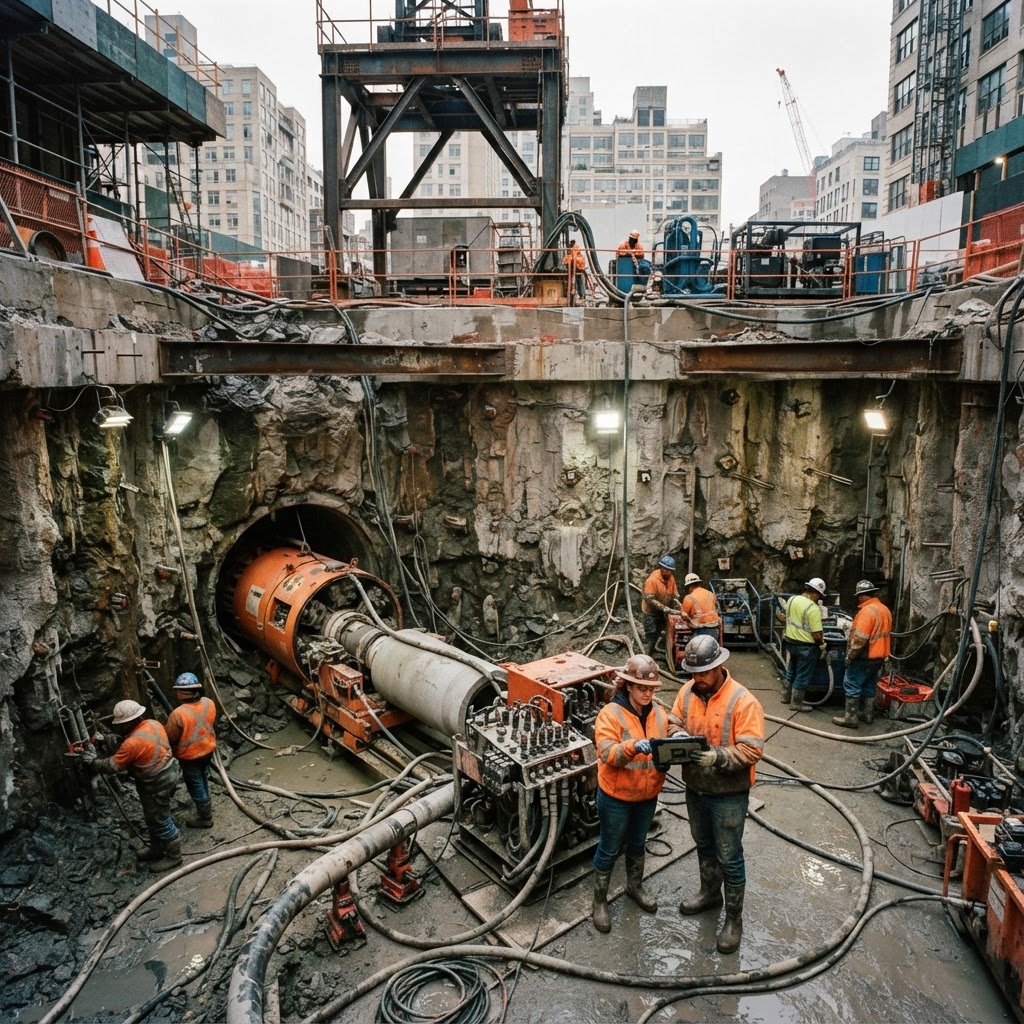
Soletanche Bachy, the underground construction subsidiary of Vinci Construction, has completed its acquisition of Maryland-based Bradshaw Construction, adding a specialist U.S. contractor with approximately $30 million in annual revenue and a hard-earned position in East Coast microtunnelling and pipe jacking.
DIG Analysis — 2026-09-29: This is a capability acquisition as much as a geographic expansion. Bradshaw brings hard-rock expertise, project experience, trained personnel, and a specialized heavy equipment fleet that would be difficult to assemble quickly through organic growth.
A specialist platform for difficult ground
Bradshaw Construction operates in a technically demanding segment of underground infrastructure. Microtunnelling and pipe jacking allow contractors to install utilities and other underground systems with limited surface disruption, but the work requires precise ground assessment, disciplined launch and reception pit construction, and equipment capable of maintaining line and grade under difficult conditions.
Hard-rock work raises the operating stakes. Contractors must manage cutting tools, slurry or spoil handling, ground variability, machine wear, and tight tolerances while coordinating with engineers, utility owners, municipalities, and traffic-control authorities. A company with a proven field record in those conditions has value beyond its revenue base.
Ground Engineering reported the acquisition as a completed transaction. The move places Bradshaw inside Vinci’s broader construction organization while preserving access to its U.S. operating knowledge. For Soletanche Bachy, that creates a local platform from which to pursue work across the East Coast and potentially support projects elsewhere in the United States.
“The strategic value is not simply the addition of a contractor. It is the transfer of hard-rock microtunnelling know-how, equipment, and execution capacity into a global construction group.”
Why the equipment matters
Specialized underground work depends on more than machine availability. The useful asset is the combination of equipment, maintenance practices, operators, project managers, tooling knowledge, and supplier relationships. Bringing those elements together can reduce the time required to mobilize for complex bids and improve confidence when estimating production rates and project risk.
The acquisition may also strengthen Vinci’s ability to offer clients a wider range of underground delivery methods. In congested corridors, trenchless construction can reduce road closures, restoration costs, and community disruption. That does not eliminate technical or commercial risk, but it gives owners another option when conventional excavation is impractical or politically difficult.
For equipment manufacturers and distributors, the transaction highlights a customer segment that buys on uptime, technical support, and application expertise rather than on machine price alone. Microtunnelling contractors require purpose-built systems, cutting tools, separation equipment, guidance technology, pumps, cranes, support vehicles, and specialized maintenance. A larger parent company can bring more purchasing leverage, but the field-level demands remain highly specific.
What to watch after closing
The next test will be operational integration. Vinci will need to retain Bradshaw’s technical staff and preserve the decision speed that often allows specialist contractors to solve problems in the field. Excessive centralization could weaken the very expertise the acquisition is intended to secure.
Market observers should watch Bradshaw’s backlog, equipment utilization, geographic expansion, and participation in larger Vinci-led bids. The most important indicator will be whether the company wins more complex work without losing its specialist identity. If that balance holds, the transaction could become a model for how major construction groups build underground capacity by acquiring focused operators rather than developing every capability internally.
It also points to a broader commercial reality. As utility replacement, water infrastructure, and urban development push construction below grade, experienced trenchless contractors are likely to attract attention from strategic buyers and financial sponsors. Bradshaw’s acquisition shows that the scarce asset is not only the machine. It is the ability to deploy that machine safely and profitably in difficult ground.