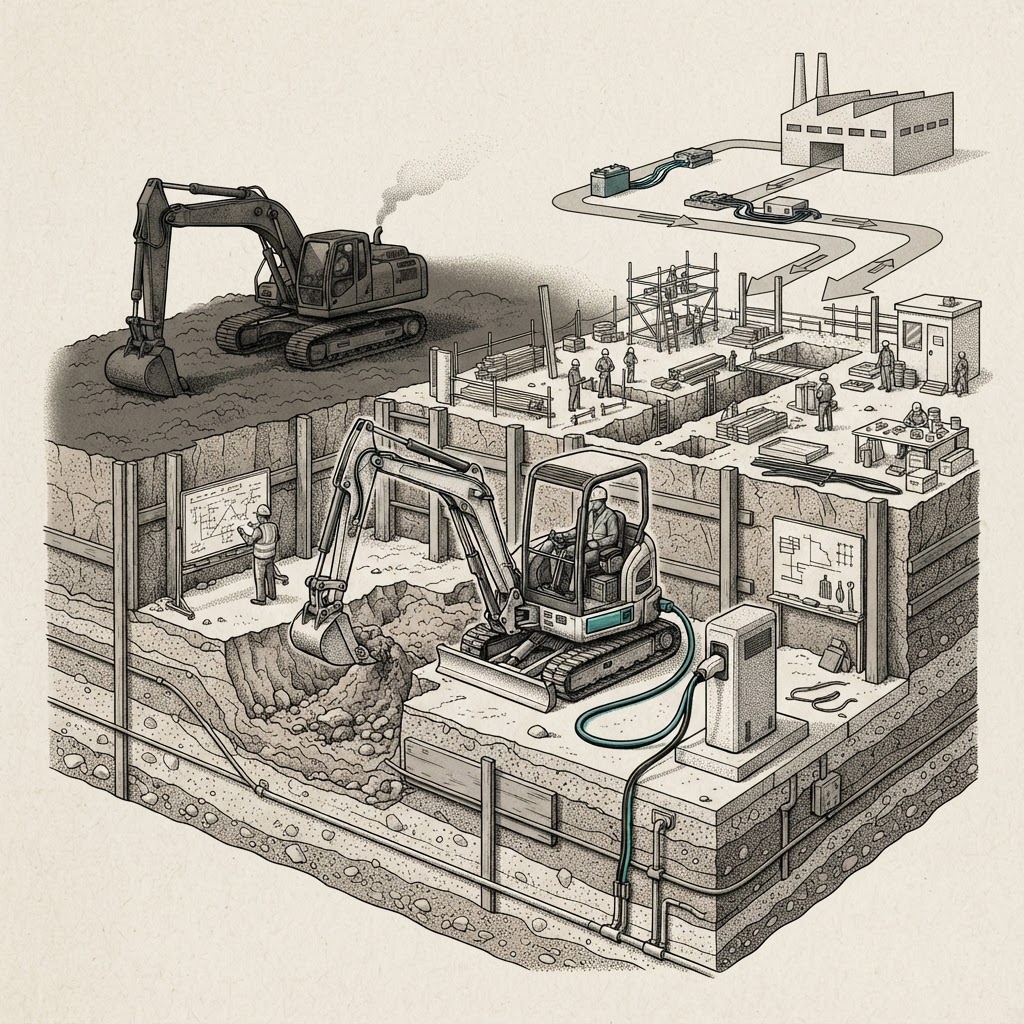
Volvo Construction Equipment has been ranked the leading OEM in off-highway electrification, a recognition of its early push into battery-powered machinery. The commercial test now is whether that position can translate into repeatable sales as customers weigh acquisition cost, charging and utilization.
Volvo Construction Equipment has been ranked the leading original equipment manufacturer in off-highway electrification, putting a formal marker on a competitive race that is moving from product launches to commercial execution. The recognition reflects the company’s strategic shift toward zero-emission machinery and investment in battery-electric technology, but it does not, by itself, establish how quickly electric machines are selling or how profitable they are.
DIG Analysis — 2026-11-11: A leading position in electrification can shape customer consideration and dealer readiness before it produces material earnings. Volvo’s next test is to turn its portfolio and reputation into orders across markets where charging access, duty cycles and purchase economics vary sharply.
Volvo Construction Equipment announced the ranking through its global news channel. The company was identified as the sector’s leading OEM, according to the recognition described in its announcement. The available information does not specify the ranking’s methodology, the size of the gap over competitors, or the underlying measures used to compare manufacturers. Those omissions limit what the result can say about market share or commercial performance.
Recognition and proof
The ranking gives Volvo a clear reference point in a market where manufacturers are competing to establish credibility with customers and channel partners. Its strategic commitment to zero-emission machinery and continued battery-electric investment have helped make electrification a visible part of the company’s positioning. Acknowledgment from an external ranking can reinforce that position, particularly when buyers are comparing new technologies and assessing which suppliers are likely to support machines over their working lives.
Still, recognition is not a substitute for operating evidence. The announcement summary provides no unit sales, revenue contribution, order backlog or utilization data for Volvo’s electric equipment. It also does not identify the ranking body or disclose the criteria behind the result. Without those details, the ranking is best read as a signal of relative standing and strategic attention, rather than a quantified measure of adoption.
“The ranking underscores Volvo’s competitive advantage as it continues to scale its electric portfolio globally.”
That advantage, if sustained, depends on more than engineering. Battery-powered equipment must fit job-site schedules, deliver acceptable performance and be supported by charging arrangements that work in the field. For customers, the purchase decision turns on total operating economics, including upfront price, energy costs, downtime and resale value. The ranking does not resolve those questions. Nor does it say which machine categories or regions are contributing most to Volvo’s standing.
Scaling the offer
Global expansion brings its own constraints. Construction sites differ in access to electrical capacity, project duration and machine utilization. A compact machine used in an urban area may face a different electrification case from larger equipment operating long shifts at remote sites. Product breadth can widen the addressable market, but it also raises demands on parts availability, technician training and customer support.
For Volvo, the commercial challenge is to scale without assuming that every customer will move at the same pace. Some fleets may adopt electric machines where local emissions rules, site requirements or operating patterns support the economics. Others may wait for lower acquisition costs, more charging infrastructure or clearer evidence on uptime and residual values. The company’s global ambitions therefore sit alongside a market that is likely to develop unevenly.
Competitors face a related pressure. A high-profile ranking can increase the cost of standing still, especially for manufacturers whose customers increasingly ask about emissions and electric options. But rivals may choose different routes, including hybrids, alternative fuels or selective battery-electric offerings, depending on machine class and regional demand. The ranking offers no evidence that a single technology path will suit the entire off-highway market.
Volvo has established a recognizable position in battery-electric construction equipment. The next evidence to watch is more concrete: portfolio expansion, regional availability and disclosed sales or operating results that show whether the position is converting into sustained customer adoption.