

Markets
CATCaterpillar$510.45-5.01%•
DEDeere & Co.$609.25-2.50%•
CNHCNH Industrial$10.74-2.98%•
AGCOAGCO Corp.$100.93-1.91%•
URIUnited Rentals$973.43-8.13%•
ALTGAlta Equipment$4.33-8.46%•
TTCToro Company$100.82-1.70%•
HRIHerc Holdings$133.55-11.54%•
MGRCMcGrath RentCorp$113.45-6.38%•
MTWManitowoc$20.31-5.58%•
CATCaterpillar$510.45-5.01%•
DEDeere & Co.$609.25-2.50%•
CNHCNH Industrial$10.74-2.98%•
AGCOAGCO Corp.$100.93-1.91%•
URIUnited Rentals$973.43-8.13%•
ALTGAlta Equipment$4.33-8.46%•
TTCToro Company$100.82-1.70%•
HRIHerc Holdings$133.55-11.54%•
MGRCMcGrath RentCorp$113.45-6.38%•
MTWManitowoc$20.31-5.58%•

Yanmar Adds Digital Capital to Its U.S. Dealer Strategy

Jon RossiJon RossiFounder & Editor-in-Chief October 7, 2026 3 min read

Yanmar America is bringing Vero Technologies into its U.S. dealer financing model with a new captive floorplan program. The move puts inventory-credit execution alongside dealer expansion as an OEM channel priority.

Yanmar Adds Digital Capital to Its U.S. Dealer Strategy

Yanmar America is adding a fintech partner to the financial infrastructure behind its U.S. dealer network. Its new captive floorplan finance program, launched with Vero Technologies, is intended to streamline how dealers finance inventory and support growth in Yanmar’s footprint. The arrangement makes dealer access to working capital a direct part of the OEM’s channel strategy, rather than a matter left entirely to conventional lenders.

DIG Analysis — 2026-10-07: The strategic value is not simply a new financing option. Floorplan terms and application processes affect how much inventory a dealer can carry, how quickly it can respond to customer demand, and how much balance-sheet capacity remains for operating the business. A digital-first program could reduce administrative friction, but its commercial impact will depend on approval standards, pricing, service quality, and whether the offer fits dealers with different scale and risk profiles.
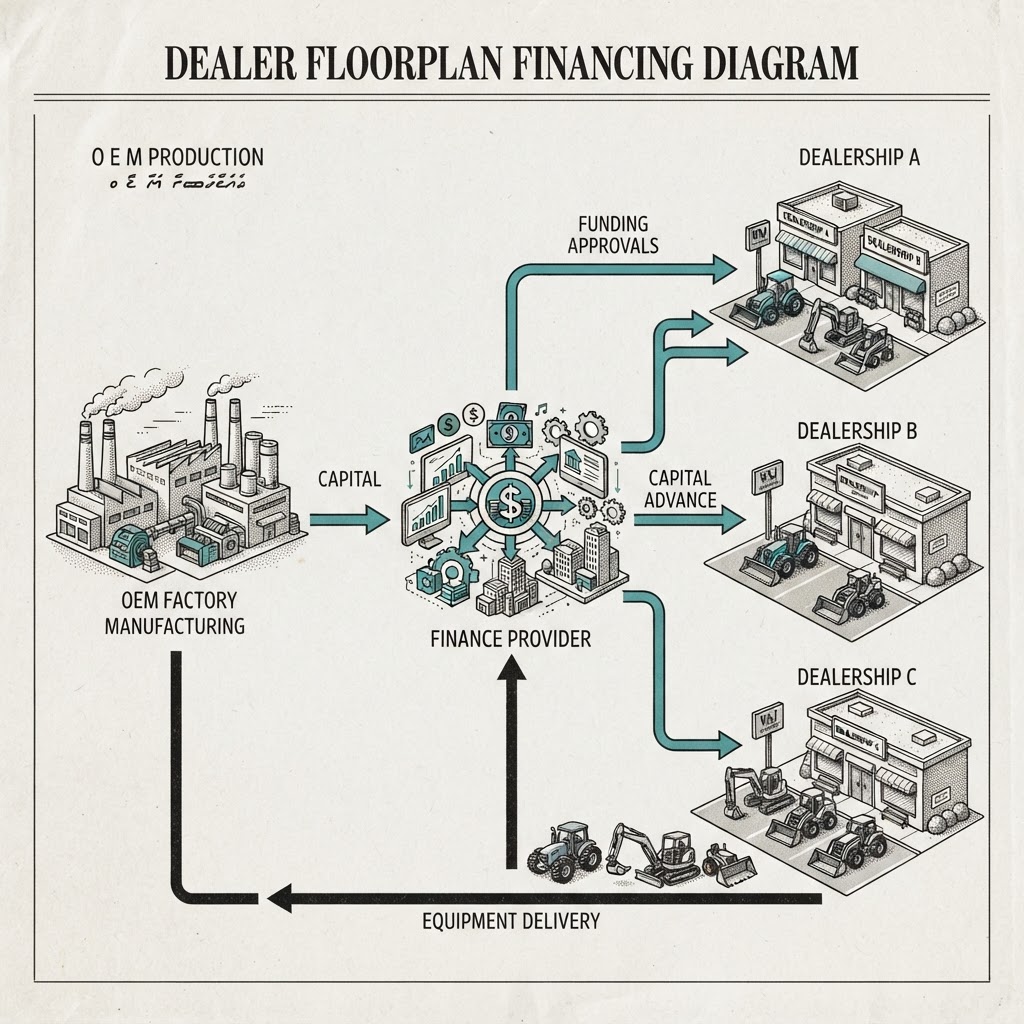
How a captive floorplan program works: the OEM sets terms, a finance partner supplies the credit, and dealers carry the inventory.
How a captive floorplan program works: the OEM sets terms, a finance partner supplies the credit, and dealers carry the inventory. Illustration: Digital Iron Group

Capital access becomes a channel lever

Floorplan financing gives dealers credit to acquire equipment before it is sold to an end customer. That allows a dealer to display or stock machines without funding the full purchase from its own cash reserves. In return, the dealer takes on financing costs and repayment obligations, making the availability and terms of credit consequential for inventory decisions.

For Yanmar, the stated aim of supporting dealer-footprint growth points to a practical constraint: a new or expanding location needs both customer demand and the capacity to stock products. Financing designed around the manufacturer’s dealer network may help align inventory credit with its products and channel requirements. It can also give the OEM a clearer way to support dealer development, though the program’s scale and eligibility criteria will determine how broadly that support reaches.

Equipment Finance News reported the Yanmar America and Vero Technologies partnership. The announcement does not provide program pricing, credit limits, approval timelines, or dealer participation figures. Those details matter. A streamlined process could improve access and reduce time spent handling financing paperwork, but digital delivery alone does not establish that credit will be cheaper, more flexible, or available to dealers that currently face tighter lending constraints.

Execution will decide the program’s value

Dealers will assess the offer against existing bank and finance-company relationships. Relevant comparisons include rates, advance limits, documentation requirements, payment schedules, and how quickly issues are resolved. If the program is competitive and straightforward to use, it could become a useful tool for inventory planning. If terms are less attractive or onboarding creates additional work, dealers may treat it as a supplementary source rather than a replacement for current facilities.

The program also creates an operational test for the OEM-fintech relationship. Dealer networks vary in size, ownership structure, sales volume, and financial strength; a single process must work across that range without weakening credit discipline. Yanmar and Vero will need clear communication about underwriting, servicing, and escalation paths so dealer principals know where decisions sit and how to address problems.

“The initiative is designed to streamline inventory financing and support the growth of Yanmar’s dealer footprint.”

Program purpose as described in the announcement, reported by Equipment Finance News

A signal for equipment finance

The partnership reflects a broader change in how OEMs approach dealer support: financing is increasingly treated as an operating capability that can shape channel reach. Digital platforms may make workflows more efficient and give finance providers better tools to process applications, but the underlying requirement remains sound credit assessment and dependable servicing. Technology changes the path through the process; it does not remove the need to balance dealer access with repayment risk.

For Yanmar, the measure of success will be visible in participation and outcomes, not the launch announcement alone. Useful indicators include how many dealers use the facility, whether smaller or newer locations gain viable inventory capacity, and whether dealers can turn financed stock into customer deliveries without carrying unsustainable costs. The program’s performance will show whether a captive floorplan offer can support network expansion while preserving dealer financial resilience.

Who This Affects

OEM Impact

OEM channel managers gain another lever to support dealer recruitment and inventory availability, but must coordinate credit policy with sales targets. Yanmar’s finance and channel teams will need to monitor dealer participation, delinquency, and inventory conversion so expansion does not create unsustainable credit exposure.

Dealer Impact

Dealer principals and finance managers can evaluate a network-oriented credit option against bank lines and other floorplan providers. If the application and servicing process is simpler, staff may spend less time on paperwork; rates, limits, and approval speed will determine whether it frees meaningful working capital or adds little beyond existing facilities.

Contractor Impact

Fleet operators and construction contractors may see better local equipment availability if participating dealers can carry more inventory, potentially improving delivery timing on Yanmar machines. Any benefit is indirect and depends on dealer uptake, stock selection, and whether financing costs affect equipment pricing or delivery terms.

Startup Impact

Equipment-finance fintech founders and Series A investors can view the deal as evidence that OEMs are willing to bring digital lenders into dealer-channel operations. The harder benchmark is repeatable servicing across a varied dealer base, with credit performance and integration requirements likely to matter more than software features alone.

Dealmaker Impact

PE dealmakers evaluating equipment distributors should test whether access to floorplan credit supports growth or increases leverage and carrying costs. Investors in finance providers can watch for dealer adoption, loss performance, and concentration risk to assess whether OEM-linked programs can scale beyond a single channel relationship.

Back to News
Yanmar AmericaVero Technologiesfloorplan financedealer networkequipment financeOEM strategy