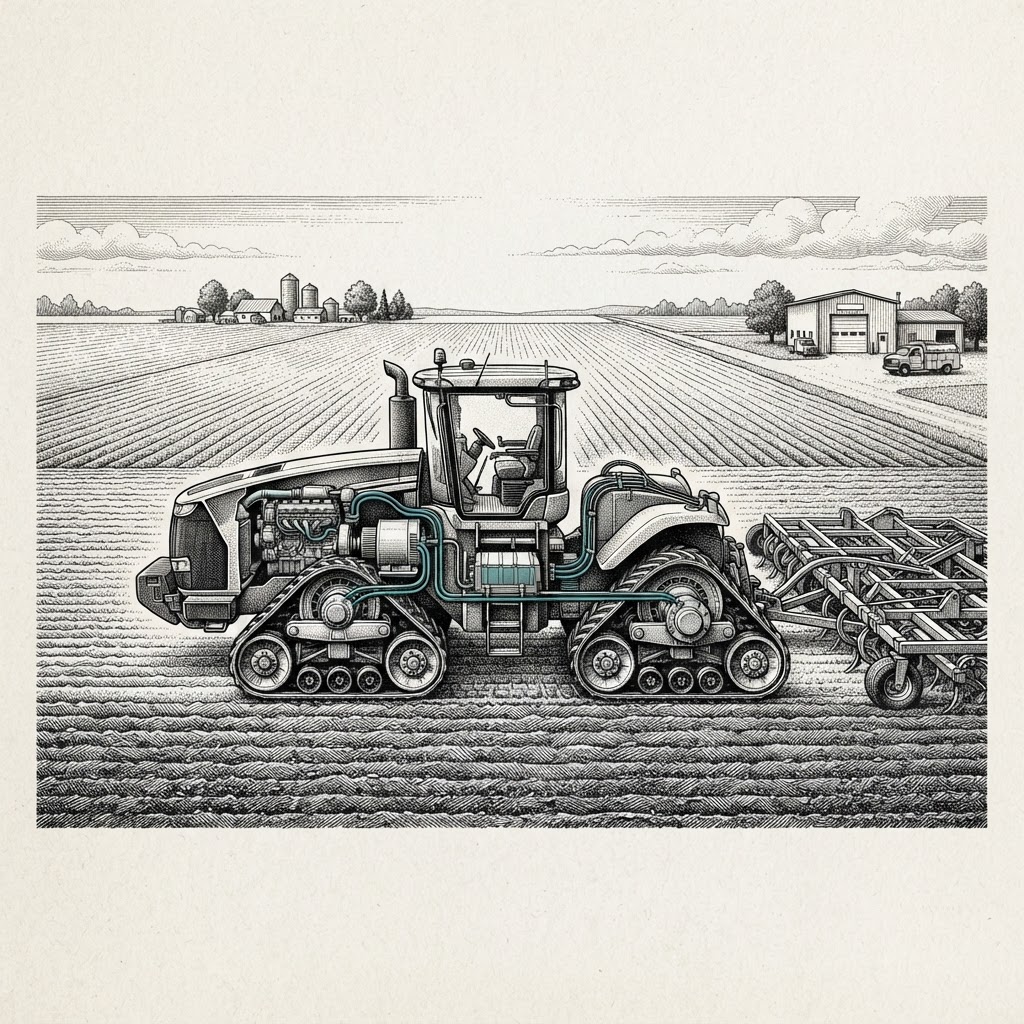
Zoomlion has introduced a 1,600-horsepower hybrid tractor for large-scale farming, a launch that puts high-capacity power at the center of the next equipment race. Its commercial case will depend on details the company has not yet disclosed, including price, fuel savings and production plans.
Zoomlion Heavy Industry Science & Technology has introduced a 1,600-horsepower hybrid tractor aimed at large-scale farming, placing an unusually high power rating at the center of a market increasingly focused on machine productivity and operating cost. The company unveiled the 9DX at the 2026 China International Agricultural Machinery Exhibition. The launch establishes a new product position; it does not yet establish how the tractor will perform in the field or what it will cost to own.
DIG Analysis — 2026-11-02: The 9DX is a bet that large farms will pay for concentrated power if hybrid architecture can deliver useful efficiency alongside the capacity to cover demanding workloads. The announcement leaves important commercial questions open: Zoomlion has not disclosed a price, fuel-consumption figures, production schedule or target markets.
Power and proof
At 1,600 horsepower, the 9DX is designed for work at a scale that places demands on more than the engine. A tractor in this class must transmit power through its driveline, manage heat, maintain traction and support implements capable of using that output. The hybrid label suggests a power system combining electric and combustion components, but the announcement, as reported by PR Newswire UK, did not specify the configuration or explain how power is divided between them.
That distinction matters. Hybrid systems can improve efficiency when their controls and duty cycle suit the work, but a power rating alone says little about fuel use per hectare, uptime or the cost of maintenance. Buyers will want operating data under comparable field conditions, along with information about battery capacity, charging or energy recovery, service intervals and component life. Without those figures, the 9DX is a product announcement rather than evidence of an economic advantage.
“The launch establishes a new product position; it does not yet establish how the tractor will perform in the field or what it will cost to own.” Digital Iron Group analysis
The exhibition debut nonetheless signals that Zoomlion wants to compete at the upper end of agricultural power. In a category where capacity can reduce the number of passes needed for some operations, more power may appeal to farms managing large acreages and short seasonal windows. But it also raises the bar for the equipment that must work around the tractor, from implements and transport to maintenance facilities.
The cost equation
For a farm operator, the relevant comparison is not horsepower against horsepower. It is the total cost of completing a task, including fuel or electricity, labor, maintenance, financing and the risk of downtime during a narrow planting or harvest window. A hybrid system could improve that equation if it reduces energy consumption or makes power available more efficiently. It could worsen it if added complexity, parts costs or limited service coverage outweigh the savings.
The company has not provided enough information to settle that calculation. Nor has it said whether the 9DX is intended for immediate commercial sale, a limited launch or a longer development program. Production volume and availability would shape the product’s significance as much as its headline rating: a high-output machine with restricted supply would serve a different market from a model offered broadly through an established dealer network.
For competitors, the announcement raises the pressure to show how their own high-capacity machines balance output and operating expense. Yet the response may not be to match the peak rating. Manufacturers can compete through reliability, implement compatibility, service access and verified productivity, areas where buyers can measure value over a season rather than infer it from a specification.
What remains unknown
Zoomlion’s next disclosures will determine whether the 9DX moves from a striking exhibition debut to a product that changes purchasing plans. A field-test program, independent performance data and clear support arrangements would give large farms a basis for evaluating the machine. Without them, prospective buyers must weigh the promise of hybrid power against uncertainty about cost and operating support.
PR Newswire UK’s report confirms the unveiling at the 2026 China International Agricultural Machinery Exhibition and the stated 1,600-horsepower rating. It does not report a delivery date, customer commitments or pricing. For now, the concrete news is the machine’s introduction and its intended place in large-scale farming; the commercial test will come when Zoomlion supplies evidence of output, efficiency and availability.